
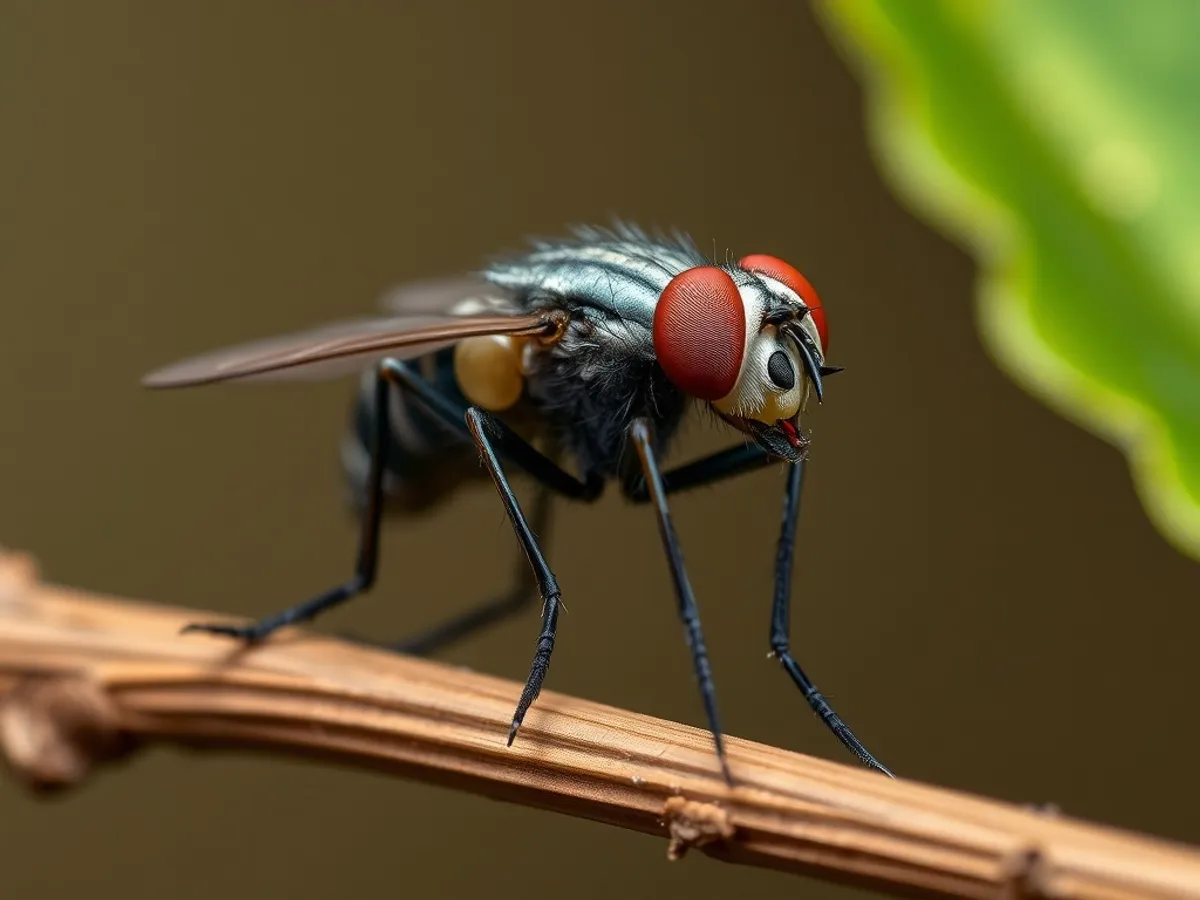
About the Stalk-eyed Fly
Stalk-eyed flies (family Diopsidae) carry their eyes and antennae on the ends of long lateral stalks, and in some species the distance between the eyes exceeds the length of the whole body. The stalks are inflated at emergence: the newly moulted fly hangs from its pupal case with short, crumpled stalks, then swallows air and pumps it out through ducts into the stalks, forcing them to extend to their full span over a few minutes, after which the cuticle hardens permanently. Eyespan is the whole point. Males contest access to the root-hair roosts where females aggregate at night, and disputes are usually settled by the two males facing off and comparing spans; the smaller male retreats without a fight, and females prefer to roost with wide-eyed males. Eyespan is therefore an honest signal of condition, since a male that developed on poor food ends up narrow-eyed. The system has a hidden genetic twist. In Teleopsis dalmanni, some X chromosomes carry a meiotic drive gene that destroys Y-bearing sperm and skews broods toward daughters, and this driving X is linked to short eyespan. Females that choose long-eyespan males are therefore, without any way of knowing it, avoiding the selfish chromosome, and the mating preference helps hold the drive in check.
Fascinating facts
Extreme Eye Stalks
Male stalk-eyed flies have eye stalks that can reach up to twice the width of their bodies, making them one of the most visually striking insects.
Non-violent Contests
Males resolve territorial disputes by lining up side by side and comparing eye stalk lengths, with the longer-stalked male usually winning without physical combat.
Sexual Selection
Females prefer males with longer eye stalks, driving the evolution of this unusual trait through sexual selection.
Detailed description
The Stalk-eyed Fly (Diopsis longicornis) is a striking dipteran insect belonging to the family Diopsidae, renowned for its extreme sexual dimorphism and exaggerated cranial morphology. Adult individuals typically measure between 6 to 10 mm in body length, but the lateral eye stalks of males can extend up to twice the width of the body, sometimes reaching over 15 mm in span. These stalks, which bear both the compound eyes and antennae at their distal ends, are supported by a reinforced exoskeleton and specialized musculature. The body is slender, with a glossy black or dark brown coloration and translucent wings. Stalk-eyed flies are diurnal and exhibit complex visual and chemical communication. Males are highly territorial, engaging in ritualized face-offs where they display their eye stalks to rivals, often pushing or grappling with their heads. Females, while possessing shorter stalks, use visual cues to select mates, favoring males with the longest and most symmetrical stalks. The species is commonly found in humid environments, particularly along the margins of slow-moving streams, marshes, and dense undergrowth in African tropical and subtropical regions. Larvae develop in decaying plant matter, contributing to nutrient cycling. Adult flies are agile fliers and are often observed perching on vegetation. Their unique morphology and behaviors make them a model organism for studies of sexual selection and morphological evolution.
Did you know?
The distance between a male stalk-eyed fly's eyes can be greater than the length of its own body.
Research & sources
Behaviour & social structure
Diopsis longicornis exhibits a range of distinctive behaviors centered around mating and resource competition. Males establish and defend small territories on vegetation near water sources, using their elongated eye stalks in visual displays to deter rivals. Territorial disputes are resolved through non-lethal contests, where males align head-to-head and push against each other, with the longer-stalked individual usually prevailing. Feeding behavior is opportunistic; adults consume a variety of organic matter, including decaying plant material, fungi, and small invertebrates, while occasionally visiting flowers for nectar. Larvae are saprophagous, feeding on decomposing plant detritus. Social interactions are largely limited to mating and territorial encounters, with no evidence of cooperative behaviors. Activity peaks during the early morning and late afternoon, when humidity is highest. Flies are sensitive to environmental changes and rely on visual cues for navigation and communication.
Reproduction & life cycle
Reproduction in D. longicornis is strongly influenced by sexual selection. The breeding season typically coincides with the onset of the rainy season, when humidity and food availability are optimal for larval development. Males perform elaborate courtship displays, showcasing their eye stalks and engaging in ritualized confrontations with rivals. Females inspect multiple males before selecting a mate, often choosing those with the longest and most symmetrical stalks. Copulation occurs on vegetation, and females lay eggs singly or in small clusters on moist, decaying plant matter. There is no parental care post-oviposition; larvae are independent upon hatching. The larval stage lasts approximately 10–14 days, followed by pupation in the substrate. Adult emergence is synchronized with favorable environmental conditions, ensuring population continuity.
Adaptations & survival
The most notable adaptation of D. longicornis is the extreme elongation of the eye stalks in males, a trait driven by sexual selection. This morphological feature enhances visual signaling during mate choice and intrasexual competition, providing a direct indicator of genetic fitness. The stalks are supported by reinforced cuticle and specialized muscles, allowing for both strength and flexibility during contests. The compound eyes at the ends of the stalks afford a wide field of vision, aiding in predator detection and navigation through dense vegetation. Larvae possess mouthparts adapted for saprophagy, enabling efficient breakdown of decaying plant material. Adults exhibit cryptic coloration and rapid flight, reducing predation risk. Behavioral adaptations include territoriality and ritualized combat, which minimize physical harm while establishing dominance hierarchies.
Cultural significance
While D. longicornis does not have a prominent role in traditional folklore or mythology, stalk-eyed flies in general have become symbolic in scientific literature as classic examples of sexual selection and exaggerated morphological traits. Their unique appearance has made them popular in educational materials and documentaries illustrating evolutionary principles. In some regions, local communities may recognize them as harmless insects associated with healthy wetlands, but there are no known traditional uses or significant cultural associations.
Recent research
Stalk-eyed flies, particularly D. longicornis, are model organisms in evolutionary biology, with numerous studies investigating the genetic and developmental basis of eye stalk elongation. Recent research has identified key genes and hormonal pathways (notably involving insulin signaling) that regulate stalk growth. Experimental studies have demonstrated that eye stalk length is an honest signal of male condition, correlating with immune function and overall fitness. Ongoing research explores the ecological consequences of sexual selection, including how environmental stressors influence trait expression and mating systems. Advances in imaging and behavioral tracking have provided new insights into the biomechanics of stalk-eyed fly contests and the sensory ecology of mate choice.
Sources
Sexual Selection for Stalk-Eyed Flies (Diopsidae): Eye-Stalk Length and Mating Success
Gerald S. Wilkinson & colleagues (1993)
scientificThe Evolution and Development of Exaggerated Morphologies in Stalk-Eyed Flies
Kevin Fowler & Andrew Pomiankowski (1998)
scientificSexual selection for eyestalk length in the stalk-eyed fly Diopsis longicornis
Wilkinson, G.S. & Dodson, G.N. (1997)
scientificDevelopmental genetics of exaggerated traits: The stalk-eyed fly as a model
Baker, R.H. & Wilkinson, G.S. (2001)
scientificSexual selection and the evolution of eye-stalks in stalk-eyed flies (Diopsidae)
Gerald S. Wilkinson & Patricia R. Dodson (1997)
scientificVideos
Habitat
Tropical and subtropical wetlands and forests


Conservation
The Stalk-eyed Fly is currently classified as Least Concern on the IUCN Red List.
Threats & challenges
Currently classified as Least Concern, D. longicornis faces localized threats from habitat loss due to wetland drainage, deforestation, and agricultural expansion. Pesticide use in agricultural areas can reduce larval survival rates. Climate change poses a potential long-term risk by altering rainfall patterns and humidity levels critical for breeding and larval development. Despite these challenges, the species remains widespread and locally abundant in suitable habitats. There is no evidence of significant population decline, but ongoing monitoring is recommended, especially in regions experiencing rapid environmental change.
Taxonomy
Scientific name
Diopsis longicornis
- Kingdom
- Animalia
- Phylum
- Arthropoda
- Class
- Insecta
- Order
- Diptera
- Family
- Diopsidae
- Genus
- Diopsis
- Species
- longicornis
Community notes
Share your observations about the Stalk-eyed Fly.
No community notes yet. Be the first!
Discover more wildlife
More fascinating animals from the encyclopedia.