
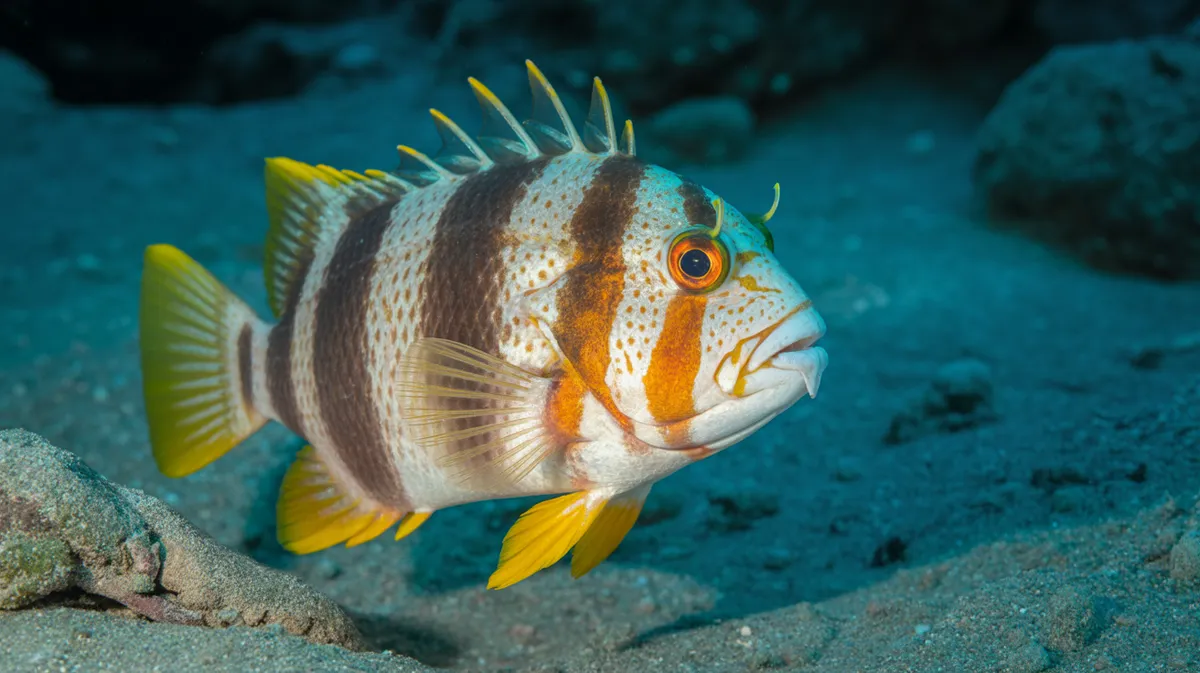
About the Stargazer Fish
Stargazers (family Uranoscopidae) look like a fish designed by an ambush specialist with no interest in elegance: the eyes and the huge upward-facing mouth are both on top of a flattened head, so the animal can bury itself in sand with nothing but eyes and lips exposed and still see and strike straight upward. Some species carry a worm-like flap of tissue inside the lower jaw and wiggle it as a lure. The strike is a sudden expansion of the mouth that sucks in prey with the pressure drop. Two independent weapons make the family notable. Behind the head, above each pectoral fin, sits a large venomous spine capable of a severely painful wound, which is why fishermen handling stargazers do so with great care. And in the genus Astroscopus, the muscles that once moved the eyes have been converted into electric organs sitting in pouches behind the eyes, generating discharges of up to around 50 volts. Electric organs have evolved several times in fish, but Astroscopus is unusual in deriving them from eye muscle rather than body or gill muscle, and it is one of very few marine fish with them. The discharge is thought to be used both defensively and to stun or disorient nearby prey.
Fascinating facts
Electric Defense
Certain stargazer species possess specialized electric organs that can deliver powerful shocks to stun prey or deter threats.
Venomous Spines
Stargazers have venomous spines located behind their opercles and above their pectoral fins, making them hazardous to handle.
Upward-Facing Eyes
Their eyes are positioned on top of their heads, allowing them to lie buried in the substrate while watching for passing prey.
Detailed description
The Stargazer Fish (Uranoscopus scaber) is a benthic marine species distinguished by its dorsally positioned eyes and mouth, which are set atop a broad, flattened head. Adult individuals typically reach lengths of 20–40 cm, with a robust, somewhat compressed body covered in small, embedded scales. The coloration is generally mottled brown to gray, providing excellent camouflage against sandy or muddy substrates. Stargazers possess a large, upward-facing mouth lined with sharp teeth, enabling them to rapidly engulf prey. Notably, this species is equipped with venomous spines located behind the operculum (gill cover), which serve as a deterrent to predators. Additionally, U. scaber has specialized electric organs derived from modified eye muscles, capable of generating mild electric shocks up to 50 volts, used for both defense and prey immobilization. The lateral line system is well-developed, aiding in the detection of vibrations and movements in the substrate. Stargazers are solitary, highly sedentary ambush predators, spending much of their lives partially buried with only their eyes and mouth exposed. Their cryptic lifestyle and unique anatomical adaptations make them one of the most specialized and enigmatic predatory fishes in coastal marine ecosystems.
Did you know?
Some stargazer fish can actually produce electric shocks of up to 50 volts to stun their prey or deter predators.
Research & sources
Behaviour & social structure
Uranoscopus scaber exhibits primarily nocturnal activity, emerging from the substrate at dusk to hunt. Its primary hunting strategy is ambush predation: the fish buries itself almost completely in sand or mud, remaining motionless for extended periods. When potential prey—typically small fish, crustaceans, or cephalopods—approaches, the Stargazer lunges upward with remarkable speed, creating a vacuum with its large mouth to suck in the victim. Stargazers are solitary and highly territorial, showing little social interaction outside of the breeding season. They rely heavily on camouflage and remain inactive during daylight hours to avoid detection by predators. Stargazers are known to use their electric organs defensively when threatened, and their venomous spines further discourage predation. Daily routines are dominated by periods of inactivity punctuated by rapid, opportunistic feeding events.
Reproduction & life cycle
Stargazer Fish are oviparous, with external fertilization. Spawning typically occurs in late spring to early summer (April–June) in temperate regions, coinciding with rising water temperatures. Males and females release gametes into the water column, where fertilization takes place. Eggs are pelagic and buoyant, drifting with currents until hatching. Larvae are planktonic and undergo several developmental stages before settling to the benthos as juveniles. There is no parental care; both eggs and larvae are left to develop independently. Sexual maturity is generally reached at 2–3 years of age. Breeding aggregations are not well-documented, but evidence suggests that individuals may temporarily congregate in favorable spawning areas.
Adaptations & survival
Uranoscopus scaber displays several remarkable adaptations for benthic ambush predation. Its dorsally positioned eyes and mouth allow it to remain buried while maintaining visual and sensory awareness of its surroundings. The cryptic coloration and ability to rapidly bury itself provide effective camouflage from both prey and predators. The presence of venomous spines behind the opercula offers a potent defense mechanism, while the electric organs—unique among bony fishes—can deliver shocks to deter predators or stun prey. The lateral line system is highly sensitive, enabling detection of subtle substrate vibrations. The large, extensible mouth and rapid strike capability facilitate the capture of elusive or fast-moving prey. These evolutionary specializations have enabled the Stargazer to occupy a unique ecological niche within coastal benthic communities.
Cultural significance
Stargazer Fish have a modest presence in regional folklore and are sometimes featured in local myths due to their unusual appearance and defensive capabilities. In Mediterranean cultures, they have been regarded with superstition, often associated with bad luck or danger because of their venom and electric organs. In some regions, the fish are occasionally consumed, but their venomous spines necessitate careful handling and preparation. Stargazers are also of interest to public aquaria and educational programs, where they are used to illustrate the diversity of marine adaptations and the complexity of benthic ecosystems.
Recent research
Recent research on Uranoscopus scaber has focused on the structure and function of its electric organs, providing insights into convergent evolution of bioelectrogenesis among fishes. Studies have also examined the ecological role of Stargazers in benthic food webs, highlighting their importance as mesopredators. Genetic analyses have clarified phylogenetic relationships within the Uranoscopidae family, revealing cryptic diversity and potential for undiscovered species. Ongoing research is investigating the effects of environmental stressors, such as hypoxia and pollution, on Stargazer physiology and reproductive success. Additionally, the venom composition is being studied for potential biomedical applications, particularly in the development of novel analgesics.
Sources
Uranoscopus scaber (Linnaeus, 1758): Taxonomy, Biology, and Ecology
FishBase Editors (2024)
scientificThe biology and ecology of Uranoscopus scaber (Pisces: Uranoscopidae) in the Mediterranean Sea
M. Dulčić, B. Glamuzina, et al. (2006)
scientificVideos
Habitat
Coastal marine environments, sandy or muddy sea floors

Conservation
The Stargazer Fish is currently classified as Least Concern on the IUCN Red List.
Threats & challenges
Currently assessed as Least Concern by the IUCN, Uranoscopus scaber faces relatively few direct threats due to its wide distribution and adaptability to various coastal habitats. However, localized population declines may occur due to habitat degradation from bottom trawling, coastal development, and pollution, which can alter or destroy preferred sandy or muddy substrates. Bycatch in commercial fisheries is a minor but persistent issue, as Stargazers are not typically targeted for consumption due to their venomous spines and unappealing appearance. Climate change and associated shifts in sea temperature and habitat availability may pose future challenges, potentially affecting spawning success and larval dispersal. Overall, populations are considered stable, but continued monitoring is warranted.
Taxonomy
Scientific name
Uranoscopus scaber
- Kingdom
- Animalia
- Phylum
- Chordata
- Class
- Actinopterygii
- Order
- Perciformes
- Family
- Uranoscopidae
- Genus
- Uranoscopus
- Species
- scaber
Community notes
Share your observations about the Stargazer Fish.
No community notes yet. Be the first!
Discover more wildlife
More fascinating animals from the encyclopedia.