
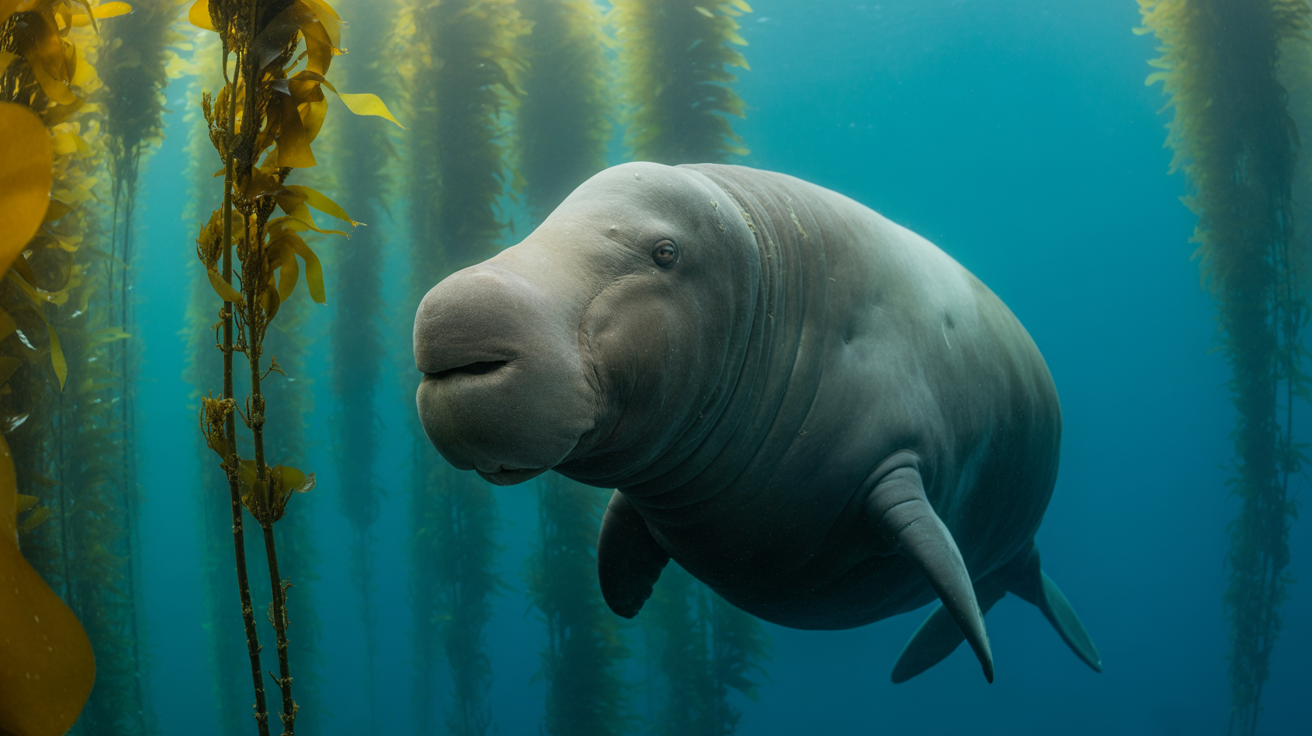
About the Steller's Sea Cow
Steller's sea cow (Hydrodamalis gigas) was the largest sirenian ever known, reaching 8 to 9 metres and several tonnes, and it was extinguished within 27 years of being described. The naturalist Georg Steller met it in 1741 when the Bering expedition was wrecked on Bering Island in the Commander group, and his account is the only one written by anyone who saw the animal alive. It had no teeth at all, grinding kelp between two horny plates in the mouth, and it could not submerge: it was so buoyant that it floated with its back permanently exposed, grazing the kelp canopy with its head under water, which made it trivially easy to harpoon from a small boat. Its skin was thick, dark, corrugated and bark-like, apparently as protection against ice and rock. Crucially, the animals Steller saw were already a relict. Fossils show Hydrodamalis once ranged around the North Pacific rim from Japan to Baja California, and it had been reduced by prehistoric hunting and by the loss of kelp forests to the last stronghold where sea otters, and therefore kelp, still persisted. Fur traders and sealers stopping at the Commander Islands took them for meat, and the last was killed around 1768.
Fascinating facts
Surface Dweller
Steller's Sea Cows were so buoyant that they could not dive below the surface and spent their entire lives floating in shallow coastal waters.
Giant Kelp Grazer
Their diet consisted exclusively of kelp and other sea grasses, which they consumed in large quantities daily to sustain their massive size.
Unique Anatomy
Unlike modern manatees and dugongs, Steller's Sea Cow had no functional teeth, relying on horny pads to chew tough sea plants.
Detailed description
Steller's sea cow (Hydrodamalis gigas) was the largest member of the order Sirenia, with adults reaching lengths of 7 to 9 meters (23–30 feet) and estimated weights between 8,000 and 10,000 kilograms (17,600–22,000 pounds). Its body was robust and spindle-shaped, covered in an exceptionally thick, wrinkled, brownish-black skin up to 2.5 centimeters (1 inch) thick, which served as protection against cold waters and potential predators. Unlike modern dugongs and manatees, Steller's sea cow lacked functional teeth, instead possessing keratinous plates for grinding tough kelp and other marine vegetation. The head was small relative to body size, with a broad, downturned snout adapted for bottom-feeding. Forelimbs were paddle-shaped and lacked nails, while hind limbs were completely absent, replaced by a broad, horizontally flattened tail fluke similar to that of whales. The ribcage was highly arched, providing buoyancy and supporting large lungs for extended dives. Steller's observations suggest these animals lived in small, loosely organized herds, often seen in pairs or family groups. They were slow-moving, spending most of their time grazing in shallow coastal waters rich in kelp. Reproduction was likely slow, with females giving birth to a single calf at a time. Their docile nature, lack of fear of humans, and inability to submerge completely made them particularly vulnerable to hunting.
Did you know?
Steller's Sea Cow went extinct less than three decades after it was first discovered, making it one of the fastest documented extinctions of a large mammal due to human activity.
Research & sources
Wikipedia summary
Steller's sea cow is an extinct sirenian described by Georg Wilhelm Steller in 1741. At that time, it was found only around the Commander Islands in the Bering Sea between Alaska and Russia; its range extended across the North Pacific during the Pleistocene epoch, and likely contracted to such an extreme degree due to the glacial cycle. It is possible that indigenous populations interacted with the animal before Europeans. Steller first encountered it on Vitus Bering's Great Northern Expedition when the crew became shipwrecked on Bering Island. Much of what is known about its behavior comes from Steller's observations on the island, documented in his posthumous publication On the Beasts of the Sea. Within 27 years of its discovery by Europeans, the slow-moving and easily-caught mammal was hunted into extinction for its meat, fat, and hide.
Behaviour & social structure
Steller's sea cows were obligate herbivores, feeding almost exclusively on kelp (Laminaria spp.) and other large brown algae found in the shallow subtidal zones around the Commander Islands. They grazed by floating at the surface or just below, using their large lips and keratinous plates to tear and grind vegetation. Feeding was a near-continuous activity, interrupted only by brief periods of rest. Socially, they formed small groups, possibly consisting of related individuals, and exhibited strong pair bonds, especially between mothers and calves. Steller noted that when one individual was injured or killed, others would attempt to assist or remain nearby, indicating a degree of social cohesion. They communicated through soft sighs and snorts, and their slow, deliberate movements reflected a low metabolic rate, an adaptation to cold, nutrient-poor environments. There is no evidence of aggressive behavior, and they appeared to lack natural predators, aside from occasional attacks by orcas or large sharks.
Reproduction & life cycle
Little direct information exists on the reproductive biology of Steller's sea cow, but extrapolations from related sirenians suggest a slow reproductive rate. Females likely gave birth to a single calf after a gestation period estimated at 12 to 14 months. Calving probably occurred in spring or early summer, coinciding with peak kelp productivity. Newborns were likely precocial, able to swim and follow their mothers shortly after birth. Maternal care was extended, with calves remaining dependent on their mothers for up to two years. The species' slow maturation and long interbirth intervals (possibly 3–5 years) would have limited population growth and recovery potential, making them especially susceptible to overexploitation.
Adaptations & survival
Steller's sea cow exhibited several remarkable adaptations for life in cold, northern marine environments. Its thick, bark-like skin and substantial subcutaneous fat layer provided insulation against frigid waters. The large, barrel-shaped body and arched ribcage enhanced buoyancy and allowed for efficient surface grazing. The absence of teeth and development of keratinous grinding plates were specialized for processing tough, abrasive kelp. Reduced metabolic rate and slow movements minimized energy expenditure. The horizontally flattened tail fluke enabled gentle propulsion, while the paddle-like forelimbs aided in steering. Their inability to submerge fully may have been a trade-off for buoyancy and thermoregulation, but it also increased vulnerability to human hunters.
Cultural significance
While Steller's sea cow was unknown to most of the world until the 18th century, it likely played a role in the subsistence practices of indigenous peoples of the Commander Islands, who may have hunted it opportunistically. After European discovery, its meat became a vital resource for stranded sailors and fur traders, who described it as tender and nutritious. The animal's rapid extinction became emblematic of the destructive impact of unregulated exploitation. In modern times, Steller's sea cow is referenced in conservation literature as a symbol of lost biodiversity and the importance of protecting vulnerable marine species. It occasionally appears in Russian folklore and is the subject of ecological and paleontological studies.
Recent research
Recent research has focused on reconstructing the evolutionary history of Hydrodamalis gigas using ancient DNA and morphological analysis, revealing its close relationship to the modern dugong and the extinct Hydrodamalis cuestae. Stable isotope studies of bone collagen have provided insights into its diet and habitat use, confirming a reliance on kelp-dominated ecosystems. Paleoecological investigations suggest that the species' range contracted dramatically during the late Pleistocene and Holocene, likely due to climate-driven habitat loss and human impacts. Ongoing research examines the ecological consequences of its extinction, particularly the potential cascading effects on kelp forest dynamics and associated marine communities. The Steller's sea cow remains a focal point in discussions of de-extinction and the ethics of ecological restoration.
Videos
Habitat
Coastal marine waters, particularly around kelp forests

Conservation
The Steller's Sea Cow is currently classified as Extinct on the IUCN Red List.
Threats & challenges
Steller's sea cow faced no significant natural predators in its restricted post-Pleistocene range, but the arrival of humans brought catastrophic threats. Following its discovery by Europeans in 1741, intense hunting for meat, fat, and hides rapidly decimated the population. The species' slow reproductive rate, limited geographic range, and lack of fear of humans exacerbated its decline. Within 27 years of European contact, the last known individuals were killed, rendering the species extinct by 1768. Earlier population declines may have resulted from prehistoric hunting and environmental changes, including the loss of kelp forests due to climatic fluctuations. Today, the extinction of Steller's sea cow serves as a cautionary example of the vulnerability of megafauna to overexploitation and habitat loss.
Taxonomy
Scientific name
Hydrodamalis gigas
- Kingdom
- Animalia
- Phylum
- Chordata
- Class
- Mammalia
- Order
- Sirenia
- Family
- Dugongidae
- Genus
- Hydrodamalis
- Species
- gigas
Community notes
Share your observations about the Steller's Sea Cow.
No community notes yet. Be the first!
Discover more wildlife
More fascinating animals from the encyclopedia.