
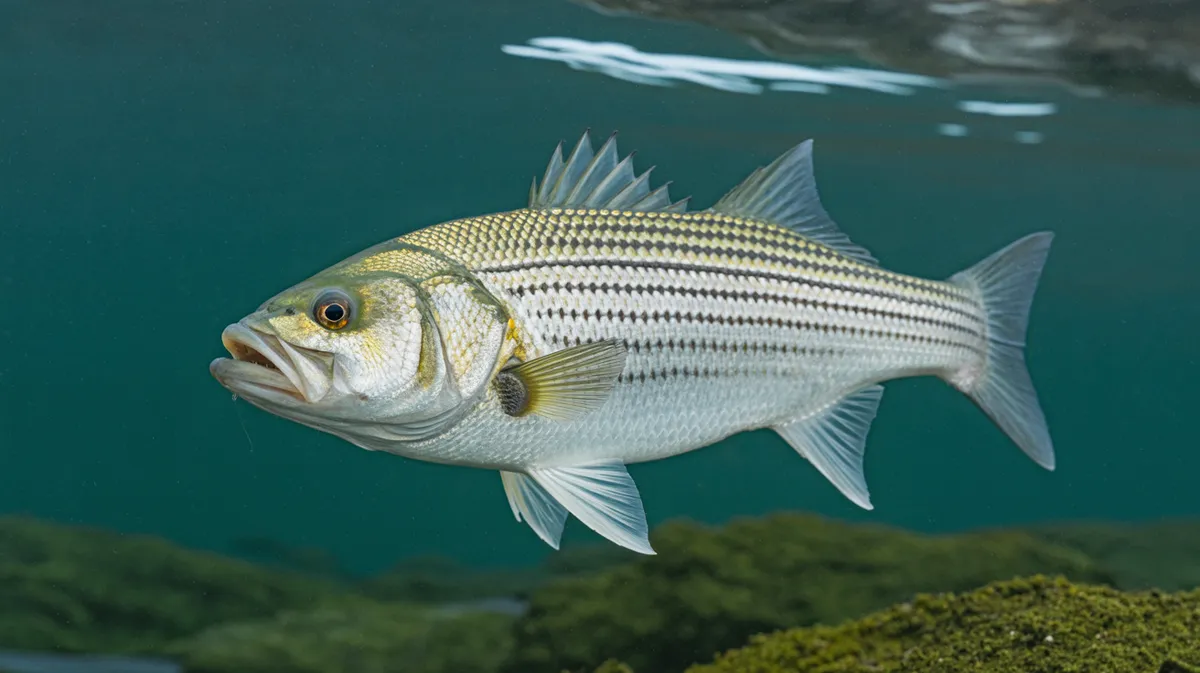
About the Striped Bass
The striped bass is a large, predatory fish native to the Atlantic coast of North America, recognized by its sleek silvery body marked with seven to eight prominent horizontal black stripes running from gills to tail. These fish are highly adaptable, thriving in both freshwater and saltwater environments, and are well known for their migratory behavior, traveling long distances between spawning and feeding grounds. Striped bass are prized game fish due to their size and fighting ability, making them popular targets for recreational anglers. They play a significant ecological role as both predators and prey within their habitats.
Fascinating facts
Powerful Swimmers
Striped bass are strong swimmers known to migrate more than 100 miles upstream to reach their spawning grounds.
Popular Game Fish
They are highly sought after by anglers for their size and spirited fight, supporting major recreational and commercial fisheries.
Anadromous Lifestyle
Striped bass can thrive in both saltwater and freshwater, moving between the two throughout their life cycle.
Detailed description
The striped bass (Morone saxatilis) is a robust, elongated fish that can reach lengths of up to 1.5 meters (59 inches) and weights exceeding 50 kg (110 lbs), though most individuals are considerably smaller. Its body is laterally compressed and covered with large, rough ctenoid scales, giving it a sleek, hydrodynamic profile. The most distinctive feature is the series of seven to eight continuous dark horizontal stripes running from the operculum (gill cover) to the base of the tail, set against a silvery-white background with a darker olive to blue-green dorsal surface. The mouth is large, terminal, and equipped with small, sharp teeth suited for grasping prey. Striped bass possess two dorsal fins—the first spiny and the second soft-rayed—as well as a deeply forked caudal fin, adaptations that contribute to their powerful swimming ability. Their lateral line is well developed, aiding in the detection of vibrations and movement in the water. This species is anadromous, migrating between marine and freshwater environments, and exhibits remarkable physiological adaptability to varying salinities. Striped bass are long-lived, with individuals documented to reach ages of over 30 years. They are apex predators in many of their habitats, playing a critical role in regulating prey populations and maintaining ecological balance.
Did you know?
Striped bass are capable of traveling hundreds of miles upriver from the ocean to spawn in freshwater, often returning to the same river where they were born.
Research & sources
Wikipedia summary
The striped bass, also called the Atlantic striped bass, striper, linesider, rock, or rockfish, is an anadromous perciform fish of the family Moronidae found primarily along the Atlantic coast of North America. It has also been widely introduced into inland recreational fisheries across the United States. Striped bass found in the Gulf of Mexico are a separate strain referred to as Gulf Coast striped bass.
Behaviour & social structure
Striped bass are primarily crepuscular, exhibiting peak activity during dawn and dusk when they hunt for prey. They are opportunistic carnivores, feeding on a variety of fish (such as menhaden, herring, and shad), crustaceans, and occasionally squid. Their hunting strategy often involves coordinated group foraging, where schools of bass drive baitfish toward the surface or into shallow water to facilitate capture. While juveniles tend to form dense schools for protection and feeding efficiency, adults may become more solitary or form smaller, loosely organized groups, especially outside the spawning season. Striped bass are highly migratory, with some populations traveling hundreds of kilometers between spawning and feeding grounds. They exhibit site fidelity, often returning to the same river systems to spawn each year. During non-migratory periods, they may establish home ranges within estuaries or coastal waters, displaying territorial behavior toward conspecifics.
Reproduction & life cycle
Spawning occurs primarily in freshwater rivers and tidal tributaries from March to June, depending on latitude and water temperature (optimal range: 12–18°C/54–64°F). Striped bass are broadcast spawners; females release between 50,000 and 3 million buoyant eggs into the water column, which are then externally fertilized by multiple males. The eggs drift downstream and hatch within 2–3 days, depending on temperature. There is no parental care; larvae are planktonic and rely on river currents for dispersal. Juveniles gradually migrate downstream to estuarine and coastal habitats as they grow. Sexual maturity is typically reached at 2–4 years for males and 4–8 years for females, with larger, older females producing disproportionately more eggs, making them vital for population sustainability.
Adaptations & survival
Striped bass exhibit remarkable osmoregulatory capabilities, allowing them to thrive in both freshwater and marine environments. Their gill and kidney physiology can rapidly adjust to changes in salinity, supporting their anadromous life cycle. The lateral line system is highly sensitive, enabling detection of prey and navigation in turbid waters. Their streamlined body and powerful musculature facilitate long-distance migrations and rapid bursts of speed to capture agile prey. The species' broad diet and flexible feeding strategies enhance survival in variable environments. Additionally, their reproductive strategy—high fecundity and broadcast spawning—maximizes the likelihood of offspring survival in dynamic riverine systems.
Cultural significance
Striped bass hold substantial cultural and economic importance along the Atlantic coast of North America. They are revered as premier game fish, supporting vibrant recreational and commercial fisheries that contribute significantly to local economies. The species features prominently in regional folklore and cuisine, particularly in the Chesapeake Bay and New England areas. Striped bass are also symbolic of successful conservation, often cited as a model for fisheries management and species recovery. In some indigenous cultures, they have been historically valued as a food source and feature in traditional ecological knowledge.
Recent research
Recent research has focused on the genetic differentiation between Atlantic and Gulf Coast striped bass populations, with implications for management and conservation. Studies using telemetry and acoustic tagging have revealed complex migratory behaviors and habitat use patterns, informing efforts to protect critical spawning and nursery habitats. Investigations into the impacts of climate change are ongoing, particularly regarding shifts in spawning timing and distribution. Additionally, research on hybridization with white bass (Morone chrysops) has led to the development of 'hybrid striped bass,' a popular aquaculture and sport fish. Ongoing monitoring programs track population trends, health, and responses to environmental changes.
Videos
Habitat
Coastal waters, estuaries, and rivers


Conservation
The Striped Bass is currently classified as Least Concern on the IUCN Red List.
Threats & challenges
While currently listed as Least Concern by the IUCN, striped bass populations have historically faced significant declines due to overfishing, habitat loss (especially spawning grounds), water pollution, and barriers to migration such as dams. Intensive management and restoration efforts, including fishing regulations, hatchery supplementation, and dam removal projects, have led to population recoveries in many regions. However, ongoing threats include climate change (altering river flow and temperature regimes), continued habitat degradation, bycatch, and competition or hybridization with introduced species. Monitoring and adaptive management remain essential to ensure long-term population stability.
Taxonomy
Scientific name
Morone saxatilis
- Kingdom
- Animalia
- Phylum
- Chordata
- Class
- Actinopterygii
- Order
- Moroniformes
- Family
- Moronidae
- Genus
- Morone
- Species
- saxatilis
Where to see a striped bass
1 zoo and aquarium in 1 country are recorded as keeping this species.

Community notes
Share your observations about the Striped Bass.
No community notes yet. Be the first!
Discover more wildlife
More fascinating animals from the encyclopedia.