
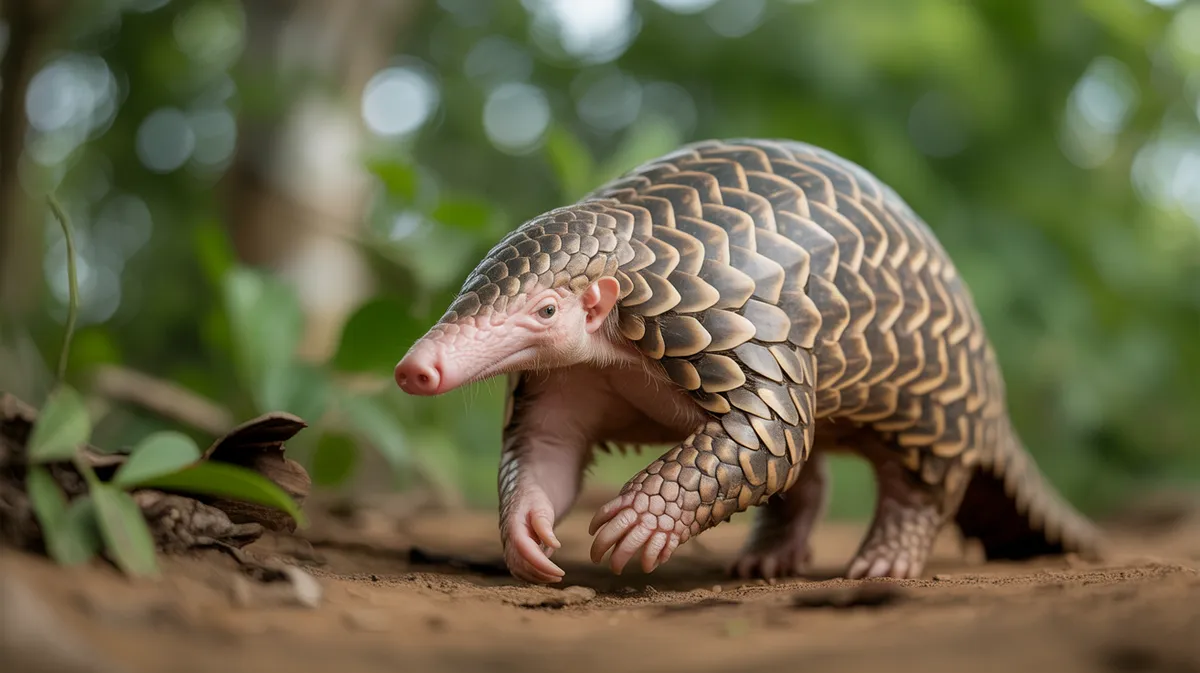
About the Sunda Pangolin
The Sunda pangolin (Manis javanica) is a nocturnal, ant- and termite-eating mammal armoured in overlapping scales of keratin, the same protein as human fingernails, which can make up around 20 per cent of its body weight. It has no teeth at all. Its tongue is longer than its head and body, anchored not in the mouth but deep in the chest near the pelvis, and it is coated with sticky saliva produced by an enormous salivary gland. Insects are swallowed whole and ground in a muscular, keratin-spined stomach with the help of small stones and grit the pangolin deliberately swallows, so it has effectively replaced teeth with a gizzard. When threatened it rolls into a tight ball, tucking the head under the tail; the scales are sharp-edged and can be scissored to cut, and a rolled pangolin is genuinely difficult for a leopard or a tiger to open. Against a human with a sack, it is useless, and that is the entire tragedy of the animal. Pangolins are the most trafficked wild mammals in the world, hunted for meat and for the scales, which are used in traditional Chinese medicine despite being made of the same material as hair. Sunda pangolins climb well, using a prehensile tail, and are now Critically Endangered.
Fascinating facts
Keratin Armor
The Sunda Pangolin’s body is covered with up to 1,000 sharp, overlapping scales made of keratin, providing protection from predators.
Insect Specialist
This pangolin feeds almost exclusively on ants and termites, consuming up to 200,000 insects in a single night.
Nocturnal and Solitary
Sunda Pangolins are active at night and spend their days hidden in burrows or hollow trees, rarely seen by humans.
Detailed description
The Sunda pangolin (Manis javanica) is a medium-sized, nocturnal mammal distinguished by its unique armor of overlapping, keratinous scales, which cover most of its body except for the face, underside, and inner limbs. Adults typically measure 40–65 cm in body length, with a tail nearly as long (35–56 cm), and weigh between 4 and 10 kg, though larger individuals have been recorded. Its elongated, conical head features small, almost vestigial eyes and ears, adaptations for its fossorial and nocturnal lifestyle. The tongue is extraordinarily long—up to 40 cm when extended—allowing it to probe deep into insect nests. Sunda pangolins are solitary, spending daylight hours curled up in burrows or tree hollows and emerging at night to forage. They are adept climbers, using their prehensile tails and strong claws to ascend trees in search of food. The species is highly secretive and elusive, rarely seen even in areas where it is known to occur. When threatened, the pangolin's primary defense is to curl into a tight ball, rendering its vulnerable parts protected by its tough scales. This species is distributed across Southeast Asia, including Thailand, Cambodia, Vietnam, Laos, Malaysia, Singapore, Indonesia, and parts of Myanmar, inhabiting a range of environments from primary and secondary forests to plantations and grasslands. Its specialized diet and low reproductive rate make it particularly vulnerable to environmental changes and exploitation.
Did you know?
Sunda Pangolins are considered the world's most trafficked mammal due to immense demand for their scales and meat.
Research & sources
Wikipedia summary
The Sunda pangolin, also known as the Malayan or Javan pangolin, is a species of pangolin. It is a member of the Manidae family. Its English name comes from the Malay name "pëngulin", which means "roller".
Behaviour & social structure
Sunda pangolins are strictly nocturnal and solitary, with individuals maintaining overlapping home ranges but rarely interacting outside of breeding. They spend much of the night foraging for ants and termites, using their acute sense of smell to locate insect nests. With powerful forelimbs and curved claws, they tear open logs, mounds, or soil to access prey, then use their sticky, elongated tongues to collect insects. They are primarily terrestrial but are also proficient climbers, often ascending trees to find food or shelter. Communication is limited, relying on scent marking via anal glands to delineate territory or signal reproductive status. When disturbed, they may emit hissing sounds or release a foul-smelling secretion. Activity peaks shortly after dusk and before dawn, with individuals traveling several kilometers per night in search of food.
Reproduction & life cycle
Reproduction in Sunda pangolins is poorly understood due to their secretive nature, but available data indicate that they are polygynous, with males seeking out receptive females during the breeding season, which may occur year-round but peaks during the wet season in some regions. After mating, gestation lasts approximately 180 days (about 6 months). Females typically give birth to a single offspring, though twins are rare. The newborn, weighing 80–450 grams, is born with soft, pale scales that harden within a few days. The young pangolin rides on the mother's tail or back for several weeks and is weaned at around 3–4 months of age. Sexual maturity is reached at about 2 years. Parental care is provided solely by the mother, who shelters the young in burrows or tree hollows.
Adaptations & survival
Sunda pangolins exhibit several remarkable adaptations. Their overlapping keratin scales provide effective armor against predators, while the ability to curl into a ball further protects vulnerable body parts. The elongated, sticky tongue—anchored deep in the thorax—enables efficient extraction of ants and termites from narrow crevices. Strong, curved claws are specialized for digging and tearing into insect nests. Reduced or absent teeth are compensated by a muscular, keratinized stomach that grinds food, aided by swallowed pebbles. Acute olfactory senses help locate prey and communicate via scent marking. Their prehensile tail aids in climbing and balance, while nocturnal habits and cryptic coloration help avoid detection by predators and humans.
Cultural significance
In various Southeast Asian cultures, pangolins have been both revered and exploited. Their scales are highly valued in traditional Chinese and Vietnamese medicine, believed (without scientific basis) to cure ailments such as asthma, arthritis, and cancer. Pangolin meat is considered a luxury food in some regions. Folklore often attributes mystical properties to pangolins, such as the ability to ward off evil or bring good luck. However, increasing awareness campaigns are working to dispel myths and reduce demand for pangolin products.
Recent research
Recent research has focused on pangolin genetics, population structure, and the impact of trafficking routes. Advances in satellite tracking and camera trapping have improved understanding of their habitat use and movement patterns. Studies on pangolin health and disease have gained urgency due to their potential role as reservoirs for zoonotic pathogens. Captive breeding remains challenging, but new insights into their nutritional and environmental needs are emerging. Conservation genetics is being used to trace the origins of trafficked individuals and inform law enforcement.
Sources
Manis javanica (Sunda Pangolin) – IUCN Red List of Threatened Species
Challender, D., Willcox, D.H.A., Panjang, E., Lim, N., Nash, H., Heinrich, S., Chong, J. (2019)
scientificEcology and Conservation of the Sunda Pangolin (Manis javanica) in Southeast Asia
Challender, D.W.S., Waterman, C., Baillie, J.E.M. (2014)
scientificVideos
Habitat
Tropical and subtropical forests
 Various Continental Regions
Grassland
Open areas dominated by grasses rather than trees, supporting numerous herbivores and their predators.
 Tropical Regions
Rainforest
Dense, wet forests with the highest biodiversity on Earth, containing more than half of the world's plant and animal species.
 Global
Forest
Wooded areas with significant tree cover and diverse plant and animal communities.
Conservation
The Sunda Pangolin is currently classified as Critically Endangered on the IUCN Red List.
Threats & challenges
The Sunda pangolin faces severe threats from illegal hunting and trafficking, driven by demand for its scales (used in traditional medicine) and meat (considered a delicacy in some cultures). It is the most heavily trafficked wild mammal globally, with populations declining by over 80% in recent decades. Habitat loss and fragmentation due to deforestation and agricultural expansion further exacerbate its decline. Low reproductive rates and specialized diets limit population recovery. Conservation challenges include weak law enforcement, lack of public awareness, and difficulties in captive breeding due to dietary and behavioral specializations. The species is listed as Critically Endangered by the IUCN and is protected under CITES Appendix I, prohibiting international trade.
Taxonomy
Scientific name
Manis javanica
- Kingdom
- Animalia
- Phylum
- Chordata
- Class
- Mammalia
- Order
- Pholidota
- Family
- Manidae
- Genus
- Manis
- Species
- javanica
Community notes
Share your observations about the Sunda Pangolin.
No community notes yet. Be the first!
Discover more wildlife
More fascinating animals from the encyclopedia.