
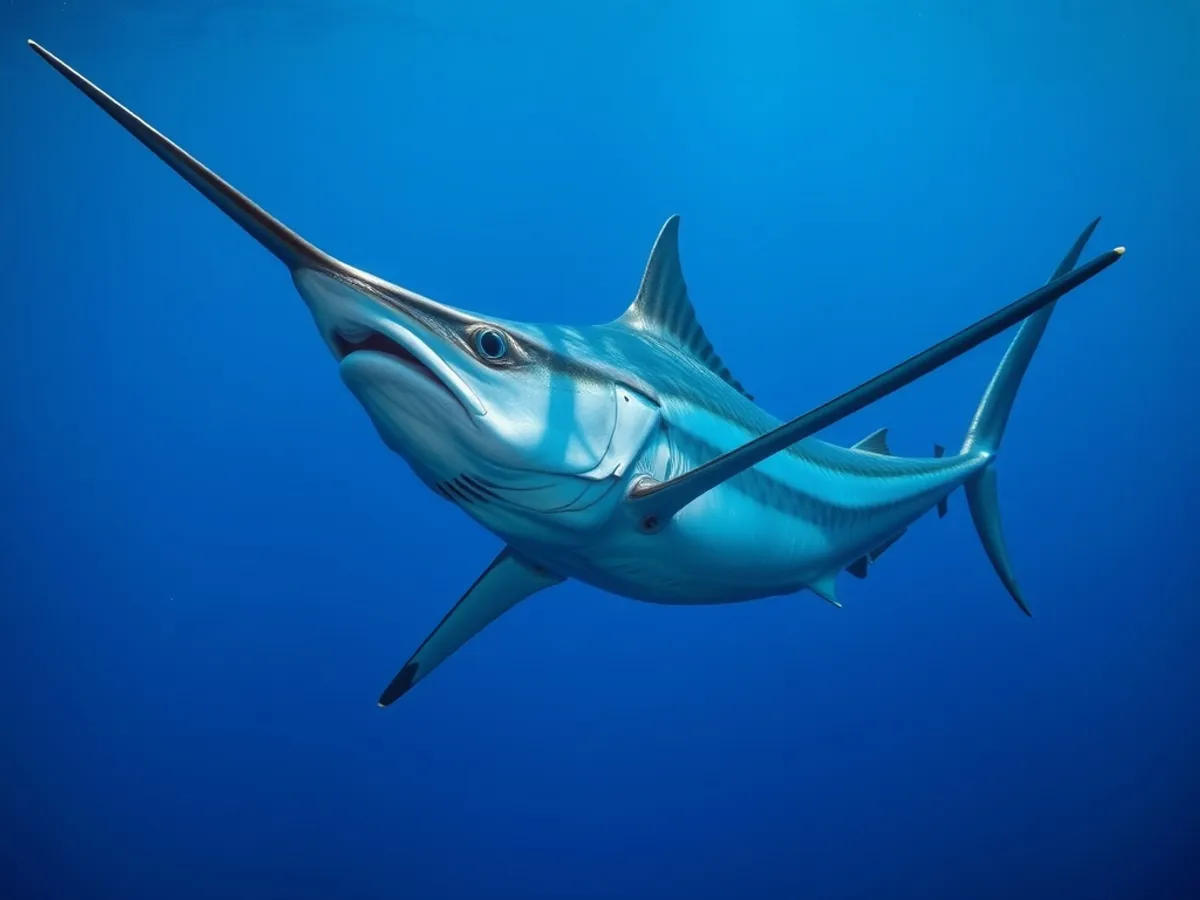
About the Swordfish
The swordfish (Xiphias gladius) carries a bill that is flattened and blade-like in cross-section, unlike the round, spear-like rostrum of a marlin, and it is not used as a lance but swung sideways through a school, slashing and stunning fish that the swordfish then turns and eats; damaged prey with clean cuts is regularly found in swordfish stomachs. The animal's greatest specialisation, however, is thermal. Swordfish are visual hunters that pursue squid and fish down to 800 metres in water only a few degrees above freezing, and cold slows the eye and brain badly, blurring the perception of fast movement. They solve this with a heater organ: one of the muscles that would normally move the eye has lost its contractile machinery and been converted into a mass of mitochondria-packed tissue that does nothing but generate heat, warming the eyes and brain by 10 to 15 degrees Celsius above the surrounding water. Warm eyes have a far faster flicker-fusion rate, so a swordfish at depth sees moving prey that would be an unresolved smear to a cold-eyed fish. Adults lose all their teeth and scales as they mature, ending as smooth, naked animals. Claims that swordfish reach 100 kilometres per hour are widely repeated but rest on no reliable measurement.
Fascinating facts
Unique Bill
The swordfish's elongated bill can be up to one-third of its total body length and is used to slash at schooling fish, stunning or injuring them for easier capture.
Deep Divers
Swordfish are capable of deep dives and can be found as far down as 650 meters (2,130 feet), often following prey into colder, deeper waters.
Incredible Speed
Swordfish are among the fastest fish in the ocean, reaching burst speeds close to 60 mph (97 km/h) thanks to their streamlined bodies and powerful tails.
Detailed description
The swordfish (Xiphias gladius) is a large, pelagic predatory fish distinguished by its elongated, flattened bill, which can comprise up to one-third of its total body length. Adults typically measure between 2.5 and 3 meters (8–10 ft) and weigh 150–300 kg, though exceptional individuals can reach 4.55 meters and 650 kg. The body is robust, laterally compressed, and tapers to a crescent-shaped caudal fin, facilitating high-speed swimming. Swordfish exhibit countershading, with a dark blue to brownish-black dorsal surface and a silvery-white ventral side, aiding camouflage in open water. Unlike most fish, adult swordfish lack scales and teeth, adaptations that reduce drag and streamline their profile. Their large eyes are adapted for vision in low-light conditions, and specialized ocular muscles can generate heat, maintaining retinal function at depth. Swordfish are solitary or loosely aggregating, rarely forming schools. They are highly migratory, traversing entire ocean basins and capable of vertical migrations from surface waters to depths exceeding 2,200 meters, often following prey or temperature gradients. Their physiology allows them to tolerate a wide range of temperatures, from 5°C to over 27°C. Swordfish are apex predators, feeding primarily on pelagic fish and squid, and play a crucial role in the trophic dynamics of open ocean ecosystems.
Did you know?
Swordfish can dive to depths over 2,100 feet (650 meters) in search of prey.
Research & sources
Wikipedia summary
The swordfish, also known as the broadbill in some countries, are large, highly migratory predatory fish characterized by a long, flat, pointed bill. They are the sole member of the family Xiphiidae. They are a popular sport fish of the billfish category. Swordfish are elongated, round-bodied, and lose all teeth and scales by adulthood. These fish are found widely in tropical and temperate parts of the Atlantic, Pacific, and Indian Oceans, and can typically be found from near the surface to a depth of 550 m (1,800 ft), and exceptionally up to depths of 2,234 m. They commonly reach 3 m (10 ft) in length, and the maximum reported is 4.55 m in length and 650 kg (1,430 lb) in weight.
Behaviour & social structure
Swordfish are primarily solitary hunters, though they may aggregate in areas of high prey density or during spawning. They exhibit diel vertical migration, often remaining at depths of 200–600 meters during the day and ascending to near-surface waters at night to feed. Their hunting strategy involves rapid bursts of speed and the use of their 'sword' to slash or stun prey, making capture easier. Swordfish are opportunistic feeders, preying on a variety of fish (such as mackerel, herring, and bluefish) and cephalopods. They are known for their powerful swimming, reaching speeds up to 97 km/h (60 mph), facilitated by their streamlined bodies and large, lunate tails. Swordfish are generally non-territorial and display little social interaction outside of breeding. They are capable of leaping clear of the water, a behavior thought to dislodge parasites or evade predators.
Reproduction & life cycle
Swordfish are oviparous, with external fertilization. Spawning occurs in warm waters (typically above 23°C), with peak activity varying by region: in the western North Atlantic, spawning peaks from April to August, while in the Mediterranean it occurs from May to July. Females are highly fecund, releasing between 1 and 29 million eggs per spawning event. Eggs and larvae are pelagic and planktonic, drifting with ocean currents. Larvae grow rapidly, reaching juvenile stages within weeks. There is no parental care post-spawning. Sexual maturity is reached at 4–5 years for females (about 170 cm in length) and 3–4 years for males (about 140 cm). Swordfish exhibit indeterminate growth, with older individuals continuing to increase in size.
Adaptations & survival
Swordfish possess several remarkable adaptations for pelagic life. Their elongated, rigid bill is used to slash and incapacitate prey, a specialization unique among billfishes. The lack of adult scales and teeth reduces hydrodynamic drag. Swordfish are among the few fish capable of regional endothermy: specialized heater organs derived from eye muscles warm the brain and eyes, enhancing vision and neural function in cold, deep waters. Their large gills and high hemoglobin concentrations support oxygen uptake during intense activity. The body musculature is adapted for sustained, powerful swimming, and the crescent-shaped tail provides efficient propulsion. Swordfish can tolerate a wide range of temperatures and oxygen levels, allowing them to exploit diverse oceanic habitats.
Cultural significance
Swordfish have held a prominent place in maritime cultures for centuries. They are revered in Mediterranean folklore and have appeared in ancient Greek and Roman art. In modern times, swordfish are highly valued in commercial and recreational fisheries, prized for their fighting ability and culinary qualities. Swordfish steaks are a delicacy in many cuisines, though concerns about mercury accumulation have led to consumption advisories in some regions. The swordfish's distinctive appearance and prowess have made it a symbol of speed and strength in literature and popular culture.
Recent research
Recent research has focused on swordfish migratory patterns using satellite tagging, revealing complex transoceanic movements and vertical migration behaviors. Genetic studies indicate significant population structure between Atlantic, Pacific, and Indian Ocean stocks, informing management strategies. Investigations into their regional endothermy have provided insights into convergent evolution among pelagic predators. Ongoing studies are examining the impacts of climate change on spawning grounds and prey availability. Advances in fisheries science have led to improved stock assessments and bycatch mitigation techniques, such as circle hooks and time-area closures.
Videos
Habitat
Open ocean (pelagic zones of temperate and tropical seas)

Conservation
The Swordfish is currently classified as Least Concern on the IUCN Red List.
Threats & challenges
Major threats to swordfish populations include overfishing, particularly from longline and drift net fisheries, which target both adults and juveniles. Bycatch, including the incidental capture of non-target species such as sea turtles and sharks, is a significant issue. Although global populations are currently assessed as 'Least Concern' by the IUCN, regional stocks (notably in the Mediterranean) have experienced historical declines due to overexploitation. Habitat degradation, pollution, and climate change (affecting ocean temperatures and prey distribution) pose additional challenges. International management measures, such as catch quotas and minimum size limits, have been implemented to promote stock recovery, but enforcement and compliance remain variable.
Taxonomy
Scientific name
Xiphias gladius
- Kingdom
- Animalia
- Phylum
- Chordata
- Class
- Actinopterygii
- Order
- Perciformes
- Family
- Xiphiidae
- Genus
- Xiphias
- Species
- gladius
Community notes
Share your observations about the Swordfish.
No community notes yet. Be the first!
Discover more wildlife
More fascinating animals from the encyclopedia.