
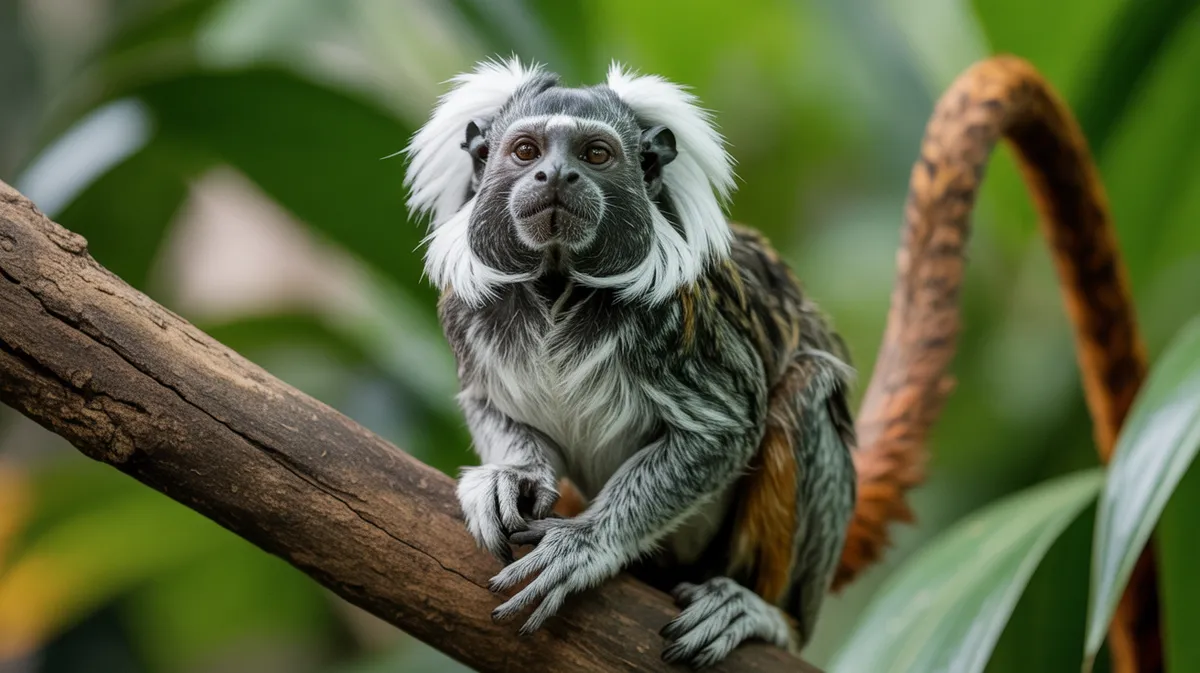
About the Tamarin
Tamarins are small, agile New World monkeys native to Central and South America, recognized for their striking facial hair and expressive faces. Typically found in tropical rainforests, these primates are highly social, living in family groups that cooperate in raising young and defending territory. Tamarins possess long fingers and claws, which help them forage for fruits, insects, and tree sap high in the forest canopy. Their playful nature, vocal communication, and diverse coloration make them fascinating subjects for primatologists and wildlife enthusiasts alike.
Fascinating facts
Arboreal Experts
Tamarins are highly adapted for life in the trees, rarely descending to the forest floor and using their agility to evade predators.
Family Bonds
Tamarin groups are cooperative breeders, with fathers and siblings playing an active role in caring for the infants.
Diverse Appearance
There are over a dozen recognized species of tamarins, each with distinct markings, such as golden hands, white tufts, or striking mustaches.
Detailed description
Tamarins (genus Saguinus) are small-bodied New World monkeys, typically measuring 20–30 cm in body length with tails often longer than their bodies, reaching up to 40 cm. Weighing between 220 and 900 grams depending on species, they are characterized by their elongated limbs, claw-like nails (tegulae) on all digits except the big toe, and distinctive facial hair patterns, such as mustaches or beards, which vary among species (e.g., Emperor tamarin's iconic white mustache). Their pelage coloration ranges from black, brown, and reddish hues to striking patches of white or gold. Tamarins possess a dental formula adapted for an omnivorous diet, with specialized incisors for gouging tree bark to access exudates. Highly arboreal, they exhibit remarkable agility, leaping distances up to 5 meters between branches. Socially, tamarins live in cohesive groups of 2–15 individuals, often comprising an extended family with a dominant breeding pair and cooperative helpers. Vocal communication is complex, involving a repertoire of whistles, trills, and alarm calls, supplemented by olfactory and visual signals. Their home ranges typically span 10–40 hectares, with overlapping territories among neighboring groups. Tamarins are diurnal, spending daylight hours foraging, grooming, and engaging in social play, while sleeping in concealed tree hollows or dense foliage at night. Their reproductive system is notable for twinning and cooperative infant care, with non-breeding group members assisting in carrying and feeding the young.
Did you know?
Tamarins have claws instead of the typical flat nails seen in most other primates, an adaptation that helps them cling to tree bark.
Research & sources
Wikipedia summary
The tamarins are squirrel-sized New World monkeys from the family Callitrichidae in the genus Saguinus. They are the first offshoot in the Callitrichidae tree, and therefore are the sister group of a clade formed by the lion tamarins, Goeldi's monkeys and marmosets.
Behaviour & social structure
Tamarins are highly social, exhibiting cooperative behaviors such as communal infant care, food sharing, and coordinated territorial defense. Their daily activity begins at sunrise, with group members emerging from sleeping sites to forage for fruits, insects, nectar, flowers, and small vertebrates. Feeding bouts are interspersed with periods of grooming, which reinforces social bonds and hierarchy. Tamarins utilize a variety of foraging techniques, including bark gouging for exudates, leaf-turning to uncover insects, and rapid pursuit of prey. They communicate through a sophisticated system of vocalizations, including long calls for group cohesion, alarm calls for predator detection, and contact calls during foraging. Agonistic encounters are resolved through displays and vocal threats rather than physical aggression. Play behavior is frequent, especially among juveniles, and includes chasing, wrestling, and object manipulation. Tamarins are vigilant, with sentinel individuals scanning for aerial and terrestrial predators such as raptors, snakes, and felids.
Reproduction & life cycle
Tamarins exhibit a cooperative breeding system, with typically only the dominant female in a group reproducing. Mating is often polyandrous, with the female mating with multiple males, which increases paternal investment in offspring. The gestation period ranges from 140 to 150 days, culminating in the birth of twins in most cases—a rare trait among primates. Births are usually synchronized with the onset of the wet season when food is abundant. Neonates are altricial and weigh about 40 grams at birth. All group members, including males and subadult siblings, participate in infant care, carrying the young and returning them to the mother for nursing. Weaning occurs at 8–10 weeks, and sexual maturity is reached at 16–20 months. Interbirth intervals are typically one year, but can be shorter if infants do not survive.
Adaptations & survival
Tamarins have evolved several adaptations for arboreal life, including long, slender fingers and claw-like nails (except for the hallux) that provide a strong grip on vertical surfaces and facilitate foraging for insects and tree exudates. Their lightweight bodies and powerful hind limbs enable agile leaping and rapid movement through the canopy. Dental adaptations include elongated lower incisors for gouging bark and accessing sap. Socially, cooperative breeding and alloparental care increase offspring survival in a challenging environment. Their cryptic coloration and small size help avoid detection by predators, while their complex vocalizations allow for efficient communication in dense forest habitats. Tamarins also exhibit behavioral flexibility, adjusting group size and foraging strategies in response to food availability and predation risk.
Cultural significance
Tamarins have limited direct cultural significance but are occasionally featured in indigenous folklore as clever or mischievous animals. In some regions, their striking appearance has led to their depiction in local art and storytelling. They are increasingly recognized as flagship species for rainforest conservation, symbolizing the need to protect biodiversity hotspots. Tamarins are also important in scientific research, particularly in studies of social behavior, cooperative breeding, and primate evolution.
Recent research
Recent research has focused on the genetic diversity and phylogenetic relationships within Saguinus, revealing complex patterns of speciation and hybridization. Studies on vocal communication have demonstrated that tamarins use referential alarm calls that can distinguish between different predator types. Ongoing fieldwork investigates the ecological role of tamarins as seed dispersers and their impact on forest regeneration. Conservation genetics projects are assessing the viability of fragmented populations and informing translocation or reintroduction efforts. Behavioral studies have highlighted the importance of alloparental care and the hormonal mechanisms underlying cooperative breeding. Advances in non-invasive monitoring, such as camera traps and acoustic sensors, are improving our understanding of tamarin population dynamics and habitat use.
Videos
Habitat
Tropical rainforest


Conservation
The Tamarin is currently classified as Varies by species (ranging from Least Concern to Critically Endangered) on the IUCN Red List.
Threats & challenges
Major threats to tamarins include habitat loss and fragmentation due to deforestation, agricultural expansion, and urbanization throughout Central and South America. Some species, such as the cotton-top tamarin (Saguinus oedipus), are critically endangered due to restricted ranges and illegal pet trade. Predation by raptors, snakes, and small carnivores poses natural risks. Human-induced pressures, including hunting and capture for biomedical research or the pet trade, further impact populations. Habitat fragmentation isolates groups, reducing genetic diversity and increasing vulnerability to stochastic events. Conservation challenges include enforcing habitat protection, maintaining habitat corridors, and mitigating human-wildlife conflict. Population trends vary by species, with some stable and others in rapid decline.
Taxonomy
Scientific name
Saguinus spp.
- Kingdom
- Animalia
- Phylum
- Chordata
- Class
- Mammalia
- Order
- Primates
- Family
- Callitrichidae
- Genus
- Saguinus
- Species
- spp.
Community notes
Share your observations about the Tamarin.
No community notes yet. Be the first!
Discover more wildlife
More fascinating animals from the encyclopedia.