
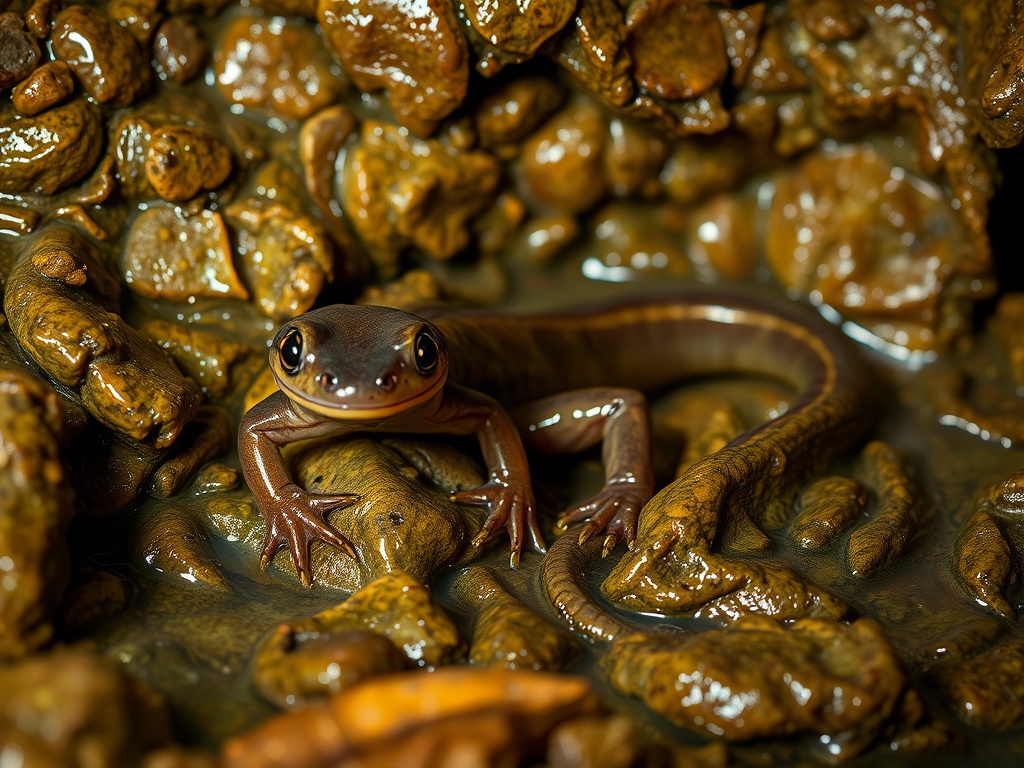
About the Texas Blind Salamander
The Texas blind salamander (Eurycea rathbuni) lives in the water-filled caves and conduits of the Edwards Aquifer beneath San Marcos, Texas, and it has never needed to see. It has no functional eyes at all, only two dark spots buried beneath the skin, and no pigment, so it is a translucent white through which the internal organs are visible; the blood-red external gills that fringe the head, retained for life, are the only colour on it. It is neotenic, meaning it never metamorphoses and never leaves the water, keeping its larval gills and fins into adulthood, which is common among cave salamanders because there is no advantage in a terrestrial adult stage underground. Its head is broad and flattened, its legs disproportionately long and spindly, and it hunts by sweeping its head slowly from side to side, detecting the pressure waves made by the tiny amphipods, snails and blind shrimp that share its aquifer. Its food arrives largely from the surface as organic material washed down through the karst, so the animal depends entirely on what happens on the land above it. It is known from only a handful of caves, sinkholes and artesian wells, and it is federally endangered; a captive assurance population is maintained at the San Marcos Aquatic Resources Center. Groundwater pumping and contamination of the aquifer are its only real threats.
Fascinating facts
No Eyes Needed
The Texas Blind Salamander's eyes are covered by skin and are nonfunctional, making it entirely dependent on other senses to survive.
Specialized Diet
It feeds on tiny aquatic invertebrates, including shrimp, snails, and amphipods found in the underground streams.
Aquifer Specialist
This species is endemic to the Edwards Aquifer system, meaning it is found nowhere else on Earth.
Detailed description
The Texas Blind Salamander (Eurycea rathbuni) is a highly specialized, troglobitic amphibian endemic to the subterranean waters of the Edwards Aquifer in Hays County, Texas. Adults typically measure 8 to 13 centimeters in total length, with a slender, laterally compressed body and reduced, vestigial eyes covered by skin, rendering them functionally blind. Their skin is unpigmented and translucent, often appearing pinkish-white due to visible blood vessels beneath the surface. Prominent feathery external gills, bright red in coloration, project from either side of the head, facilitating gas exchange in the oxygen-poor cave waters. Limbs are relatively short but robust, with four toes on the forelimbs and five on the hindlimbs, less reduced than in some other cave salamanders. The species exhibits paedomorphosis, retaining larval features such as gills and a tail fin throughout life, and does not undergo metamorphosis into a terrestrial adult stage. Texas Blind Salamanders are entirely aquatic, inhabiting deep limestone caves and fissures where sunlight never penetrates. Their sensory systems are highly adapted for life in darkness, relying on mechanoreception and chemoreception to detect prey and navigate their environment. The species is long-lived, with individuals estimated to survive for over ten years in the wild, though precise longevity is not well documented.
Did you know?
Despite living its whole life in total darkness, the Texas Blind Salamander can sense subtle water movements to find prey such as small crustaceans and snails.
Research & sources
Wikipedia summary
The Texas blind salamander is a rare and endangered cave-dwelling troglobite amphibian native to San Marcos, Hays County, Texas, specifically the San Marcos Pool of the Edwards Aquifer. This species resembles the olm, another stygofaunal salamander from Europe. Unlike the olm, this amphibian's body is not as elongated, and also has less reduced digits on its limbs.
Behaviour & social structure
Texas Blind Salamanders are solitary and primarily nocturnal, though the perpetual darkness of their habitat renders traditional diurnal cycles irrelevant. They are sit-and-wait predators, remaining motionless for extended periods and ambushing small aquatic invertebrates such as amphipods, copepods, and insect larvae. Prey detection relies on a combination of chemosensory cues and the lateral line system, which senses minute water vibrations. Feeding occurs year-round, but activity may decrease during periods of low aquifer flow. Social interactions are minimal outside of the breeding season, and individuals maintain loose territories, likely defined by resource availability. Aggressive encounters are rare due to the low population density and limited food resources. The species exhibits low metabolic rates, an adaptation to the nutrient-scarce cave environment, and can survive prolonged periods without food.
Reproduction & life cycle
Reproductive biology in Eurycea rathbuni is not fully understood due to the inaccessibility of its habitat, but available evidence suggests year-round breeding with possible peaks in spring and early summer when water temperatures are stable. Fertilization is internal, as in other plethodontid salamanders, with males depositing spermatophores that are picked up by females. Females lay small clutches of 10–30 eggs, attaching them to submerged rocks or crevices within the cave system. Embryonic development is slow, with hatching occurring after several weeks, depending on water temperature. There is no documented parental care post-oviposition; larvae are independent upon hatching and exhibit the same paedomorphic features as adults. Sexual maturity is reached at approximately 2–3 years of age.
Adaptations & survival
The Texas Blind Salamander displays a suite of morphological and physiological adaptations for subterranean life. These include complete loss of functional eyes, depigmentation, and the retention of external gills for respiration in hypoxic environments. Enhanced chemosensory and mechanosensory systems compensate for the lack of vision, allowing detection of prey and navigation in total darkness. The lateral line system is particularly well-developed, sensitive to subtle water movements. Metabolic rates are significantly reduced, enabling survival in environments with scarce food resources. Paedomorphosis, or the retention of larval traits into adulthood, is an evolutionary specialization that allows the species to remain fully aquatic and exploit the stable cave environment. Limb morphology is adapted for maneuvering through narrow crevices and over uneven substrates.
Cultural significance
The Texas Blind Salamander holds symbolic value as an indicator species for the health of the Edwards Aquifer, a critical water source for central Texas. It is featured in local conservation campaigns and educational programs highlighting the importance of groundwater protection. While not prominent in folklore or mythology, its unique biology and rarity have made it a flagship species for cave and aquifer conservation efforts in the region. The salamander is occasionally referenced in scientific literature and natural history exhibits as an example of extreme adaptation to subterranean environments.
Recent research
Recent research has focused on the genetic diversity and population structure of Eurycea rathbuni, revealing low genetic variability likely due to its isolated habitat. Studies using environmental DNA (eDNA) have improved detection and monitoring of populations without direct disturbance. Investigations into its sensory biology have provided insights into the evolution of cave-dwelling vertebrates, particularly regarding the loss of vision and enhancement of other senses. Ongoing research aims to better understand its reproductive ecology, response to environmental stressors, and potential for captive breeding as a conservation strategy. The species is also studied as a model for paedomorphosis and evolutionary adaptation to extreme environments.
Videos
Habitat
Subterranean freshwater aquifers and caves

Conservation
The Texas Blind Salamander is currently classified as Endangered on the IUCN Red List.
Threats & challenges
The primary threats to Eurycea rathbuni stem from its extremely restricted range and dependence on the Edwards Aquifer. Groundwater depletion due to over-extraction for human use, pollution from agricultural runoff and urbanization, and contamination from chemical spills pose significant risks to water quality and salamander survival. Habitat alteration, such as cave collapse and changes in aquifer hydrology, further threaten the species. The salamander's low reproductive rate and small, fragmented population exacerbate its vulnerability. Climate change may intensify droughts, reducing aquifer recharge and further stressing the population. Conservation efforts are challenged by the inaccessibility of the habitat and the need to balance human water demands with ecosystem preservation. Population trends are difficult to assess, but the species is believed to be declining.
Taxonomy
Scientific name
Eurycea rathbuni
- Kingdom
- Animalia
- Phylum
- Chordata
- Class
- Amphibia
- Order
- Caudata
- Family
- Plethodontidae
- Genus
- Eurycea
- Species
- rathbuni
Community notes
Share your observations about the Texas Blind Salamander.
No community notes yet. Be the first!
Discover more wildlife
More fascinating animals from the encyclopedia.