
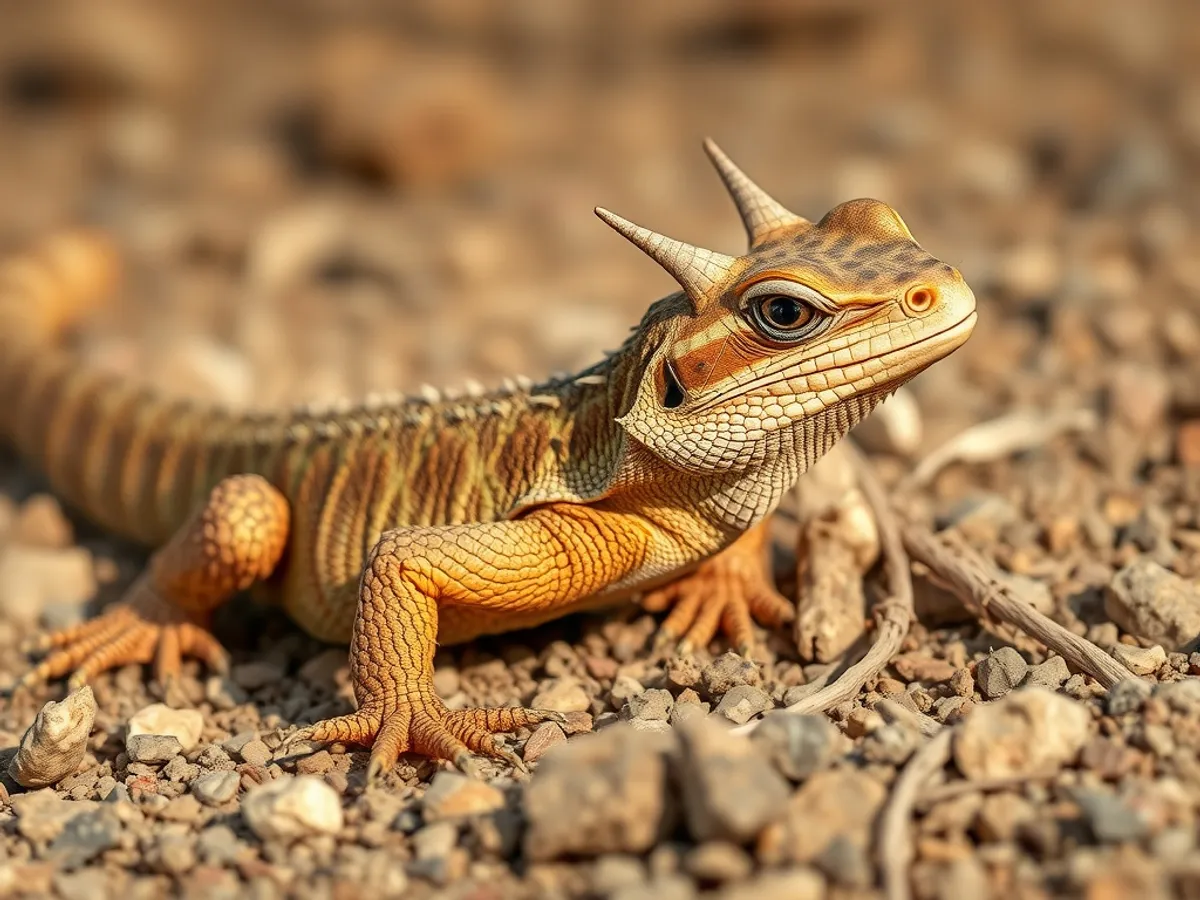
About the Texas Horned Lizard
The Texas horned lizard (Phrynosoma cornutum) is famous for the strangest defence in North American herpetology: it can rupture small sinuses behind its eyes and squirt a jet of its own blood up to about 1.5 metres. This is not a general-purpose weapon. It is aimed almost exclusively at canids and cats, and the blood carries a compound, apparently sourced from the lizard's diet, that tastes foul to them; coyotes and foxes recoil and paw at their mouths, while birds and snakes are unaffected and the lizard does not bother squirting at them. The diet is the other key to the animal. It is an ant specialist, and above all a harvester ant specialist, eating hundreds of ants a day and tolerating a load of formic acid and alkaloid venom that would sicken most lizards, thanks to specialised plasma proteins. That specialisation is now its downfall: invasive red imported fire ants have displaced harvester ants across much of Texas, and broadcast insecticides used against fire ants remove what is left. The lizard's flattened, disc-like body is a solar collector, letting it warm quickly, and fine channels between the scales wick rain and dew across the skin by capillary action, moving water uphill to the corners of the mouth. It is the state reptile of Texas and has declined sharply across its eastern range.
Fascinating facts
Blood-Squirting Defense
When threatened by predators such as canines, the Texas Horned Lizard can shoot a stream of blood from its eyes up to several feet away to confuse and deter attackers.
Ant Specialist
Over 70% of the Texas Horned Lizard's diet consists of ants, particularly harvester ants, making it highly specialized in its feeding habits.
Desert Dweller
This species thrives in dry, open habitats like deserts and grasslands, where its camouflage and spiny body provide protection from predators and extreme environments.
Detailed description
The Texas horned lizard (Phrynosoma cornutum) is a medium-sized, robust lizard, typically measuring 6.5–11.5 cm (2.5–4.5 in) in snout-vent length, with a total length up to 15 cm (6 in). Its most distinctive feature is the crown of sharp, backward-pointing occipital horns on its head, complemented by rows of smaller spines along the body and sides. The dorsal coloration varies from light brown to reddish or gray, often with darker blotches, providing effective camouflage against sandy or rocky substrates. The ventral surface is pale and unmarked. The body is notably flattened and broad, which aids in thermoregulation and predator avoidance. Limbs are short but strong, adapted for rapid burrowing and movement across loose soils. The Texas horned lizard is diurnal and ectothermic, relying on basking to regulate its body temperature. Its eyes are positioned for a wide field of vision, and it possesses a unique defense mechanism: when threatened, it can squirt a stream of blood from the ocular sinuses, deterring predators such as canids. This species is primarily insectivorous, with a strong dietary specialization for harvester ants (Pogonomyrmex spp.), but will also consume beetles, grasshoppers, and other arthropods. The lizard is solitary outside of the breeding season, exhibiting territorial behaviors, and is most active during warm months, with periods of brumation in colder weather.
Did you know?
Despite its fearsome appearance, the Texas Horned Lizard is harmless to humans and relies almost entirely on ants for its diet.
Research & sources
Wikipedia summary
The Texas horned lizard is one of about 21 North American species of spikey-bodied reptiles called horned lizards, all belonging the genus Phrynosoma. It occurs in south-central regions of the US and northeastern Mexico, as well as several isolated introduced records and populations from Southern United States. Though some populations are stable, severe population declines have occurred in many areas of Texas and Oklahoma. The Texas spiny lizard may be confused for a Texas horned lizard due to its appearance and overlapping habitat. Because the Texas horned lizard is listed as a threatened species in the state, it is illegal to pick up, touch, or possess them in Texas.
Behaviour & social structure
Texas horned lizards are generally solitary and exhibit territoriality, especially among males during the breeding season. Their daily activity is strongly influenced by ambient temperature; they emerge in the morning to bask and forage, retreating to shade or burrows during the hottest part of the day. Foraging is primarily sit-and-wait, with the lizard remaining motionless and ambushing passing prey, especially ants. When consuming harvester ants, they use rapid tongue flicks and are resistant to the ants' venom. They may dig shallow burrows for overnight shelter or to escape extreme temperatures. When threatened, they rely first on camouflage and immobility; if approached, they may flatten their bodies, hiss, or inflate themselves to appear larger. The blood-squirting defense is reserved for persistent or canine predators. Social interactions are minimal outside of mating, with occasional intraspecific aggression observed among males.
Reproduction & life cycle
Breeding occurs in late spring to early summer (typically May–June), triggered by increasing temperatures and photoperiod. Males engage in courtship displays, including head-bobbing and circling, to attract females. Texas horned lizards are oviparous; females lay a single clutch per year, containing 13–45 eggs (average 20–30), in a nest chamber excavated 10–15 cm (4–6 in) below the surface. Incubation lasts 40–60 days, depending on soil temperature and moisture. Females provide no parental care after oviposition. Hatchlings emerge in mid to late summer, measuring about 2.5 cm (1 in) snout-vent length, and are independent from birth. Juvenile survival is low due to predation and environmental hazards.
Adaptations & survival
Phrynosoma cornutum exhibits several remarkable adaptations. Its cryptic coloration and spiny morphology provide both camouflage and physical deterrence against predators. The ability to squirt blood from the eyes is a unique defense, involving rupture of small blood vessels in the orbital sinus, which produces a foul-tasting fluid that deters canids and some birds. The lizard's digestive system is highly specialized for processing the chitinous exoskeletons and venom of harvester ants, featuring robust stomach acids and enzymes. Its flattened body aids in heat absorption and allows it to press closely to the ground to avoid detection. Behavioral adaptations include burrowing and selective basking to regulate body temperature, and the ability to remain motionless for extended periods to avoid detection.
Cultural significance
The Texas horned lizard is an iconic symbol of the American Southwest and holds special status as the official state reptile of Texas. It is affectionately known as the 'horned toad' or 'horny toad' in regional folklore, despite being a true lizard. The species features prominently in local mythology, children's stories, and as a mascot for various organizations. Historically, indigenous peoples and early settlers regarded the lizard as a symbol of resilience and adaptation to harsh environments. Its image is used in educational outreach and conservation campaigns, and it remains a cherished emblem of Texas heritage.
Recent research
Recent research has focused on the genetic diversity and phylogeography of Phrynosoma cornutum, revealing distinct population structures and historical range shifts related to Pleistocene climate changes. Studies on its diet have highlighted the lizard's dependence on harvester ants and vulnerability to ant community changes. Ongoing research investigates the physiological mechanisms of blood-squirting and resistance to ant venom. Conservation genetics projects are assessing population connectivity and the effects of habitat fragmentation. Citizen science initiatives and telemetry studies are providing new insights into movement patterns, habitat use, and responses to environmental change.
Videos
Habitat
Arid and semi-arid grasslands, deserts, and scrublands


Conservation
The Texas Horned Lizard is currently classified as Near Threatened on the IUCN Red List.
Threats & challenges
Major threats to the Texas horned lizard include habitat loss and fragmentation due to urbanization, agriculture, and conversion of native grasslands. Widespread use of pesticides has reduced populations of harvester ants, their primary food source. Invasive fire ants (Solenopsis invicta) compete with and displace native ant species, further impacting food availability. Road mortality, illegal collection for the pet trade, and predation by domestic animals also contribute to declines. Although some populations remain stable, significant declines have been documented in Texas and Oklahoma, leading to its listing as a threatened species in Texas. Conservation challenges include restoring native habitats, managing invasive species, and public education to reduce illegal collection.
Taxonomy
Scientific name
Phrynosoma cornutum
- Kingdom
- Animalia
- Phylum
- Chordata
- Class
- Reptilia
- Order
- Squamata
- Family
- Phrynosomatidae
- Genus
- Phrynosoma
- Species
- cornutum
Community notes
Share your observations about the Texas Horned Lizard.
No community notes yet. Be the first!
Discover more wildlife
More fascinating animals from the encyclopedia.