
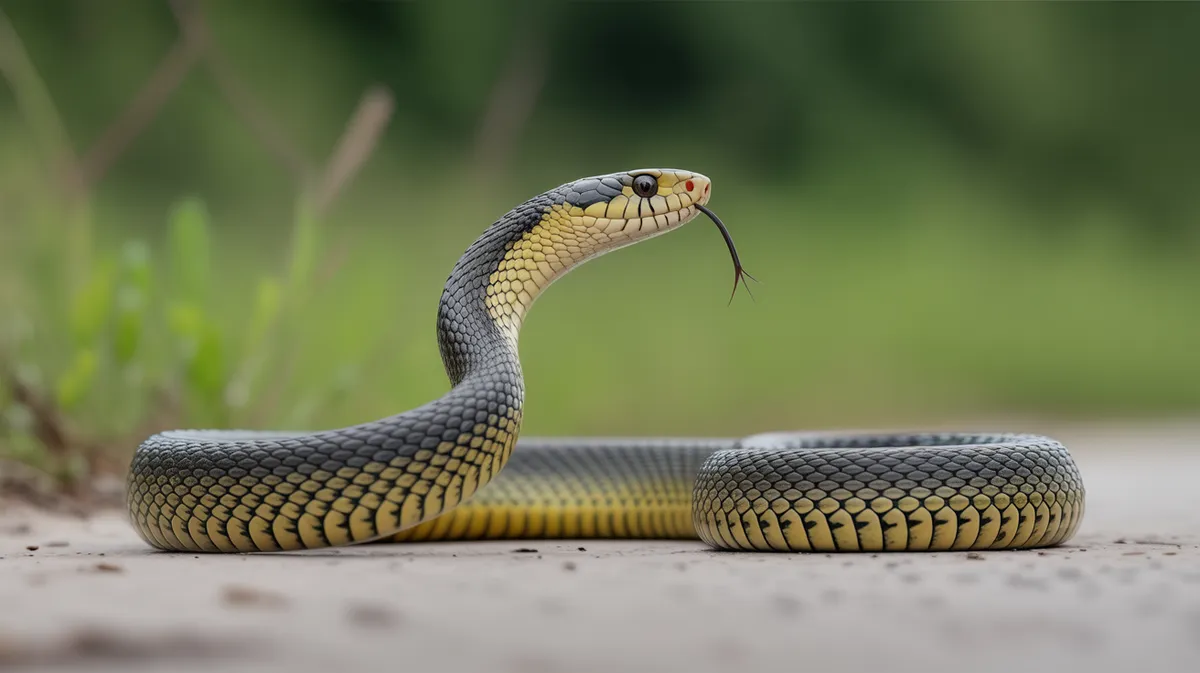
About the Texas Rat Snake
The Texas Rat Snake is a large, nonvenomous colubrid native to the central United States, especially Texas. It is known for its impressive climbing ability and variable coloration, typically ranging from yellowish to tan with dark brown or olive-green blotches. This snake plays a vital ecological role by controlling rodent populations and is commonly found near forests, grasslands, and human settlements. Although it can be defensive and may bite when threatened, the Texas Rat Snake is not dangerous to humans. Its adaptability has made it one of the most widespread snakes in its range.
Fascinating facts
Impressive Climber
Texas Rat Snakes can climb vertical surfaces with ease, including brick walls and trees, in search of food or shelter.
Rodent Control
They primarily eat rodents, birds, and eggs, making them valuable for natural pest control in both wild and suburban environments.
Color Variability
This species exhibits a wide range of color patterns, from yellowish-tan to greenish or dark brown, often with bold blotches.
Detailed description
The Texas rat snake (Pantherophis obsoletus lindheimeri) is a robust, medium-to-large colubrid, with adults typically measuring between 120 and 180 cm (4–6 ft) in total length, though some individuals may exceed 210 cm (7 ft). Its dorsal coloration is highly variable, ranging from yellowish or tan to olive-green, with prominent dark brown or olive blotches running along the back and sides; the ventral surface is usually lighter, often white or cream with irregular black markings. The head is slightly wider than the neck and may display a faint spear-point pattern. Texas rat snakes possess keeled dorsal scales, aiding in locomotion and climbing. Their eyes are relatively large, with round pupils, providing keen vision for both diurnal and nocturnal activity. This species is renowned for its exceptional climbing ability, often found in trees, shrubs, or even scaling vertical surfaces such as brick walls. Texas rat snakes are solitary outside of the breeding season and are primarily terrestrial but readily exploit arboreal and semi-aquatic habitats. They are active from early spring through late fall, with peak activity during warm, humid periods. When threatened, they may vibrate their tails, flatten their heads, and emit a musky odor as defensive behaviors. Despite their sometimes aggressive defensive displays, they are nonvenomous and pose no significant threat to humans.
Did you know?
Despite their sometimes intimidating appearance and defensive behaviors, Texas Rat Snakes are completely nonvenomous and are popular among reptile enthusiasts as pets.
Research & sources
Wikipedia summary
The Texas rat snake is a subspecies of the black rat snake, a nonvenomous colubrid. It is found in the United States, primarily within the state of Texas, but its range extends into Louisiana, Arkansas and Oklahoma. It intergrades with other subspecies of Elaphe obsoleta, so exact range boundaries are impossible to distinguish. The epithet lindheimeri is to honor the German-American naturalist Ferdinand Jacob Lindheimer, who collected the first specimen in New Braunfels, Texas.
Behaviour & social structure
Texas rat snakes are primarily crepuscular, exhibiting peak activity during dawn and dusk, though they may also be active at night in hot weather. They are opportunistic feeders, preying on a wide range of vertebrates including rodents, birds, bird eggs, lizards, and occasionally amphibians. Hunting is typically accomplished via active foraging, using both chemosensory cues (Jacobson’s organ) and visual stimuli to locate prey. They are powerful constrictors, subduing prey with rapid coils before swallowing it whole. Juveniles often climb trees and shrubs in search of small birds and eggs, while adults more frequently hunt terrestrial mammals. Texas rat snakes are solitary, except during the breeding season or when multiple individuals are attracted to abundant food sources. They are known to hibernate communally with other snake species in rock crevices or mammal burrows during colder months. When encountered by predators or humans, they may hiss loudly, strike, or release a foul-smelling musk from their cloacal glands.
Reproduction & life cycle
Breeding occurs in spring, typically from April to June, following emergence from winter dormancy. Males engage in combat rituals to compete for access to females. Courtship involves tactile stimulation and pheromone signaling. Females lay a single clutch per year, usually containing 6–24 leathery eggs, deposited in concealed, humid locations such as rotting logs, leaf litter, or abandoned burrows. Incubation lasts approximately 60–75 days, depending on environmental temperature. Hatchlings measure 28–38 cm (11–15 in) in length and are independent from birth, receiving no parental care. Sexual maturity is reached at 2–4 years of age, with growth rates influenced by food availability and environmental conditions.
Adaptations & survival
Texas rat snakes exhibit several adaptations for survival in diverse habitats. Their strong, muscular bodies and keeled scales facilitate efficient climbing and movement through dense vegetation or rough surfaces. Highly flexible jaws and expandable bodies allow them to consume prey much larger than their head diameter. Their cryptic coloration provides camouflage among leaf litter, tree bark, and grasslands, reducing predation risk. Behavioral adaptations include tail vibration (mimicking rattlesnakes), musking, and head flattening to deter predators. Their broad diet and tolerance of disturbed habitats, including agricultural and suburban areas, have enabled them to thrive despite environmental changes.
Cultural significance
Texas rat snakes are often misunderstood due to their defensive behaviors and superficial resemblance to venomous snakes, leading to unnecessary persecution. However, they play a crucial role in controlling rodent populations, benefiting agriculture and human health. In some local folklore, they are regarded as beneficial 'house snakes' for their pest control services. They are also popular in the pet trade due to their hardiness and striking appearance, though wild-caught specimens may be more defensive than captive-bred individuals. There are no significant mythological or medicinal uses documented, but they contribute to regional biodiversity and ecological balance.
Recent research
Recent genetic studies have clarified the taxonomy of the Pantherophis obsoletus complex, leading to reclassification from the former genus Elaphe. Ongoing research focuses on hybridization zones and intergradation with other rat snake subspecies, as well as the effects of urbanization on movement patterns and population genetics. Studies using radio telemetry have provided insights into home range size, habitat selection, and seasonal activity. There is increasing interest in their role as bioindicators of ecosystem health due to their sensitivity to environmental changes and reliance on diverse prey.
Sources
Systematics of the Eastern Ratsnake Complex (Pantherophis obsoletus complex): Phylogeography and Taxonomic Revision
Burbrink, F.T., Lawson, R., & Slowinski, J.B. (2000)
scientificVideos
Habitat
Forests, grasslands, agricultural areas, and suburban regions
 Various Continental Regions
Grassland
Open areas dominated by grasses rather than trees, supporting numerous herbivores and their predators.
 Elevated Terrain
Mountain
High-altitude environments with varying climates and specialized wildlife adapted to rugged terrain and thin air.
 Global
Forest
Wooded areas with significant tree cover and diverse plant and animal communities.
 Global
Freshwater
Lakes, rivers, and wetlands with diverse aquatic ecosystems.
Conservation
The Texas Rat Snake is currently classified as Least Concern on the IUCN Red List.
Threats & challenges
While currently classified as Least Concern, Texas rat snakes face several localized threats. Habitat loss due to urbanization, agriculture, and road construction can fragment populations and reduce suitable nesting or hibernation sites. They are frequently killed by vehicles or intentionally by humans who mistake them for venomous species. Pesticide use may indirectly affect them by reducing prey availability. Despite these challenges, their adaptability and generalist habits have allowed populations to remain stable in most areas. Ongoing monitoring is recommended, particularly in rapidly developing regions.
Taxonomy
Scientific name
Pantherophis obsoletus lindheimeri
- Kingdom
- Animalia
- Phylum
- Chordata
- Class
- Reptilia
- Order
- Squamata
- Family
- Colubridae
- Genus
- Pantherophis
- Species
- lindheimeri
Community notes
Share your observations about the Texas Rat Snake.
No community notes yet. Be the first!
Discover more wildlife
More fascinating animals from the encyclopedia.