
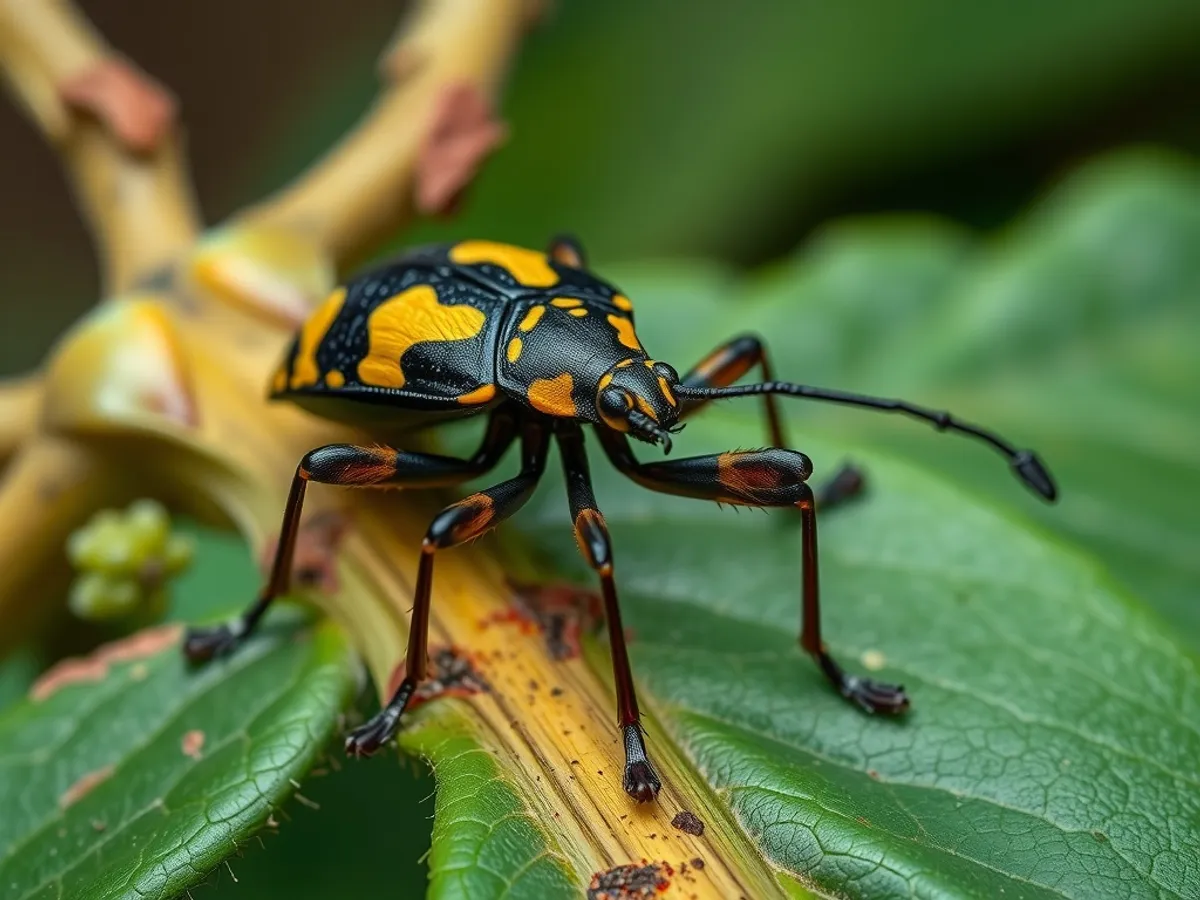
About the Thorn Bug
The thorn bug is a small, distinctive insect known for its pronounced, thorn-like projection extending from its back, which serves as camouflage among plant stems and thorns. Native to Central and South America, it has also established populations in southern Florida and the Caribbean. Thorn bugs are sap-feeding insects that use their needle-like mouthparts to pierce and suck plant juices, often forming colonies on tree branches. While generally harmless, heavy infestations can sometimes damage ornamental or fruit trees. Their unusual appearance and interesting social behaviors make them a subject of fascination among entomologists and nature enthusiasts.
Fascinating facts
Plant Mimicry
The thorn bug’s sharp dorsal spine makes it nearly indistinguishable from a thorn, providing excellent protection from predators.
Maternal Care
Female thorn bugs display maternal care by guarding their eggs and nymphs and warning them of danger through vibrations.
Vibrational Communication
Thorn bugs use substrate-borne vibrations to communicate, coordinating colony activities and warning each other of threats.
Detailed description
Umbonia crassicornis, commonly known as the thorn bug, is a striking member of the treehopper family (Membracidae), easily recognized by its enlarged, thorn-like pronotal projection that can reach up to 7-9 mm in length, often surpassing the body itself. Adults typically measure 8-10 mm in body length and display vibrant coloration, ranging from green and yellow to pink or reddish hues, often with contrasting black markings. This cryptic morphology provides effective camouflage among the thorns and stems of host plants. The species exhibits pronounced sexual dimorphism: females are generally larger and possess a more robust pronotal spine than males. Thorn bugs are gregarious, frequently forming dense aggregations on branches, particularly during the nymphal stages. Their piercing-sucking mouthparts are adapted to extract phloem sap from a wide variety of woody plants, including legumes, citrus, and ornamental trees. Umbonia crassicornis demonstrates complex social behaviors, such as maternal care, where females actively guard their eggs and nymphs from predators and parasitoids. The life cycle comprises egg, five nymphal instars, and adult stages, with development influenced by temperature and host plant quality. The species is native to Central and South America but has expanded its range into the Caribbean and southern Florida, facilitated by human movement of ornamental plants. Its ecological role includes serving as prey for birds, ants, and parasitoid wasps, and as a host for mutualistic ants that harvest honeydew secretions.
Did you know?
Thorn bugs belong to the treehopper family and are closely related to cicadas and leafhoppers.
Research & sources
Behaviour & social structure
Thorn bugs are primarily diurnal, with peak activity during the early morning and late afternoon. They feed by inserting their stylets into plant tissues to access phloem sap, often forming feeding aggregations that can include dozens of individuals. Nymphs and adults communicate through substrate-borne vibrational signals, which are used for mate attraction, alarm, and coordination of group movements. Maternal care is a hallmark of this species: females remain with their egg masses and young nymphs, aggressively defending them against predators such as ants, spiders, and parasitoid wasps. Defensive behaviors include wing flicking, body jerking, and the emission of alarm vibrations. While feeding, thorn bugs excrete excess sap as honeydew, which attracts tending ants; these ants, in turn, provide additional protection against natural enemies. Thorn bugs are sedentary but may disperse to new host plants if food becomes scarce or overcrowding occurs. They are not migratory and tend to remain on the same host plant throughout their development.
Reproduction & life cycle
Reproduction in Umbonia crassicornis involves complex courtship behaviors, including vibrational signaling by males to attract receptive females. Mating typically occurs during the wet season, coinciding with increased plant growth and sap flow. Females lay clusters of 50-100 eggs in slits they cut into young stems or petioles using their ovipositor. The incubation period lasts 10-14 days, depending on ambient temperature. After hatching, nymphs remain clustered near the oviposition site, guarded by the mother for several weeks. Maternal care includes physical defense and the production of vibrational signals to coordinate offspring movement and deter predators. Nymphs undergo five molts (instars) before reaching adulthood, a process that takes 4-6 weeks. There may be multiple overlapping generations per year in tropical climates, with population peaks following the rainy season.
Adaptations & survival
The most conspicuous adaptation of the thorn bug is its hypertrophied, thorn-like pronotum, which provides camouflage and deters visual predators by mimicking plant spines. Their cryptic coloration further enhances concealment. The piercing-sucking mouthparts are specialized for feeding on phloem sap, allowing exploitation of a wide range of woody host plants. Social behaviors, particularly maternal care and vibrational communication, are advanced among treehoppers and increase offspring survival. Mutualistic relationships with ants, mediated by honeydew production, offer additional protection from predators and parasitoids. The ability to rapidly colonize new habitats and host plants has facilitated their range expansion, demonstrating ecological flexibility.
Cultural significance
While Umbonia crassicornis does not have a prominent role in folklore or traditional medicine, its unusual appearance has made it a subject of fascination among naturalists, educators, and artists. In some regions, it is featured in educational materials to illustrate insect camouflage, maternal care, and plant-insect interactions. Its presence in gardens and parks sometimes leads to concern among horticulturists, but it is generally regarded as a minor pest. The thorn bug's striking form has inspired biomimetic designs and is occasionally referenced in popular science media.
Recent research
Recent research on Umbonia crassicornis has focused on its vibrational communication system, revealing complex signaling used in mate attraction, maternal care, and predator defense. Studies have demonstrated that maternal care significantly increases offspring survival by deterring predators and parasitoids. Genetic analyses have explored population structure and dispersal patterns, particularly in introduced regions such as Florida. Ongoing research investigates the ecological impacts of thorn bug infestations on ornamental and fruit crops, as well as the dynamics of mutualistic relationships with tending ants. The species serves as a model organism for studying the evolution of social behavior and communication in insects.
Sources
Maternal Care and Sibling Cooperation in the Neotropical Treehopper Umbonia crassicornis
Cocroft, R.B. (1996)
scientificVibrational Communication and the Coordination of Social Behavior in Umbonia crassicornis
Cocroft, R.B. & Hamel, J.A. (2010)
scientificVibrational Communication and the Coordination of Social Behavior in Umbonia crassicornis
Cocroft, R.B., Hamel, J.A. (2010)
scientificMaternal Care in Umbonia crassicornis (Hemiptera: Membracidae) and Its Effect on Offspring Survival
Cocroft, R.B. (2002)
scientificVideos
Habitat
Tropical and subtropical forests, gardens, and woodlands

Conservation
The Thorn Bug is currently classified as Least Concern on the IUCN Red List.
Threats & challenges
Currently, Umbonia crassicornis is not considered threatened and is classified as Least Concern. Its populations are stable across its native and introduced ranges. However, localized outbreaks can occur, particularly in ornamental or fruit tree plantings, where heavy infestations may cause branch dieback or reduced fruit yield. Natural enemies, including predatory insects, birds, and parasitoid wasps, regulate populations. Pesticide use in managed landscapes can disrupt these natural controls and occasionally lead to secondary pest outbreaks. Habitat loss and climate change may alter the distribution of host plants and natural enemies, potentially impacting future population dynamics, but no significant declines have been documented.
Taxonomy
Scientific name
Umbonia crassicornis
- Kingdom
- Animalia
- Phylum
- Arthropoda
- Class
- Insecta
- Order
- Hemiptera
- Family
- Membracidae
- Genus
- Umbonia
- Species
- crassicornis
Community notes
Share your observations about the Thorn Bug.
No community notes yet. Be the first!
Discover more wildlife
More fascinating animals from the encyclopedia.