
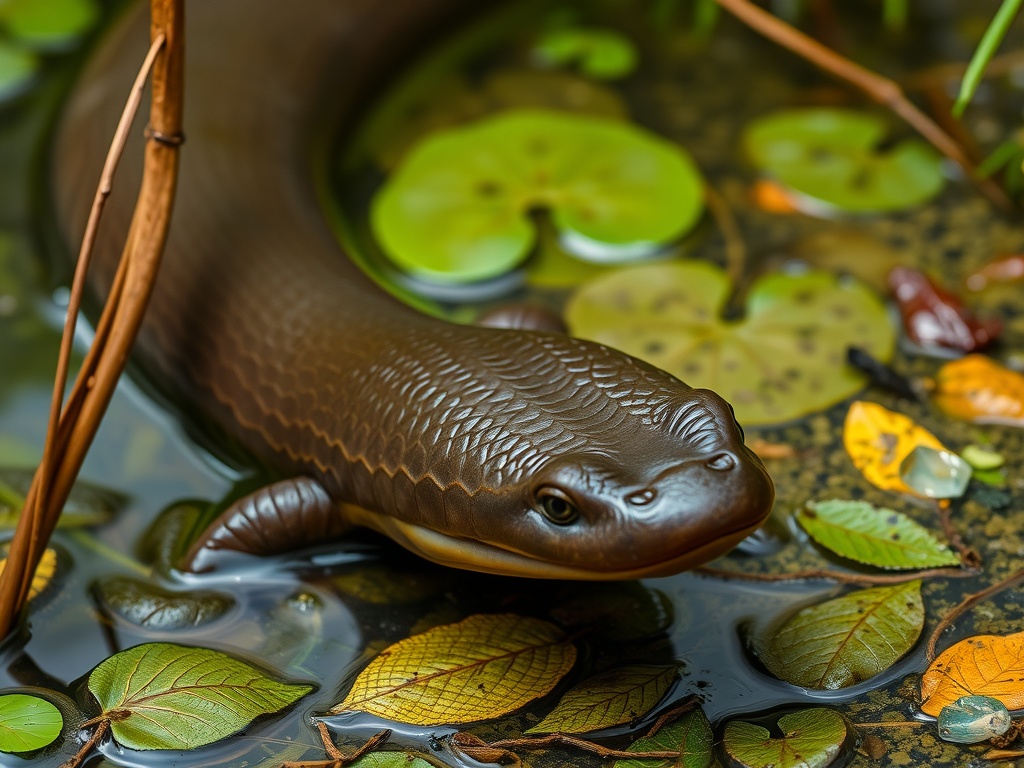
About the Three-toed Amphiuma
The Three-toed Amphiuma is a large, eel-like aquatic salamander native to the southeastern United States. Distinguished by its long, cylindrical body and tiny, vestigial limbs with three toes on each foot, it often grows up to 1 meter in length. Despite its snake-like appearance, it is a true amphibian and spends most of its life in slow-moving or stagnant freshwater environments. Nocturnal and secretive, the Three-toed Amphiuma rarely emerges from the water and is well-adapted to muddy, vegetated swamps and bayous.
Fascinating facts
Tiny Limbs
Despite reaching up to a meter in length, the Three-toed Amphiuma's legs are extremely small and functionless for walking.
Nocturnal Hunter
It usually hunts at night, preying on fish, insects, crustaceans, and even other amphibians.
Powerful Jaws
The Three-toed Amphiuma can inflict a painful bite with its strong jaws if handled or threatened.
Detailed description
The Three-toed Amphiuma (Amphiuma tridactylum) is among the largest extant salamanders in North America, with adults typically measuring 46–102 cm (18–40 in) in total length and weighing up to 1.5 kg. Its body is elongated, cylindrical, and laterally compressed, giving it an eel-like appearance, while the skin is smooth, slimy, and dark gray to brownish-black, sometimes with a lighter ventral surface. The most distinctive anatomical feature is its extremely reduced limbs, each ending in three minute toes—a trait unique among North American amphibians. The head is broad and flattened, with small, lidless eyes and a large mouth lined with sharp, recurved teeth. Amphiumas possess both lungs and gills during early development, but adults retain only rudimentary gill slits and rely primarily on lungs for respiration, surfacing periodically to gulp air. Their lateral line system is well-developed, aiding in the detection of vibrations and movement in turbid waters. The skin contains numerous mucous glands, which help prevent desiccation and facilitate cutaneous respiration. Nocturnal by nature, A. tridactylum spends daylight hours hidden in submerged debris, burrows, or dense aquatic vegetation. It is a solitary species, exhibiting territorial behavior, and is capable of producing vocalizations such as clicks and squeaks, especially when disturbed. The species is long-lived, with individuals in captivity surviving over 20 years.
Did you know?
Unlike most salamanders, the Three-toed Amphiuma retains both lungs and gills as a juvenile but loses its external gills as it matures, becoming almost entirely aquatic as an adult.
Research & sources
Wikipedia summary
Amphiuma tridactylum, the three-toed amphiuma, is a species of aquatic salamander native to the Southeastern United States.
Behaviour & social structure
Three-toed Amphiumas are primarily nocturnal and secretive, emerging from their refuges at night to forage. They are opportunistic carnivores, preying on a variety of aquatic organisms including fish, crayfish, insects, annelids, mollusks, tadpoles, and even small amphibians and reptiles. Hunting is typically ambush-based: the amphiuma remains motionless, sensing prey via its lateral line, then rapidly lunges and grasps the target with its powerful jaws. Feeding is facilitated by a strong bite and suction, and prey is often swallowed whole. Cannibalism has been observed, especially in crowded or resource-limited environments. Social interactions are minimal outside of the breeding season, and individuals may display aggressive behaviors such as biting if confined together. During periods of drought or low water, amphiumas can aestivate by burrowing into mud, reducing metabolic activity and surviving for months until conditions improve. They are capable of producing defensive vocalizations and may bite if handled.
Reproduction & life cycle
Breeding in Amphiuma tridactylum typically occurs from late winter to early spring (December to May), though timing may vary with latitude and local climate. Courtship involves tactile and chemical cues, with males and females engaging in brief physical contact. Fertilization is internal: the male deposits a spermatophore, which the female picks up with her cloaca. Females lay between 100 and 200 eggs in a single clutch, depositing them in moist cavities or burrows adjacent to water, often under logs or debris. The female coils around the eggs and provides parental care by guarding and keeping them moist until hatching, which occurs after 4–5 months depending on temperature and humidity. Larvae are fully aquatic, possessing external gills, and undergo a slow metamorphosis over several months. Unlike many salamanders, amphiumas do not have a free-swimming larval stage; juveniles resemble miniature adults and are independent upon hatching.
Adaptations & survival
The Three-toed Amphiuma exhibits several remarkable adaptations for an aquatic, low-oxygen, and often ephemeral habitat. Its reduced limbs and streamlined body enable efficient movement through dense vegetation and muddy substrates. The lateral line system allows detection of prey and predators in dark or murky water. Cutaneous and pulmonary respiration facilitate survival in hypoxic environments, and the ability to aestivate in mud enables persistence through droughts. Mucous secretion reduces water loss and provides a slippery defense against predators. The powerful jaws and sharp teeth are specialized for grasping and consuming a wide variety of prey, including hard-shelled crustaceans. The species’ tolerance for a broad range of water qualities, including low dissolved oxygen and high turbidity, is a key evolutionary advantage in unstable wetland environments.
Cultural significance
The Three-toed Amphiuma has limited direct cultural significance, but it has occasionally appeared in local folklore and is sometimes mistaken for snakes or eels due to its appearance. In some southern U.S. communities, amphiumas have been referred to as 'congo eels' or 'ditch eels.' They have been used in scientific research on amphibian physiology, particularly studies of respiration, osmoregulation, and muscle function. There are no known traditional medicinal or culinary uses, and the species is not considered of economic importance.
Recent research
Recent research on Amphiuma tridactylum has focused on its remarkable regenerative abilities, including the capacity to heal wounds and regenerate tail tissue. Studies have also examined its genome, revealing insights into the evolution of limb reduction and adaptation to aquatic life. Ecological research has highlighted the amphiuma’s role as a top invertebrate predator in wetland ecosystems, influencing community structure and nutrient cycling. Ongoing studies are investigating the effects of environmental contaminants and habitat alteration on population health and reproductive success. Advances in telemetry and environmental DNA (eDNA) techniques are improving detection and monitoring of wild populations.
Videos
Habitat
Slow-moving freshwater swamps, bayous, sloughs, and ditches


Conservation
The Three-toed Amphiuma is currently classified as Least Concern on the IUCN Red List.
Threats & challenges
Currently classified as Least Concern by the IUCN, the Three-toed Amphiuma faces localized threats from habitat destruction, wetland drainage, water pollution (including pesticides and heavy metals), and fragmentation due to agricultural and urban development. Road mortality and collection for the pet trade or scientific research may also impact some populations. Amphiumas are sensitive to changes in hydrology and water quality, making them vulnerable to long-term environmental degradation. Climate change, with its potential to alter precipitation patterns and increase drought frequency, poses an emerging threat. However, the species’ wide distribution and adaptability to disturbed habitats have so far prevented significant population declines.
Taxonomy
Scientific name
Amphiuma tridactylum
- Kingdom
- Animalia
- Phylum
- Chordata
- Class
- Amphibia
- Order
- Urodela
- Family
- Amphiumidae
- Genus
- Amphiuma
- Species
- tridactylum
Community notes
Share your observations about the Three-toed Amphiuma.
No community notes yet. Be the first!
Discover more wildlife
More fascinating animals from the encyclopedia.