
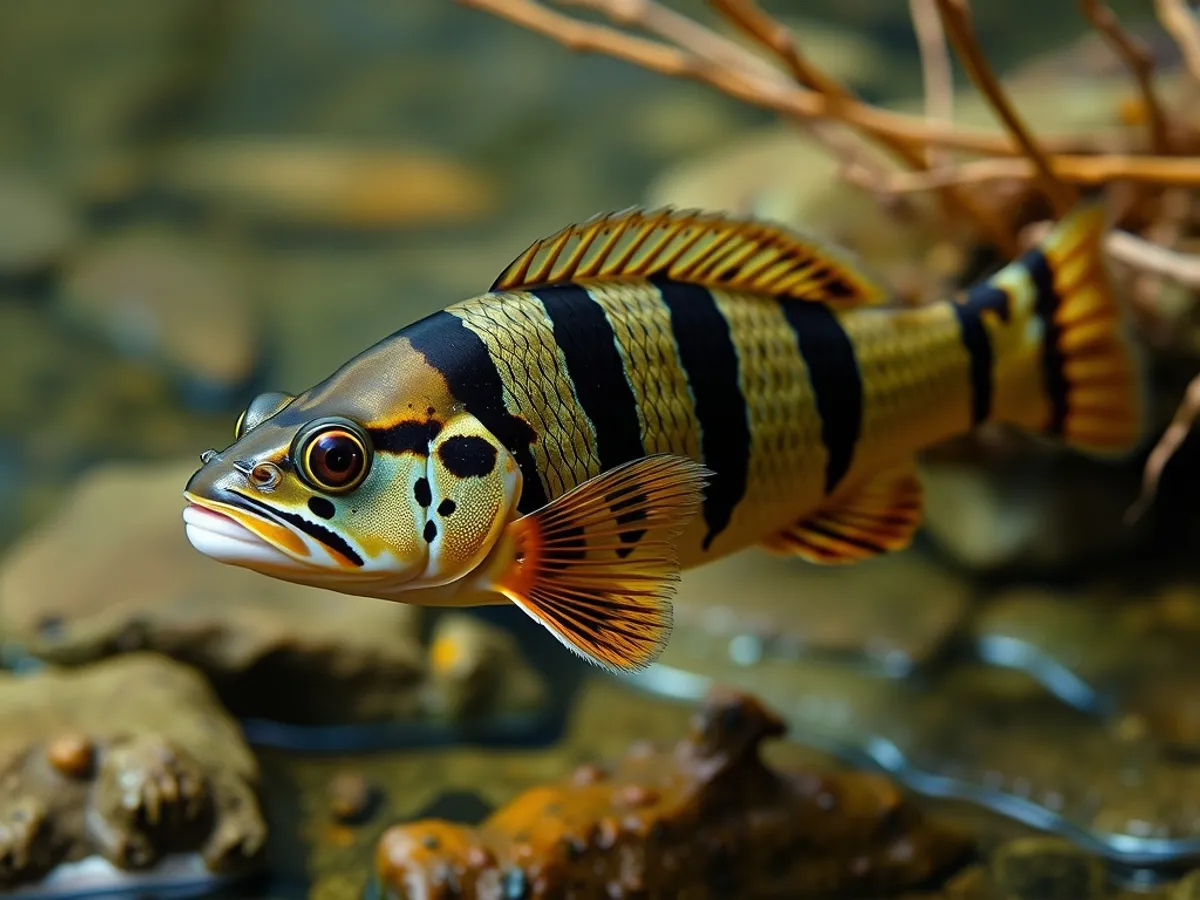
About the Tiger Barb
The tiger barb is a small, lively freshwater fish native to Southeast Asia, recognized for its striking orange-gold coloration and bold black vertical stripes that resemble those of a tiger. Typically found in clear, slow-moving streams and swamps, these fish are highly social and best kept in groups. Tiger barbs are known for their energetic swimming and sometimes fin-nipping tendencies, making them popular yet sometimes challenging aquarium inhabitants. They are hardy and adaptable, thriving in a variety of water conditions when provided with a well-planted environment.
Fascinating facts
Dynamic Swimmers
Tiger barbs are extremely active and spend much of their time darting around the middle layers of the water column.
Color Variations
Selective breeding has resulted in several color morphs, including green, albino, and long-finned varieties.
Social Structure
They thrive in groups of six or more, which helps reduce aggressive tendencies and encourages natural shoaling behavior.
Detailed description
The Tiger Barb (Puntigrus tetrazona) is a small, robust cyprinid fish, typically reaching 6–7 cm in standard length, with a deep, laterally compressed body. Its most distinctive feature is the presence of four bold, black vertical bands set against a shimmering gold to orange background, with red or orange tinges on the snout, fins, and ventral region. The dorsal fin is pointed and edged in black, while the pelvic and anal fins often display a reddish hue. Tiger Barbs possess a terminal mouth with no barbels, and their scales are relatively large and reflective. In the wild, they inhabit clear or turbid, slow-moving streams, rivers, and swampy areas rich in submerged vegetation. Social by nature, they form shoals of 5–20 individuals, exhibiting complex hierarchies and frequent intraspecific interactions. Their energetic swimming style and tendency for fin-nipping are well-documented, especially in confined or understocked environments. Tiger Barbs are omnivorous, feeding on a variety of invertebrates, plant material, and detritus. Sexual dimorphism is subtle, with females generally larger and rounder, especially when gravid. Reproduction is oviparous, with external fertilization and no parental care. Their adaptability to a range of water parameters and striking appearance have made them a staple in the aquarium trade worldwide.
Did you know?
Despite their small size, tiger barbs can dominate community tanks if not kept in proper shoals, often outcompeting larger fish for food and space.
Research & sources
Wikipedia summary
The tiger barb or Sumatra barb, is a species of tropical cyprinid fish. The natural geographic range reportedly extends throughout the Malay Peninsula, Sumatra and Borneo in Indonesia, with unsubstantiated sightings reported in Cambodia. Tiger barbs are also found in many other parts of Asia, and with little reliable collection data over long periods of time, definite conclusions about their natural geographic range versus established introductions are difficult. Tiger barbs may sometimes be confused with Puntigrus anchisporus, Puntigrus navjotsodhii, or Puntigrus partipentazona, which are similar in appearance, the only differences being the slightly different stripe pattern and the number of scales these fish have.
Behaviour & social structure
Tiger Barbs are diurnal, displaying peak activity during daylight hours. In the wild and in captivity, they are highly social, forming dynamic shoals where dominance hierarchies are established through displays and minor aggression. Fin-nipping, a common behavior, is thought to be both a social interaction and a feeding strategy, targeting the fins of slower or weaker individuals. They exhibit schooling behavior for protection against predators and to increase foraging efficiency. Feeding is opportunistic: they consume aquatic insects, crustaceans, algae, and organic detritus, often foraging near the substrate and among aquatic plants. Tiger Barbs communicate through body posturing, color changes, and rapid darting movements. In aquaria, they may become more aggressive if kept in small groups, but aggression is diffused in larger shoals (6 or more individuals). They are known for their curiosity and will investigate new objects or changes in their environment.
Reproduction & life cycle
Tiger Barbs are egg scatterers, with spawning typically triggered by rising water temperatures and increased daylight, mimicking the onset of the rainy season in their native range. Courtship involves males chasing and displaying to females, often in dense vegetation or over fine-leaved plants. Females can lay between 200 and 500 adhesive eggs per spawning event, which are fertilized externally by the male. Incubation lasts 24–36 hours at optimal temperatures (26–28°C), after which larvae become free-swimming within 3–5 days. There is no parental care; adults may consume eggs and fry if not separated. Sexual maturity is reached at 6–7 months under favorable conditions. In the wild, breeding is likely seasonal, coinciding with increased food availability and optimal water conditions.
Adaptations & survival
Tiger Barbs have evolved several adaptations for survival in variable freshwater environments. Their laterally compressed bodies and strong pectoral fins allow for agile maneuvering among dense aquatic vegetation. The conspicuous banding pattern provides disruptive camouflage, breaking up their outline and confusing predators. Social shoaling reduces individual predation risk and enhances foraging success. Their omnivorous diet and robust digestive system enable them to exploit a wide range of food sources, from animal prey to plant matter. Behavioral plasticity, such as adjusting aggression and social structure based on group size and environmental complexity, contributes to their resilience in both wild and captive settings.
Cultural significance
Tiger Barbs have no major role in traditional folklore or mythology but are highly significant in the global aquarium trade, where they have been popular since the mid-20th century. Their striking appearance and active behavior have made them a favorite among hobbyists, and selective breeding has produced several color morphs, including albino, green, and long-finned varieties. In some regions, they are used in educational settings to teach principles of animal behavior and social dynamics. There are no known traditional medicinal or culinary uses.
Recent research
Recent research has focused on the social behavior and aggression modulation in Tiger Barbs, particularly the effects of group size and environmental enrichment on fin-nipping and stress levels. Genetic studies have clarified the taxonomy of the Puntigrus genus, distinguishing P. tetrazona from closely related species based on mitochondrial DNA and morphometric analyses. Ongoing studies are investigating the ecological impact of introduced populations and the potential for hybridization with related species. Advances in captive breeding have improved understanding of reproductive physiology and larval development, contributing to more sustainable aquarium trade practices.
Videos
Habitat
Freshwater streams, rivers, and swamps


Conservation
The Tiger Barb is currently classified as Least Concern on the IUCN Red List.
Threats & challenges
Currently assessed as Least Concern by the IUCN, wild populations of Tiger Barbs face localized threats from habitat degradation, pollution, and overharvesting for the aquarium trade. Deforestation and conversion of wetlands for agriculture in Southeast Asia have led to the loss and fragmentation of natural habitats. Water pollution from agricultural runoff and urbanization poses additional challenges. However, their wide distribution, adaptability, and extensive captive breeding have mitigated significant population declines. Introduced populations in non-native areas may disrupt local ecosystems, but there is limited evidence of major ecological impact.
Taxonomy
Scientific name
Puntigrus tetrazona
- Kingdom
- Animalia
- Phylum
- Chordata
- Class
- Actinopterygii
- Order
- Cypriniformes
- Family
- Cyprinidae
- Genus
- Puntigrus
- Species
- tetrazona
Community notes
Share your observations about the Tiger Barb.
No community notes yet. Be the first!
Discover more wildlife
More fascinating animals from the encyclopedia.