
About the Tiger Moth
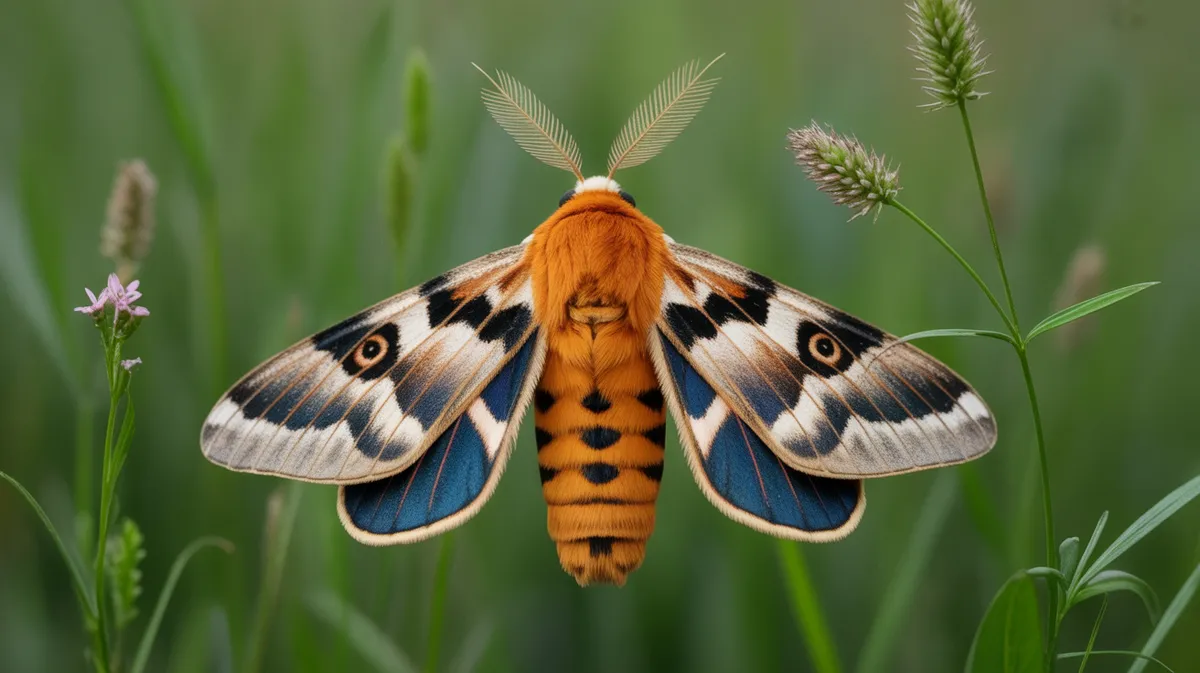
The Tiger Moth is a strikingly colorful invertebrate known for its bold patterns of orange, white, and black on its wings. Its vibrant appearance serves as a warning to predators about its unpalatability, thanks to toxins accumulated from its larval host plants. Tiger Moth caterpillars, often called 'woolly bears,' are covered in dense, bristly hairs. These moths are primarily nocturnal and are attracted to light, making them a common sight around outdoor lamps in their native habitats. Their adaptability allows them to thrive in a variety of environments, from temperate forests to gardens and grasslands.
Fascinating facts
Bristly Caterpillars
Tiger Moth larvae, or woolly bears, have dense, spiky hairs that can irritate skin and provide protection from predators.
Warning Colors
The bold coloration of the Tiger Moth warns predators that it is toxic or distasteful, a defense mechanism called aposematism.
Bat Jamming
Adult Tiger Moths can produce ultrasonic sounds that disrupt bat echolocation, reducing the chance of being caught.
Detailed description
The Garden Tiger Moth (Arctia caja) is a medium-to-large member of the family Erebidae, with a wingspan ranging from 45 to 65 mm. Its forewings are chocolate brown with bold white patches, while the hindwings are bright orange-red adorned with striking blue-black spots, a coloration that serves as an aposematic warning to potential predators. The moth's body is robust, covered in fine setae, and its head bears feathery antennae, which are more pronounced in males. The caterpillar, commonly known as the 'woolly bear,' is densely covered in long, dark brown to black hairs interspersed with orange bands, which can cause mild skin irritation in some humans. Adults are primarily nocturnal and are active from June to August in temperate regions. They are strong fliers and are frequently attracted to artificial lights at night. The larvae feed on a wide variety of herbaceous plants, including nettles, dock, and dandelion, contributing to their adaptability across diverse habitats. The adult moths do not feed, relying on energy reserves accumulated during the larval stage. Their life cycle consists of complete metamorphosis: egg, larva, pupa, and adult, with overwintering typically occurring in the pupal stage.
Did you know?
Some Tiger Moth species can not only hear bat echolocation but also respond with their own ultrasonic signals to deter attack.
Research & sources
Wikipedia summary
The de Havilland DH.82 Tiger Moth is a 1930s British biplane designed by Geoffrey de Havilland and built by the de Havilland Aircraft Company. It was operated by the Royal Air Force (RAF) and other operators as a primary trainer aircraft. In addition to the type's principal use for ab initio training, the Second World War had RAF Tiger Moths operating in other capacities, including maritime surveillance and defensive anti-invasion preparations; some aircraft were even outfitted to function as armed light bombers.
Behaviour & social structure
Tiger Moths are solitary creatures, with both larvae and adults exhibiting largely independent behavior. Larvae are voracious feeders, often consuming a wide range of host plants to accumulate defensive toxins such as pyrrolizidine alkaloids. When threatened, caterpillars may curl into a tight ball, exposing their bristly hairs as a deterrent. Adult moths, although short-lived (typically surviving only a few weeks), engage in rapid, erratic flight patterns to evade predators. Both larvae and adults utilize chemical defenses: adults can excrete a yellow fluid from their thoracic glands when handled, which contains distasteful compounds. The moth's aposematic coloration is reinforced by its ability to produce ultrasonic clicks via tymbal organs, which can jam bat echolocation and serve as an acoustic warning signal. Daily activity is primarily nocturnal, with adults resting in concealed locations during daylight hours.
Reproduction & life cycle
Mating in Arctia caja is initiated by pheromone communication, with females releasing sex pheromones to attract males over considerable distances. Courtship is brief, and copulation typically occurs at night. Females lay clusters of several hundred eggs on the undersides of suitable host plants. The eggs hatch within 7–14 days, depending on temperature. Larvae undergo five to six instars over a period of 4–8 weeks, growing rapidly as they feed. Pupation occurs in a loose cocoon constructed from larval hairs and silk, usually at ground level among leaf litter. The species is univoltine in most of its range, producing one generation per year, with pupae overwintering and adults emerging the following summer. There is no parental care beyond egg-laying.
Adaptations & survival
Arctia caja exhibits several notable adaptations for survival. Its vivid coloration (aposematism) warns predators of its chemical defenses, which are sequestered from toxic host plants during the larval stage. The dense setae on larvae deter predation and can cause irritation to vertebrate predators. Adults possess tymbal organs that generate ultrasonic clicks, which have been shown to interfere with bat echolocation, reducing predation risk. The species' polyphagous larval diet allows it to exploit a wide range of habitats and food sources, contributing to its ecological success. Overwintering as a pupa enables survival through harsh climates, and the ability to fly at night reduces competition and predation.
Cultural significance
The Tiger Moth has featured in folklore and popular culture, often symbolizing transformation and resilience due to its dramatic metamorphosis and striking appearance. The 'woolly bear' caterpillar is the subject of weather lore in North America, where the width of its orange band is said to predict the severity of the coming winter—a belief not supported by science. The moth's vivid patterns have inspired artists and naturalists alike, and it is a popular subject for educational outreach about insect life cycles and biodiversity.
Recent research
Recent studies have focused on the molecular basis of aposematism and chemical defense in Arctia caja, revealing the sequestration and modification of plant-derived alkaloids. Research into the moth's ultrasonic clicking has provided insights into predator-prey coevolution, particularly in the context of bat-moth interactions. Population genetics studies are ongoing to assess the impact of habitat fragmentation on genetic diversity. Additionally, the species is used as a model organism in studies of lepidopteran development and phenotypic plasticity.
Videos
Habitat
Temperate forests, meadows, gardens, and grasslands


Conservation
The Tiger Moth is currently classified as Least Concern on the IUCN Red List.
Threats & challenges
Although currently listed as Least Concern, Arctia caja populations have shown declines in parts of Europe, attributed to habitat loss, agricultural intensification, and pesticide use. Light pollution may disrupt nocturnal behaviors and mating. Climate change poses a potential threat by altering the distribution of suitable habitats and host plants. In some regions, the species is considered a garden pest due to larval feeding on ornamental plants, occasionally leading to targeted control measures. However, its broad ecological tolerance and high reproductive output help buffer against localized declines.
Taxonomy
Scientific name
Arctia caja
- Kingdom
- Animalia
- Phylum
- Arthropoda
- Class
- Insecta
- Order
- Lepidoptera
- Family
- Erebidae
- Genus
- Arctia
- Species
- caja
Community notes
Share your observations about the Tiger Moth.
No community notes yet. Be the first!
Discover more wildlife
More fascinating animals from the encyclopedia.