
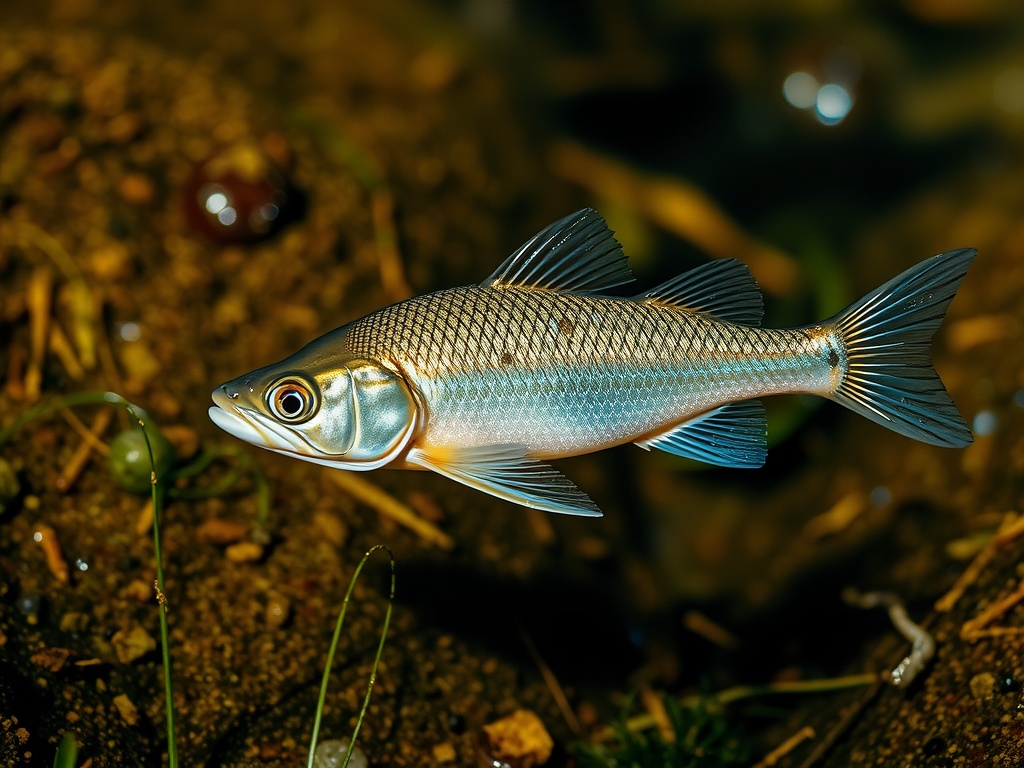
About the Tinfoil Barb
The tinfoil barb is a large, striking freshwater fish native to Southeast Asia, easily recognized by its silvery body and bright red or orange-tipped fins. Growing up to 35 cm (14 inches) in length, it is a popular species in the aquarium trade due to its hardiness and vibrant appearance. In the wild, tinfoil barbs are schooling fish found in rivers, streams, and flooded forests, often forming large groups. They are fast swimmers and require ample space when kept in captivity, as they are very active and social.
Fascinating facts
Grows Large
Tinfoil barbs can reach up to 35 cm (14 inches) in length, making them much larger than most typical aquarium fish.
Schooling Fish
In the wild, tinfoil barbs are highly social and form large schools, which helps them stay safe from predators.
Shimmering Scales
Their name comes from their shiny, metallic scales that reflect light, giving them a tinfoil-like appearance.
Detailed description
The tinfoil barb (Barbonymus schwanenfeldii) is a robust, deep-bodied cyprinid fish, typically reaching lengths of 25–35 cm (10–14 inches), though some individuals may grow larger in optimal conditions. Its most distinctive features are its metallic, silvery scales that reflect light, giving a 'tinfoil' appearance, and its vividly colored fins—dorsal, caudal, anal, and pelvic fins are often tinged with red or orange, sometimes with black markings. The head is relatively small with a terminal mouth, adapted for omnivorous feeding. Tinfoil barbs possess a forked caudal fin and a streamlined body, facilitating rapid swimming in strong currents. They are highly social, forming large, cohesive schools in the wild, which provides protection from predators and enhances foraging efficiency. Their lateral line is well-developed, aiding in navigation and schooling behavior. In their native habitats, they inhabit a variety of freshwater environments, including large rivers, floodplains, and seasonally inundated forests, often migrating with seasonal water level changes. Juveniles and adults may display subtle differences in coloration and fin shape, with mature individuals exhibiting more pronounced hues. Their lifespan in captivity can exceed 10 years with proper care, while wild longevity is less well documented.
Did you know?
Despite their popularity in aquariums, tinfoil barbs can live for over a decade and reach sizes that surprise many first-time owners.
Research & sources
Wikipedia summary
The tinfoil barb is a tropical Southeast Asian freshwater fish of the family Cyprinidae. This species was originally described as Barbus schwanenfeldii by Pieter Bleeker in 1853, and has also been placed in the genera Barbodes and Puntius. The specific epithet is frequently misspelled schwanefeldii.
Behaviour & social structure
Tinfoil barbs are diurnal and highly active, spending much of the day swimming in midwater or near the surface in search of food. Their omnivorous diet includes aquatic plants, algae, detritus, small invertebrates, and occasionally fish eggs or fry. In the wild, they often graze on submerged vegetation and organic debris, contributing to ecosystem nutrient cycling. Schooling is a dominant behavioral trait; individuals maintain close proximity to conspecifics, using visual and lateral line cues to coordinate movement and avoid predation. When startled, the school may scatter rapidly, only to regroup moments later. In captivity, they exhibit similar schooling tendencies and may become stressed or display abnormal behaviors if kept singly or in small groups. Feeding is opportunistic, and they may display competitive behaviors during feeding times, but overt aggression is rare except in overcrowded conditions.
Reproduction & life cycle
Barbonymus schwanenfeldii is an open-water, group-spawning species with no parental care. Spawning typically coincides with the onset of the rainy season, when rising water levels trigger reproductive activity. Females are batch spawners, releasing thousands of adhesive eggs into the water column, which then settle among submerged vegetation or debris. Males fertilize the eggs externally. Incubation is rapid, with eggs hatching within 24–36 hours at optimal temperatures (about 26–28°C). Larvae are free-swimming shortly after hatching and begin feeding on plankton and microinvertebrates. There is no evidence of nest building or brood guarding; survival of offspring depends on rapid growth and avoidance of predation. Sexual maturity is typically reached at 2–3 years of age, depending on environmental conditions.
Adaptations & survival
The tinfoil barb exhibits several adaptations for life in dynamic freshwater systems. Its streamlined body and powerful fins enable sustained swimming in fast-flowing rivers. The reflective scales may serve as camouflage, disrupting the outline of the fish and confusing predators. A well-developed lateral line system allows detection of water movement and facilitates precise schooling behavior. As an omnivore, its terminal mouth and pharyngeal teeth are adapted for a varied diet, allowing exploitation of diverse food sources. The species' ability to tolerate a wide range of water conditions, including variable pH and dissolved oxygen levels, contributes to its ecological success and popularity in the aquarium trade.
Cultural significance
The tinfoil barb holds moderate cultural significance in Southeast Asia, where it is sometimes consumed as a food fish, though its bony flesh limits its commercial value. Its striking appearance and peaceful nature have made it a staple in the ornamental fish trade worldwide. In some local traditions, brightly colored fish like the tinfoil barb are considered symbols of prosperity and good fortune. However, there are no widespread myths or folklore specifically associated with this species.
Recent research
Recent research has focused on the species' role in freshwater ecosystem dynamics, particularly its impact on aquatic vegetation and nutrient cycling. Genetic studies have clarified its taxonomic position within the Barbonymus genus and highlighted historical confusion with closely related species. Investigations into captive breeding have improved understanding of its reproductive biology, aiding sustainable aquaculture and reducing pressure on wild populations. Studies on invasive populations outside its native range are ongoing, examining ecological impacts and management strategies. The species is also used as a model organism for studying schooling behavior and fish physiology.
Videos
Habitat
Freshwater rivers and streams


Conservation
The Tinfoil Barb is currently classified as Least Concern on the IUCN Red List.
Threats & challenges
Currently assessed as Least Concern by the IUCN, the tinfoil barb faces localized threats from overfishing for the aquarium trade, habitat degradation due to dam construction, pollution, and deforestation in parts of its range. While populations remain stable in many areas, fragmentation of river systems and loss of floodplain habitats could pose future risks. Introduction to non-native habitats has led to established populations in some regions, raising concerns about potential ecological impacts. Monitoring of wild populations is ongoing, but large-scale declines have not been documented. Sustainable management of wild-caught specimens and habitat conservation are recommended to prevent future declines.
Taxonomy
Scientific name
Barbonymus schwanenfeldii
- Kingdom
- Animalia
- Phylum
- Chordata
- Class
- Actinopterygii
- Order
- Cypriniformes
- Family
- Cyprinidae
- Genus
- Barbonymus
- Species
- schwanenfeldii
Community notes
Share your observations about the Tinfoil Barb.
No community notes yet. Be the first!
Discover more wildlife
More fascinating animals from the encyclopedia.