
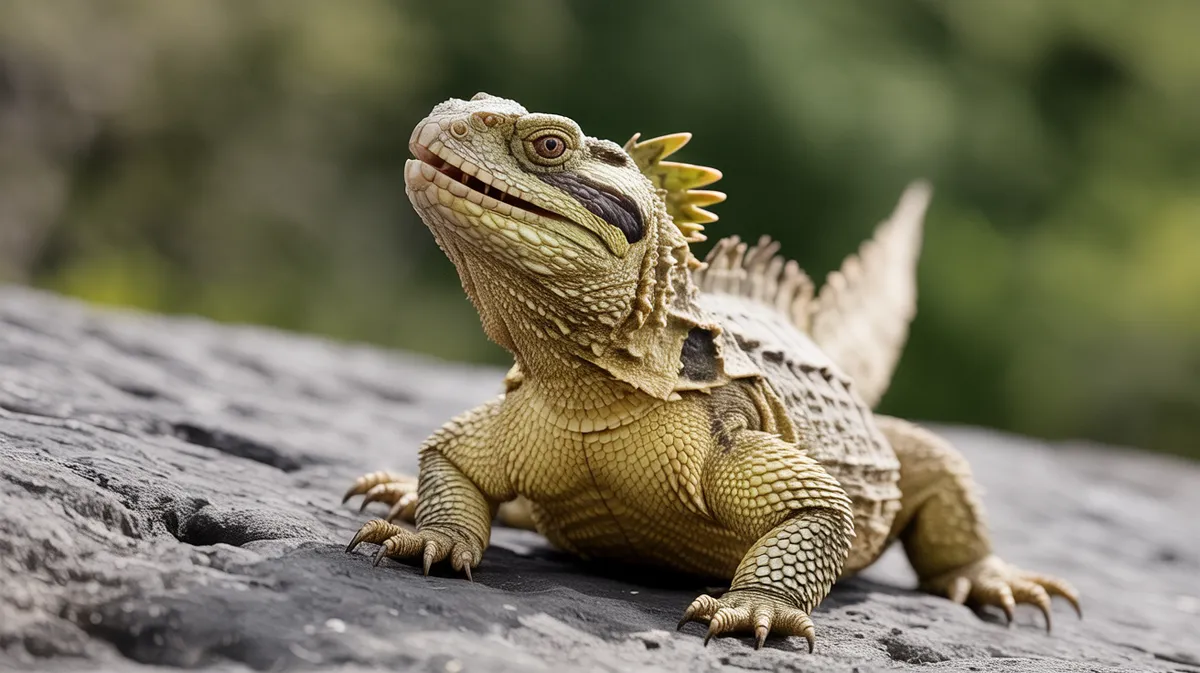
About the Tuatara
The tuatara is not a lizard, though almost everyone assumes it is. It is the last survivor of the Rhynchocephalia, an order that split from the lizards and snakes well over 200 million years ago — every other member of its lineage is extinct, which makes it less a reptile among reptiles than the final page of a separate book. Juveniles carry a functioning third eye on the top of the head, complete with lens and retina, which is covered by scales as the animal matures and appears to help regulate circadian and seasonal rhythms. Its metabolism is extraordinarily slow: it is active at temperatures that would leave most reptiles torpid, grows for decades, may not breed until it is twenty, and can live beyond a century. Its teeth are not teeth in the usual sense but fused projections of the jawbone that cannot be replaced — an old tuatara simply chews with a worn jaw. Sex is set by nest temperature, and warmer nests produce males, which makes a warming climate a direct threat to a species that already exists only on a scatter of New Zealand islands.
Fascinating facts
Living Fossil
Tuataras are the last living representatives of the order Rhynchocephalia, which dates back over 200 million years.
Parietal Eye
Tuataras have a third 'parietal eye' on the top of their heads, which is visible in juveniles and believed to help with thermoregulation and detecting changes in daylight.
Unique Jaw Structure
Their jaws have a dual row of teeth in the upper jaw and a single row in the lower jaw, allowing for a shearing motion not found in other reptiles.
Detailed description
The tuatara (Sphenodon punctatus) is a medium-sized reptile, typically reaching 50–61 cm (20–24 in) in length and weighing between 0.5 and 1.5 kg (1.1–3.3 lbs), with males generally larger than females. Its robust body is covered in rough, olive-green to brownish scales, and a distinctive crest of spiny scales runs along the back, more pronounced in males. Tuataras possess a unique skull structure with two temporal openings, a feature distinguishing them from lizards and snakes. One of their most remarkable anatomical features is the parietal or 'third' eye, visible as a translucent spot on the top of the head in juveniles, which is thought to aid in circadian and seasonal regulation. Their jaws are equipped with two rows of upper teeth that overlap a single row of lower teeth, allowing for an efficient shearing bite. Tuataras are primarily nocturnal, but juveniles may be active during the day to avoid predation by adults. They are ectothermic and exhibit extremely slow metabolism, enabling them to survive in the cool, temperate climate of New Zealand. Lifespans can exceed 100 years, with individuals known to reproduce well into their 60s and 70s. The tuatara is the sole surviving member of the order Rhynchocephalia, a lineage that diverged from other reptiles over 250 million years ago, making it a critical species for understanding amniote evolution.
Did you know?
Tuataras are the only surviving members of an ancient reptilian order that existed alongside the earliest dinosaurs.
Research & sources
Wikipedia summary
The tuatara is a species of reptile endemic to New Zealand. Despite its close resemblance to lizards, it is actually the only extant member of a distinct lineage, the previously highly diverse order Rhynchocephalia. The name tuatara is derived from the Māori language and means "peaks on the back".
Behaviour & social structure
Tuataras are solitary and territorial, often occupying burrows that they dig themselves or co-opt from seabirds such as petrels. They are primarily nocturnal, emerging at night to hunt, but may bask in the sun during cooler weather. Their diet is carnivorous, consisting of invertebrates (beetles, spiders, wētā, earthworms), small reptiles, amphibians, bird eggs, and occasionally juvenile seabirds. Tuataras use a sit-and-wait hunting strategy, relying on their acute vision and olfaction to detect prey. Social interactions are generally limited to the breeding season, when males become more aggressive and display dominance through head bobbing, body inflation, and crest erection. Outside of this period, tuataras maintain solitary territories, with minimal overlap except in densely populated areas. They exhibit seasonal activity patterns, becoming less active or dormant during the coldest months.
Reproduction & life cycle
Tuataras have a slow and infrequent reproductive cycle. Mating occurs during the austral summer (January–March), with males engaging in ritualized courtship displays. Fertilization is internal, but unlike most reptiles, tuataras lack a copulatory organ; instead, sperm is transferred by cloacal apposition. Females lay a clutch of 5–19 leathery eggs in shallow burrows, typically every 2–5 years, as the reproductive cycle is prolonged by the slow development of follicles and recovery time post-laying. Incubation is exceptionally long, ranging from 11 to 16 months, the longest of any reptile, and is highly temperature-dependent. Warmer incubation temperatures produce males, while cooler temperatures yield females (temperature-dependent sex determination). Hatchlings are independent from birth and receive no parental care. Juveniles are vulnerable to predation by adults and other predators, leading them to adopt diurnal activity patterns for the first few years.
Adaptations & survival
Tuataras possess several unique adaptations. Their low metabolic rate and tolerance for cool temperatures allow them to thrive in environments unsuitable for most reptiles. The parietal eye, though not used for vision, is believed to regulate circadian rhythms and hormone production. Their dentition, with double upper and single lower rows, is specialized for shearing prey. Tuataras can survive long periods without food, an adaptation to the sporadic availability of prey on isolated islands. They also exhibit remarkable longevity and delayed sexual maturity, with individuals not reaching reproductive age until 10–20 years old. The ability to regenerate lost tails and the presence of a well-developed pineal gland are further evolutionary specializations.
Cultural significance
The tuatara holds significant cultural and spiritual value for the Māori, New Zealand's indigenous people. It is considered a taonga (treasure) and features in traditional stories and carvings, often symbolizing guardianship and longevity. Māori traditionally regarded tuataras as kaitiaki (guardians) of sacred places. The species is protected under New Zealand law, and conservation initiatives often involve partnerships with local iwi (tribes), reflecting its importance in cultural heritage and biodiversity.
Recent research
Recent research has focused on the tuatara's genome, which was sequenced in 2020 and revealed a unique combination of reptilian, avian, and mammalian features, providing insights into vertebrate evolution. Studies on their temperature-dependent sex determination are informing conservation strategies in the face of climate change. Ongoing research includes monitoring population genetics, disease resistance, and the effects of translocation on genetic diversity. The tuatara's unique immune system and longevity are also of biomedical interest, with potential implications for aging and disease resistance in other species.
Videos
Habitat
Coastal forests and scrublands on offshore islands


Conservation
The Tuatara is currently classified as Vulnerable on the IUCN Red List.
Threats & challenges
Historically, tuataras were widespread across New Zealand, but their range is now restricted to around 35 offshore islands and a few fenced mainland sanctuaries, primarily due to habitat destruction and the introduction of mammalian predators (rats, stoats, cats). The predation of eggs and juveniles by invasive species has been the most significant threat. Climate change poses a new challenge, as rising temperatures may skew sex ratios toward males, threatening population viability. Habitat loss, disease, and genetic bottlenecks in small populations are ongoing concerns. Conservation efforts, including translocations, predator eradication, and captive breeding, have stabilized some populations, but continued vigilance is required.
Taxonomy
Scientific name
Sphenodon punctatus
- Kingdom
- Animalia
- Phylum
- Chordata
- Class
- Reptilia
- Order
- Rhynchocephalia
- Family
- Sphenodontidae
- Genus
- Sphenodon
- Species
- punctatus
Community notes
Share your observations about the Tuatara.
No community notes yet. Be the first!
Discover more wildlife
More fascinating animals from the encyclopedia.