
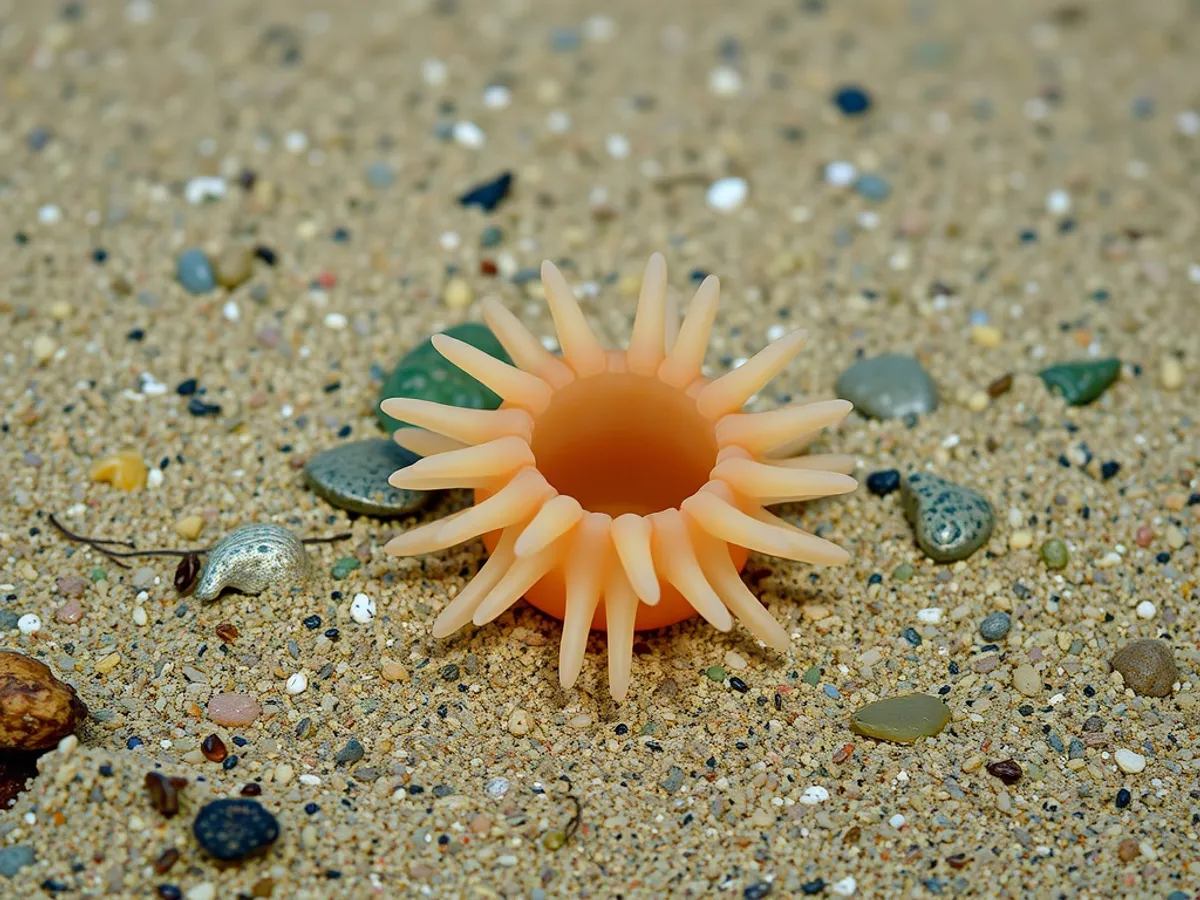
About the Tube Anemone
The Tube Anemone is a solitary, tube-dwelling marine invertebrate known for its long, flowing tentacles and vibrant coloration. It constructs a soft, mucous-based tube in sandy or muddy substrates, into which it retreats when threatened. Unlike true sea anemones, tube anemones belong to a separate order and possess two distinct rings of tentacles. These animals are primarily nocturnal, extending their tentacles at night to capture plankton and small prey. Their delicate tentacles can deliver a mild sting to both prey and potential predators.
Fascinating facts
Unique Tube Builder
Tube Anemones secrete a special mucus that binds sand and mud, allowing them to create strong, flexible tubes up to 1 meter long.
Nocturnal Hunter
They are mainly active at night, when they extend their stinging tentacles to capture zooplankton and tiny animals drifting by.
Colorful Display
Tube Anemones display a stunning array of colors, from pale pinks and purples to bright oranges and greens, making them popular in aquariums.
Detailed description
Cerianthus membranaceus, commonly known as the Tube Anemone, is a large, solitary anthozoan distinguished by its elongated, cylindrical body and vibrant, flowing tentacles. The organism can reach up to 40 cm in length, with tentacles spanning 15–30 cm in diameter when fully extended. Its body is encased in a flexible, parchment-like tube constructed from secreted mucus and specialized stinging organelles called ptychocysts, which provide both structural integrity and protection from predators. The anemone exhibits two distinct whorls of tentacles: the outer, longer tentacles are used for prey capture, while the shorter, inner tentacles manipulate food towards the central mouth. The coloration of C. membranaceus is highly variable, ranging from white and yellow to deep purple and green, often with contrasting tentacle tips. Unlike true sea anemones, tube anemones lack a pedal disc and are not attached directly to the substrate; instead, they remain buried in soft sediments, able to retract rapidly into their tubes when disturbed. The species is primarily nocturnal, emerging at dusk to feed and retreating at dawn. Cerianthus membranaceus is a non-colonial, solitary polyp, but in some cases, multiple polyps may be present within a single tube, a rare trait among tube-building cnidarians. The species is found from shallow subtidal zones down to depths of 40 meters, favoring sandy or muddy coastal environments in the Mediterranean Sea and eastern Atlantic.
Did you know?
Tube Anemones can regenerate lost tentacles if damaged or eaten by predators.
Research & sources
Wikipedia summary
Tube-dwelling anemones or ceriantharians look very similar to sea anemones but belong to an entirely different order of anthozoans. They are solitary, living buried in soft sediments. Tube anemones live inside and can withdraw into tubes, which are composed of a fibrous material made from secreted mucus and threads of nematocyst-like organelles known as ptychocysts. Within the tubes of these ceriantharians, more than one polyp is present, which is an exceptional trait because species that create tube systems usually contain only one polyp per tube. Ceriantharians were formerly classified in the taxon Ceriantipatharia along with the black corals but have since been moved to their own order, Ceriantharia.
Behaviour & social structure
Tube Anemones are largely sedentary but exhibit complex behaviors related to feeding and defense. At night, they extend their tentacles to form a conspicuous crown, maximizing surface area for intercepting plankton and small invertebrates carried by currents. Prey is immobilized by nematocysts and transported to the mouth by coordinated tentacle movements. When threatened by predators such as fish, crabs, or sudden changes in water flow, the anemone can rapidly contract its body and withdraw completely into its protective tube. Unlike many cnidarians, C. membranaceus does not form colonies or engage in social interactions; individuals are strictly solitary. The anemone’s daily routine is governed by light levels, with tentacles retracted during daylight hours to minimize predation risk and desiccation in shallow waters. Tube maintenance is an ongoing process, with the animal periodically secreting new layers of mucus and ptychocysts to repair or extend its tube.
Reproduction & life cycle
Cerianthus membranaceus exhibits both sexual and asexual reproduction. Sexual reproduction is dioecious, with individuals producing either eggs or sperm that are released into the water column for external fertilization, typically during warmer months (late spring to early summer) when planktonic food is abundant. The resulting planula larvae are planktonic for several weeks before settling onto suitable substrate and metamorphosing into juvenile polyps. Asexual reproduction via budding is rare but has been observed in laboratory conditions. There is no parental care; larvae are entirely independent post-fertilization. Growth to maturity can take several months to years, depending on environmental conditions.
Adaptations & survival
Key adaptations include the secretion of ptychocysts, unique to ceriantharians, which allow the construction of robust, flexible tubes that provide refuge from predators and environmental stressors. The dual whorls of tentacles enable efficient prey capture and food manipulation, while the ability to rapidly retract into the tube is a critical anti-predator response. The tube also buffers against sediment disturbance and hypoxia. Bioluminescence has been reported in some populations, possibly serving as a deterrent to nocturnal predators. The species’ nocturnal activity reduces competition and predation risk.
Cultural significance
While not prominent in folklore or mythology, tube anemones are valued in the marine aquarium trade for their striking appearance and are sometimes featured in public aquaria. Their unique tube-building behavior and vibrant coloration make them subjects of educational and scientific interest, illustrating the diversity and specialization of cnidarians.
Recent research
Recent research has focused on the molecular and structural properties of ptychocysts, revealing their evolutionary divergence from other cnidarian stinging cells. Studies on larval dispersal and population genetics have provided insights into connectivity among Mediterranean populations. Ongoing work explores the ecological role of tube anemones in benthic communities, including their influence on sediment stability and microhabitat creation for other invertebrates. Cerianthus membranaceus is also being investigated as a model for understanding the evolution of solitary versus colonial lifestyles in anthozoans.
Videos
Habitat
Coastal sandy and muddy sea floors

Conservation
The Tube Anemone is currently classified as Least Concern on the IUCN Red List.
Threats & challenges
Currently, Cerianthus membranaceus is not considered threatened and is listed as Least Concern. However, local populations may be impacted by coastal development, sedimentation, pollution, and bottom trawling, which can disrupt their soft-bottom habitats. Climate change and ocean acidification may pose future risks by altering sediment composition and prey availability. The species is not targeted by fisheries but may be collected for the aquarium trade in some regions.
Taxonomy
Scientific name
Cerianthus membranaceus
- Kingdom
- Animalia
- Phylum
- Cnidaria
- Class
- Anthozoa
- Order
- Ceriantharia
- Family
- Cerianthidae
- Genus
- Cerianthus
- Species
- membranaceus
Community notes
Share your observations about the Tube Anemone.
No community notes yet. Be the first!
Discover more wildlife
More fascinating animals from the encyclopedia.