
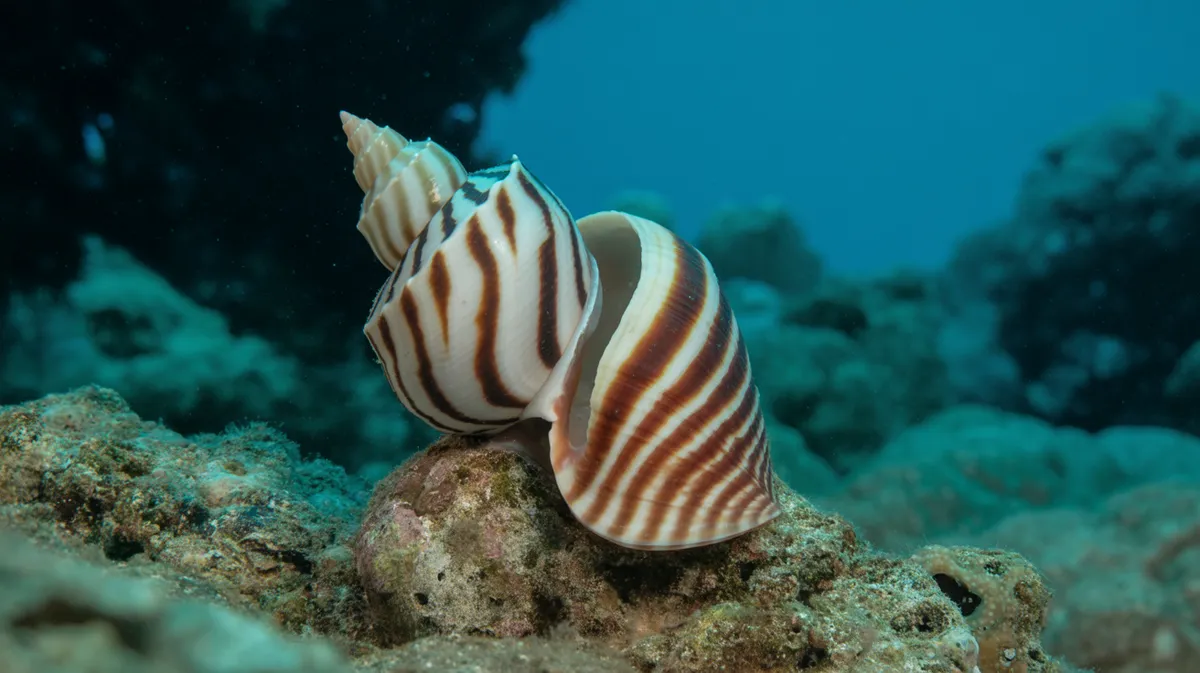
About the Turban Shell
The Turban Shell is a large marine gastropod mollusk known for its thick, rounded, and beautifully spiraled shell that resembles a turban. Its shell, often greenish with mottled patterns, can reach up to 20 centimeters in diameter, making it one of the largest in its family. Turban shells inhabit shallow coral reefs and rocky shorelines, where they graze on algae using a specialized rasping tongue called a radula. The operculum, a hard, disc-like structure, serves as a protective door when the animal retracts into its shell. This mollusk is prized for both its flesh, which is consumed as seafood, and its shell, which is used in jewelry and ornamentation.
Fascinating facts
Impressive Shell
The turban shell's thick, robust shell can reach up to 20 centimeters in diameter, making it one of the largest in its family.
Algae Grazer
Turban shells feed primarily on algae, helping to control algal growth on coral reefs and rocky substrates.
Natural Armor
When threatened, the turban shell withdraws into its shell and seals the opening with a hard operculum for protection.
Detailed description
Turbo marmoratus, commonly known as the Green Turban Shell, is one of the largest marine gastropods, with adult shells typically ranging from 15 to 20 centimeters in diameter and weighing up to 2 kilograms. The shell is robust, thick, and globular, with a distinctive greenish hue and intricate marbled patterns, providing effective camouflage among coral and rocky substrates. Its surface is often encrusted with algae or epibionts, further aiding concealment. The animal’s soft body is protected by the shell, and it possesses a muscular foot used for locomotion and anchorage to substrates. The head bears two pairs of tentacles, with the larger pair housing eyes at their bases, providing limited vision. Turbo marmoratus is primarily nocturnal, emerging at night to graze on macroalgae and biofilm using its radula—a specialized, chitinous ribbon lined with rows of microscopic teeth. The operculum, a thick, calcareous disc, seals the shell’s aperture when the animal retracts, offering protection from predators and desiccation. This species is generally solitary but may aggregate in areas with abundant food. Its life span is estimated at 10–20 years in the wild, depending on environmental conditions and predation pressure.
Did you know?
The operculum of the turban shell was historically used as an inlay material in decorative arts and is still collected today for its beauty.
Research & sources
Behaviour & social structure
Turbo marmoratus exhibits mainly nocturnal activity, remaining hidden under rocks or within crevices during daylight to avoid predation. At night, it becomes active, slowly moving across the substrate in search of algae, its primary food source. The species uses chemosensory cues to locate food and can detect changes in water chemistry, which may signal the presence of predators or conspecifics. Feeding is accomplished by scraping algae from hard surfaces with the radula, leaving distinctive grazing marks. While generally solitary, individuals may be found in loose aggregations in areas of high algal density, though there is no evidence of social hierarchy or cooperative behavior. When threatened, the turban shell retracts rapidly into its shell and seals the opening with its operculum, which is exceptionally thick and can deter many predators, including fish, crustaceans, and octopuses.
Reproduction & life cycle
Turbo marmoratus is dioecious, with separate male and female individuals. Spawning typically occurs during warmer months, often coinciding with lunar cycles, which may synchronize gamete release. Fertilization is external: males and females release sperm and eggs into the water column, where fertilization occurs. Females are highly fecund, producing thousands of eggs per spawning event. The eggs develop into free-swimming planktonic larvae (veligers) that drift with currents for several weeks, allowing for wide dispersal. After the larval stage, juveniles settle onto suitable substrates and undergo metamorphosis into the adult form. There is no parental care after spawning, and juvenile mortality is high due to predation and environmental factors.
Adaptations & survival
Turbo marmoratus has evolved several notable adaptations for survival in dynamic reef environments. The thick, heavy shell provides robust protection against predators and wave action, while its marbled coloration and encrusting epibionts offer effective camouflage. The operculum is not only a physical barrier but also minimizes water loss during low tide exposures. Its radula is highly specialized for scraping tough macroalgae from hard surfaces, and the muscular foot allows for strong adhesion, preventing dislodgement by currents or predators. The species’ nocturnal habits reduce predation risk from visually oriented diurnal predators. Larval dispersal via planktonic veligers increases the likelihood of colonizing new habitats and maintaining genetic diversity.
Cultural significance
The Green Turban Shell has significant cultural and economic value in many Indo-Pacific regions. Its flesh is considered a delicacy in some Asian cuisines, and the thick, nacreous shell—often referred to as 'mother-of-pearl'—is highly sought after for carving, inlay work, and jewelry. In some Pacific Island cultures, the operculum was historically used as a form of currency or as decorative buttons and amulets. The shell’s distinctive appearance has also made it a symbol of marine abundance and natural beauty in local folklore and art.
Recent research
Recent research on Turbo marmoratus has focused on its role in reef ecosystems as a grazer, contributing to algal control and substrate health. Genetic studies have revealed significant population structure across its range, suggesting limited larval dispersal between distant reefs. Investigations into shell microstructure have provided insights into biomineralization processes, with potential applications in materials science. Conservation-oriented studies are examining the effects of overharvesting and habitat loss, with some regions implementing size limits and harvest bans to protect vulnerable populations. Ongoing research also explores the impact of ocean acidification on shell formation and larval development.
Sources
Biology and ecology of the green turban shell, Turbo marmoratus (Linnaeus, 1758)
J.D. Taylor & M. Glover (2006)
scientificTurbo marmoratus Linnaeus, 1758: Biology and Ecology of the Green Turban Shell
Ponder, W.F. & Lindberg, D.R. (2020)
scientificVideos
Habitat
Coral reefs and rocky shorelines

Conservation
The Turban Shell is currently classified as Least Concern on the IUCN Red List.
Threats & challenges
While currently listed as Least Concern by the IUCN, Turbo marmoratus faces localized threats from overharvesting for its edible flesh and highly prized shell, which is used in jewelry and decorative arts. Habitat degradation, particularly the loss of coral reefs due to climate change, ocean acidification, and destructive fishing practices, poses significant long-term risks. Collection pressure can be intense in some regions, leading to population declines and local extirpations. Additionally, pollution and sedimentation can impact larval survival and reduce suitable habitat for juveniles. Despite these challenges, the species remains relatively widespread and resilient, but continued monitoring is recommended to detect emerging threats.
Taxonomy
Scientific name
Turbo marmoratus
- Kingdom
- Animalia
- Phylum
- Mollusca
- Class
- Gastropoda
- Order
- Vetigastropoda
- Family
- Turbinidae
- Genus
- Turbo
- Species
- marmoratus
Community notes
Share your observations about the Turban Shell.
No community notes yet. Be the first!
Discover more wildlife
More fascinating animals from the encyclopedia.