
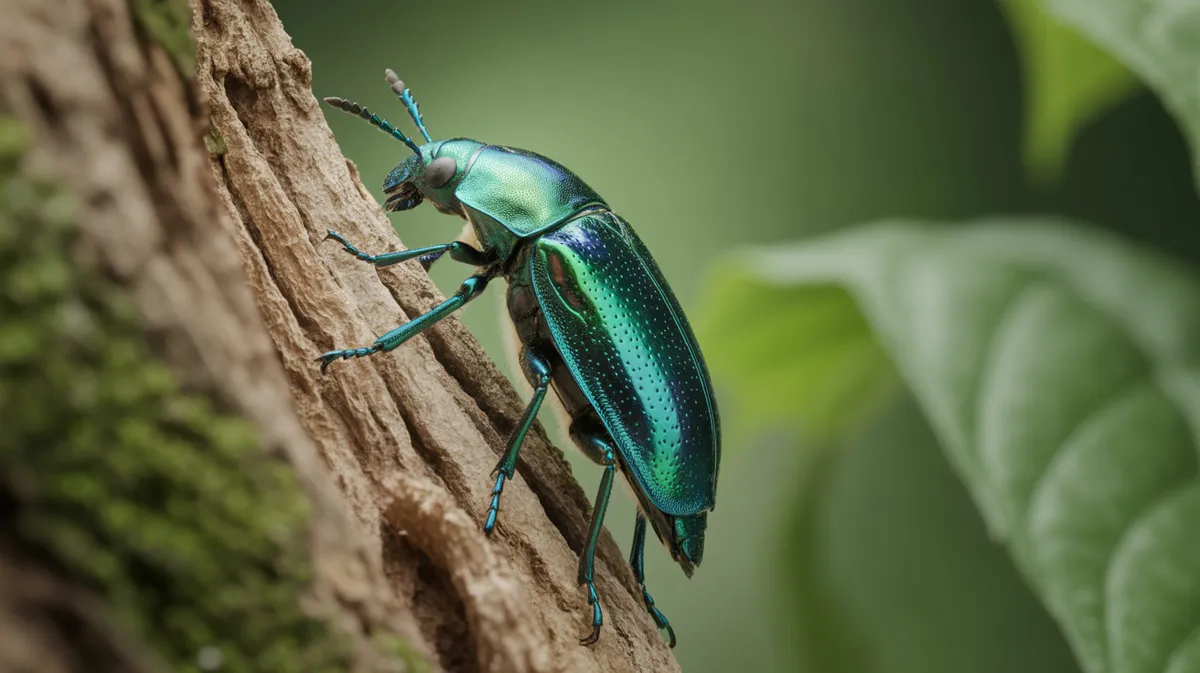
About the Turquoise jewel beetle
The Turquoise jewel beetle is a strikingly beautiful beetle known for its iridescent turquoise and emerald-green elytra, which shimmer in sunlight. Native primarily to East Asia, especially Japan, this beetle inhabits forests where it can be found on dead or dying trees. Its metallic coloration provides both camouflage among leaves and a warning to potential predators. The larvae develop inside hardwood trees, playing an important role in the decomposition process and forest nutrient cycling.
Fascinating facts
Brilliant Iridescence
The jewel beetle's metallic turquoise color comes from microscopic layers in its exoskeleton that scatter and reflect light in unique ways.
Woodland Larvae
Larvae of the Turquoise jewel beetle develop inside decaying hardwood trees, aiding in decomposition and nutrient cycling.
Artistic Inspiration
The beetle's wing cases have been used for centuries in Japanese crafts, such as inlays for lacquerware and decorative accessories.
Detailed description
Chrysochroa fulgidissima, commonly known as the Turquoise jewel beetle, is a medium-sized buprestid beetle, typically measuring 25–35 mm in length. Its most notable feature is the brilliant metallic turquoise and emerald-green coloration of its elytra, caused by microscopic multilayer structures that reflect and refract light, rather than pigmentation. The pronotum often displays golden or coppery hues, and some individuals exhibit subtle red or violet longitudinal stripes. The beetle's body is elongated and slightly flattened, which aids in navigating the crevices of tree bark. Adults are diurnal and are most active during warm, sunny days, when their iridescence is most pronounced. The species possesses well-developed mandibles for chewing plant material, and its tarsi are adapted for gripping smooth surfaces. The antennae are serrate and relatively short, used primarily for detecting chemical cues. Larvae are creamy-white, legless grubs that bore into hardwoods, especially dead or dying trees, where they play a crucial role in decomposition and nutrient cycling. The life cycle can span several years, with the majority of time spent in the larval stage, and adults emerging synchronously in late spring to early summer.
Did you know?
The elytra (wing covers) of the Turquoise jewel beetle are so prized that they have been used as inlays in Japanese lacquerware and jewelry since the Edo period.
Research & sources
Behaviour & social structure
Turquoise jewel beetles are solitary and primarily arboreal, spending most of their adult lives on or near host trees. Adults feed on leaves, bark, and occasionally pollen, showing a preference for sunlit branches. They are strong fliers and can cover considerable distances in search of suitable oviposition sites. During the hottest part of the day, adults may retreat to the shaded undersides of leaves to avoid overheating. Males are often observed patrolling tree trunks and branches, actively searching for females by following pheromone trails. When threatened, adults may drop to the ground and remain motionless, relying on their cryptic coloration for camouflage. Larvae are xylophagous, tunneling through the wood of host trees and rarely leaving their galleries until pupation. There is no evidence of social cooperation or aggregation outside of mating periods.
Reproduction & life cycle
Breeding occurs in late spring to early summer, coinciding with the emergence of adults. Males locate females using a combination of visual cues and sex pheromones. Courtship involves antennal tapping and circling behaviors. After mating, females lay eggs singly in crevices or under the bark of dead or dying hardwood trees, especially species such as Zelkova, Quercus, and Castanopsis. The eggs hatch after 2–3 weeks, and the larvae immediately begin boring into the wood. Larval development is slow, typically lasting 2–3 years depending on environmental conditions and wood quality. Pupation occurs within the wood, and the adult emerges by chewing an exit hole. There is no parental care; all life stages are independent after oviposition.
Adaptations & survival
The iridescent coloration of Chrysochroa fulgidissima serves multiple adaptive functions: it provides camouflage among sun-dappled leaves, acts as a warning signal to potential predators, and may play a role in mate recognition. The structural coloration is produced by nanoscale layers in the cuticle, which also confer resistance to abrasion. The flattened body shape allows the beetle to access narrow spaces under bark. Larvae possess robust mandibles for boring through tough wood and are able to digest cellulose with the help of symbiotic gut microbes. Adults have strong flight muscles and streamlined bodies for rapid, agile flight, aiding in dispersal and escape from predators.
Cultural significance
In Japan, the Turquoise jewel beetle is known as 'Tamamushi' and holds significant cultural value. Its iridescent elytra have been used for centuries as decorative inlays in traditional crafts, most famously in the Tamamushi Shrine at Hōryū-ji Temple, dating back to the 7th century. The beetle symbolizes beauty, immortality, and transformation in Japanese art and folklore. Its shimmering colors have inspired poetry and lacquerware designs, and it is occasionally collected by entomologists and hobbyists for display.
Recent research
Recent research has focused on the optical properties of the beetle's elytra, revealing complex multilayered nanostructures responsible for its unique iridescence, which has inspired biomimetic materials science. Studies have also examined the beetle's role in forest ecosystems as a decomposer and its interactions with host tree species. Ongoing research is investigating the chemical composition of its pheromones and potential applications in pest management. Genetic studies are beginning to explore population structure and phylogeography across East Asia, providing insights into historical dispersal and adaptation.
Videos
Habitat
Forest

Conservation
The Turquoise jewel beetle is currently classified as Least Concern on the IUCN Red List.
Threats & challenges
Currently, Chrysochroa fulgidissima is classified as Least Concern, with stable populations across its range. However, localized threats include habitat loss due to deforestation, urbanization, and the removal of deadwood from managed forests, which reduces available breeding sites. Pesticide use in forestry and agriculture may also negatively impact populations. Climate change could alter the distribution of suitable host trees and affect developmental timing. Despite these pressures, the species remains common in protected and semi-natural forests, and there are no indications of significant population declines at present.
Taxonomy
Scientific name
Chrysochroa fulgidissima
- Kingdom
- Animalia
- Phylum
- Arthropoda
- Class
- Insecta
- Order
- Coleoptera
- Family
- Buprestidae
- Genus
- Chrysochroa
- Species
- fulgidissima
Community notes
Share your observations about the Turquoise jewel beetle.
No community notes yet. Be the first!
Discover more wildlife
More fascinating animals from the encyclopedia.