
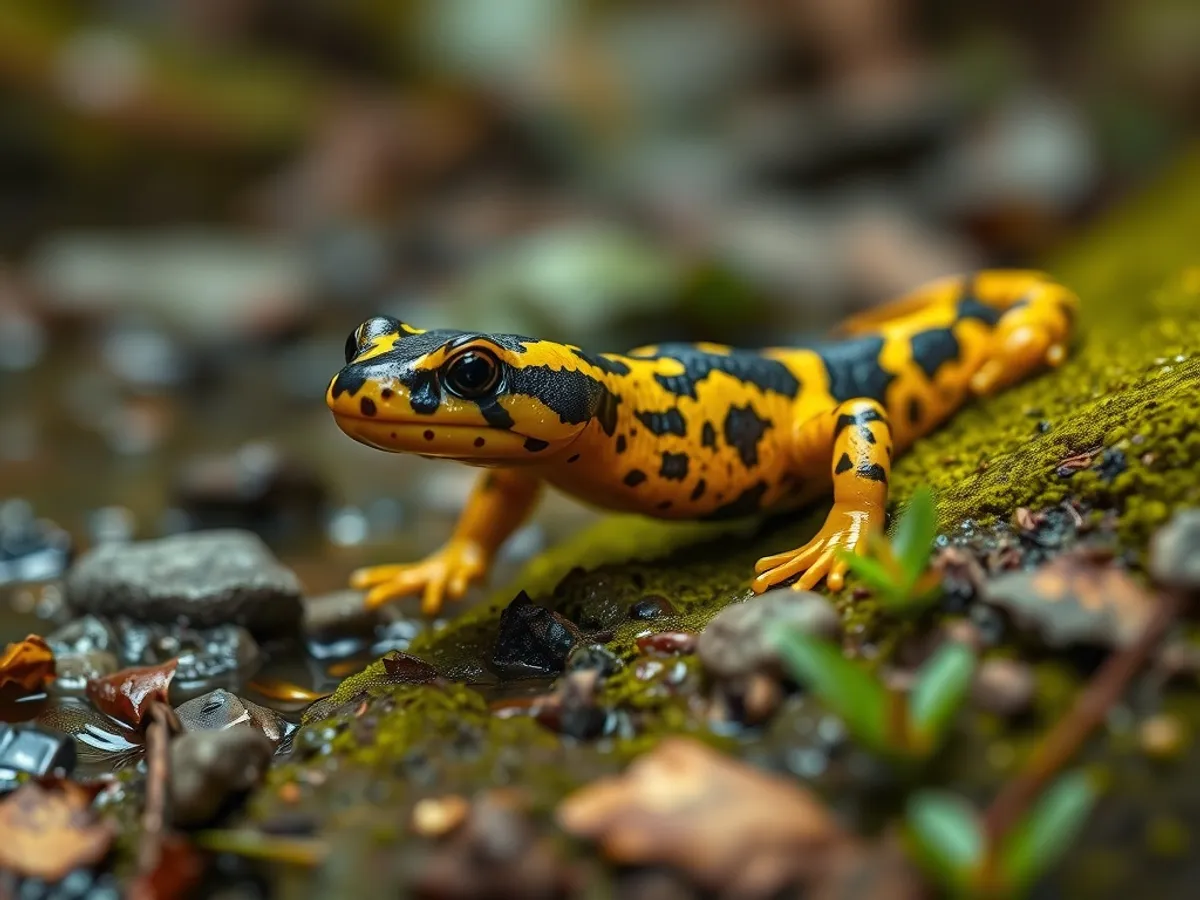
About the Tuscan Fire Salamander
The Tuscan Fire Salamander is a strikingly colored amphibian native to central Italy, particularly the regions of Tuscany and Umbria. It is characterized by its glossy black body adorned with vibrant yellow markings, which serve as a warning for its toxic skin secretions. This nocturnal salamander prefers humid, temperate forests and is typically found near streams or other freshwater sources. During the day, it hides under logs, stones, or dense foliage to avoid desiccation and predators. The species plays a crucial role in controlling insect populations within its ecosystem.
Fascinating facts
Aposematic Coloration
Their bold yellow and black coloration serves as a warning to predators about their toxic skin secretions.
Nocturnal Lifestyle
Tuscan Fire Salamanders are primarily active at night, searching for insects, worms, and small invertebrates.
Habitat Specialist
They thrive in moist, densely vegetated forests, always close to clean freshwater sources for breeding and hydration.
Detailed description
The Tuscan Fire Salamander (Salamandra salamandra gigliolii) is a robust, medium-sized amphibian, typically reaching lengths of 15–20 cm, with females often slightly larger than males. Its skin is smooth and moist, displaying a striking aposematic coloration of glossy black with irregular, bright yellow patches or stripes, which vary individually and serve as a warning of its potent skin toxins (mainly samandarine alkaloids). The head is broad with prominent parotoid glands behind the eyes, which secrete these toxins as a defense against predators. Eyes are relatively large with horizontal pupils, adapted for nocturnal vision. Limbs are well-developed, with four toes on the forelimbs and five on the hindlimbs, aiding in terrestrial locomotion across leaf litter and uneven forest terrain. The species is primarily terrestrial, only approaching water for breeding. Its lungs are well-developed, but cutaneous respiration remains important, necessitating a moist microhabitat. The Tuscan Fire Salamander is largely solitary outside of the breeding season, exhibiting territorial behavior and a preference for stable, undisturbed forest environments. This subspecies is endemic to central Italy, with a distribution centered in the Apennine foothills, where it plays a key ecological role as both predator and prey within its ecosystem.
Did you know?
Unlike many amphibians, the Tuscan Fire Salamander gives birth to fully formed juvenile salamanders rather than laying eggs in water.
Research & sources
Behaviour & social structure
Tuscan Fire Salamanders are predominantly nocturnal, emerging from their daytime refuges—such as under logs, stones, or dense leaf litter—after dusk, especially during humid or rainy conditions. They are slow-moving and deliberate, relying on stealth and their cryptic coloration to avoid detection. Their diet consists mainly of terrestrial invertebrates, including earthworms, slugs, insects, spiders, and occasionally small vertebrates such as juvenile amphibians. Hunting is primarily by active foraging, using chemosensory cues to locate prey. They capture prey with a rapid extension of the sticky tongue. Social interactions are minimal outside the breeding season; individuals are generally solitary and may exhibit aggressive displays, such as posturing or tail elevation, if territories are encroached upon. During periods of drought or extreme cold, they may enter a state of torpor, retreating deeper underground to maintain hydration and avoid temperature extremes.
Reproduction & life cycle
Breeding occurs from late winter to early spring (February–April), triggered by rising humidity and temperature. Males locate females via pheromonal cues and engage in a courtship ritual involving tactile and chemical signals. Fertilization is internal: the male deposits a spermatophore, which the female picks up with her cloaca. Females are ovoviviparous, retaining fertilized eggs internally until the larvae are ready to hatch. Gestation lasts approximately 6–9 months, after which the female deposits fully developed aquatic larvae (typically 20–40 per clutch) into slow-moving streams or pools. Larvae are equipped with external gills and undergo a metamorphosis lasting 2–6 months, depending on environmental conditions. Parental care is limited to the selection of optimal oviposition sites; there is no further investment after larval release.
Adaptations & survival
The Tuscan Fire Salamander exhibits several adaptations for survival in temperate forest environments. Its aposematic coloration deters predators by advertising its toxicity, while the parotoid glands produce potent neurotoxins as a chemical defense. Moist, permeable skin facilitates cutaneous respiration, allowing survival in low-oxygen microhabitats. Behavioral adaptations include nocturnality and secretive habits to minimize water loss and predation risk. The species’ ability to enter torpor during adverse conditions is a physiological adaptation to fluctuating Mediterranean climates. Reproductive strategies, such as ovoviviparity and larval deposition in clean, well-oxygenated streams, enhance offspring survival in variable environments.
Cultural significance
Fire salamanders, including the Tuscan subspecies, have a prominent place in European folklore and mythology, often associated with fire due to their striking coloration and the belief that they could withstand flames. In Tuscany, they are sometimes regarded as symbols of resilience and transformation. Historically, their toxins were believed to have medicinal or magical properties, though there is no evidence of widespread traditional use in central Italy. The species is occasionally featured in local art and literature, reflecting its iconic status in the region’s natural heritage.
Recent research
Recent research on Salamandra salamandra gigliolii has focused on population genetics, revealing significant genetic differentiation from other S. salamandra subspecies, likely due to geographic isolation in the Apennines. Studies on chemical ecology have characterized the composition and variability of skin toxins, with implications for predator-prey dynamics and evolutionary adaptation. Ongoing monitoring projects assess the impact of emerging diseases, particularly chytrid fungi, on population health. Conservation research is increasingly examining the effects of habitat fragmentation and climate change on breeding success and larval survival. Citizen science initiatives in Tuscany and Umbria are contributing valuable data on distribution and population trends.
Sources
Molecular phylogeography and subspecies differentiation in the fire salamander (Salamandra salamandra) in Italy
N. Canestrelli, M. Zangari, G. Nascetti (2006)
scientificSalamandra salamandra: The IUCN Red List of Threatened Species 2023
IUCN SSC Amphibian Specialist Group
conservationVideos
Habitat
Temperate forest near freshwater streams
 Elevated Terrain
Mountain
High-altitude environments with varying climates and specialized wildlife adapted to rugged terrain and thin air.
 Global
Forest
Wooded areas with significant tree cover and diverse plant and animal communities.
 Global
Freshwater
Lakes, rivers, and wetlands with diverse aquatic ecosystems.
Conservation
The Tuscan Fire Salamander is currently classified as Least Concern on the IUCN Red List.
Threats & challenges
Although currently listed as Least Concern, the Tuscan Fire Salamander faces several localized threats. Habitat fragmentation and degradation due to urbanization, deforestation, and agricultural expansion reduce suitable breeding and foraging sites. Pollution of freshwater habitats, particularly from pesticides and fertilizers, poses a risk to larval development. Road mortality is a significant threat during seasonal migrations. Emerging infectious diseases, such as chytridiomycosis (caused by Batrachochytrium dendrobatidis) and the salamander chytrid fungus (B. salamandrivorans), present growing concerns for population stability. Climate change, leading to altered precipitation patterns and increased drought frequency, may further impact habitat suitability and reproductive success. Despite these challenges, populations remain relatively stable in protected and undisturbed areas.
Taxonomy
Scientific name
Salamandra salamandra gigliolii
- Kingdom
- Animalia
- Phylum
- Chordata
- Class
- Amphibia
- Order
- Urodela
- Family
- Salamandridae
- Genus
- Salamandra
- Species
- gigliolii
Community notes
Share your observations about the Tuscan Fire Salamander.
No community notes yet. Be the first!
Discover more wildlife
More fascinating animals from the encyclopedia.