
About the Vaquita
The vaquita (Phocoena sinus) is the smallest cetacean, around 1.5 metres long, and it has the smallest range of any marine mammal, confined to a patch of the northern Gulf of California only a few thousand square kilometres in extent. It was not described until 1958. Today it is the most endangered marine mammal in the world, with acoustic surveys in 2023 and 2024 detecting somewhere between six and ten individuals. Almost nothing about the vaquita itself is the problem: it has never been hunted, it is not directly targeted, and its habitat is not degraded in any dramatic way. It is dying in gillnets set illegally for the totoaba, a large fish whose swim bladder is dried and smuggled to China, where it fetches tens of thousands of dollars a kilogram as a status good and a supposed remedy, which has earned it the name "aquatic cocaine". Vaquitas entangle in the same mesh and drown. Conservation biologists had long assumed such a tiny population would be doomed by inbreeding, but a genomic study in 2022 found the opposite: vaquitas have been naturally rare for tens of thousands of years and have purged most of their harmful recessive mutations, so the remaining animals carry a low genetic load. The species is not genetically doomed. It simply has to stop drowning in nets.
Fascinating facts
Smallest Porpoise
The vaquita is the smallest of all cetaceans, measuring only about 1.2 to 1.5 meters in length.
Endemic Habitat
Vaquitas are found only in a small region of the northern Gulf of California, making their range extremely limited.
Critical Threat
The main threat to the vaquita is bycatch in illegal gillnets set for totoaba fish, whose swim bladders are highly valued on the black market.
Detailed description
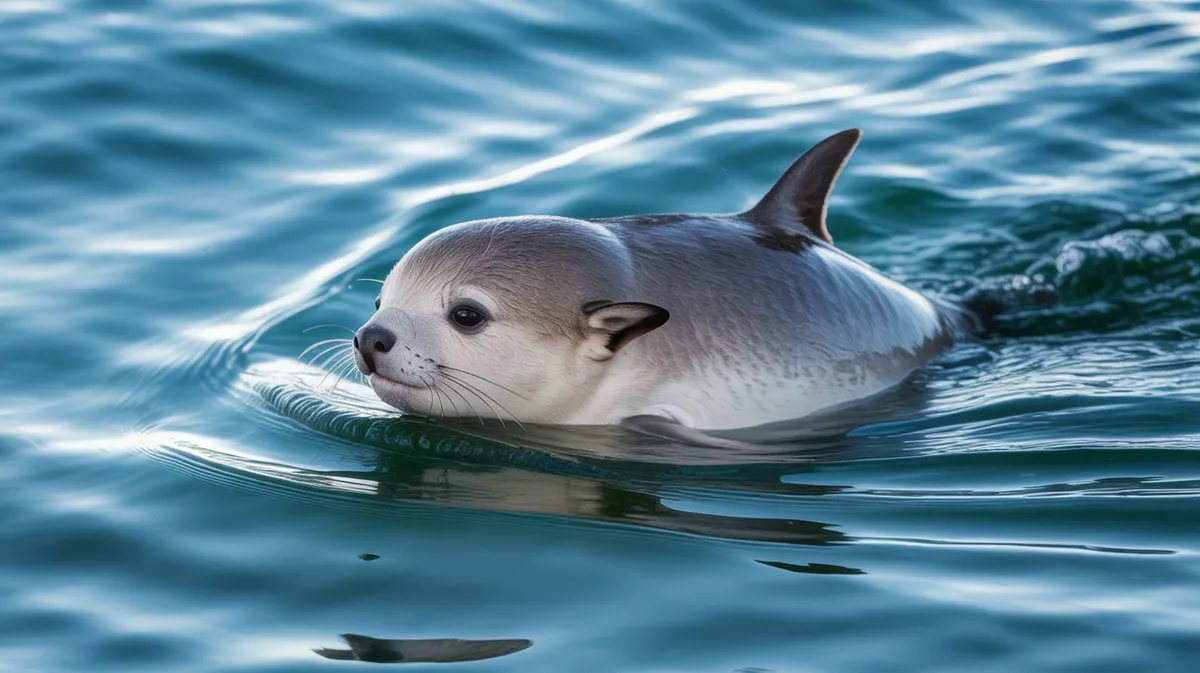
The vaquita (Phocoena sinus) is the smallest extant cetacean, with adult females reaching up to 150 cm in length and males slightly smaller at around 140 cm. It is characterized by a robust, stocky body, a rounded head with no beak, and distinctive facial markings: dark rings around the eyes and dark patches on the lips, which contrast with its pale gray body and lighter ventral surface. The dorsal fin is tall and triangular, an adaptation for maneuvering in shallow, turbid waters. Vaquitas possess 34–40 spade-shaped teeth in each jaw, suited for grasping small prey. Their lungs and circulatory system are adapted for short, shallow dives, typically less than 5 minutes, as they forage near the sea bottom. The species is elusive and rarely observed at the surface, often surfacing alone or in small groups of 2–3. Acoustic communication is crucial for vaquitas, as their habitat is often murky and vision is limited; they use high-frequency echolocation clicks for navigation and prey detection. Vaquitas are non-migratory, with a home range restricted to a small area (approximately 4,000 km²) in the northern Gulf of California. Their population is estimated at fewer than 10 individuals as of 2023, making them the most endangered marine mammal in the world.
Did you know?
There are estimated to be fewer than 10 vaquitas left in the wild as of 2024, making them perilously close to extinction.
Research & sources
Wikipedia summary
The vaquita is a species of porpoise endemic to the northern end of the Gulf of California in Baja California, Mexico. Reaching a maximum body length of 150 cm (4.9 ft) (females) or 140 cm (4.6 ft) (males), it is the smallest of all living cetaceans. The species is currently on the brink of extinction, and is listed as Critically Endangered by the IUCN Red List; the steep decline in abundance is primarily due to bycatch in gillnets from the illegal totoaba fishery.
Behaviour & social structure
Vaquitas are highly reclusive and display cryptic surface behavior, making them difficult to study in the wild. They are typically solitary or found in very small groups, rarely exceeding three individuals, which is unusual among porpoises. Their surfacing is brief and inconspicuous, often producing little splash or disturbance. Vaquitas feed primarily on demersal fish (such as croakers and grunts), crustaceans, and cephalopods, foraging near the sea floor in shallow waters less than 50 meters deep. They use echolocation to locate prey in turbid conditions, emitting high-frequency clicks (up to 150 kHz) that are beyond the range of most marine predators and human-made noise. Vaquitas are thought to be crepuscular feeders, with increased activity during dawn and dusk. Social interactions are minimal, with little evidence of complex group structures or cooperative behaviors. Their vocalizations are limited to clicks, with no known whistles or complex calls.
Reproduction & life cycle
Vaquita reproduction is poorly understood due to the species' rarity, but available data suggest a low reproductive rate. Mating likely occurs in late spring to early summer, with a gestation period of approximately 10–11 months. Calving peaks in late March to April. Females give birth to a single calf every 2 years, and twins have never been documented. Newborns measure about 70–75 cm in length and are nursed for 6–8 months. Parental care is provided solely by the mother, with no evidence of paternal involvement. Sexual maturity is reached at around 3–6 years of age. The low reproductive rate, combined with high juvenile mortality from bycatch, severely limits the population’s ability to recover.
Adaptations & survival
Vaquitas have evolved several adaptations for survival in their unique habitat. Their small, robust bodies and tall dorsal fins allow for agile maneuvering in shallow, silty waters. High-frequency echolocation enables them to detect prey and navigate in low-visibility conditions. Their muted coloration provides camouflage against the sandy seabed and murky water, reducing predation risk. Physiologically, vaquitas have a high blood-to-body volume ratio and increased myoglobin concentrations, supporting short, frequent dives. Their spade-shaped teeth are specialized for grasping slippery, soft-bodied prey. Behaviorally, their elusive nature and minimal surfacing reduce detection by predators and humans.
Cultural significance
The vaquita has limited traditional cultural significance, as it was only scientifically described in 1958 and is rarely encountered by local communities. However, it has become a powerful symbol of marine conservation and the consequences of illegal wildlife trade. The vaquita features prominently in international campaigns to protect endangered species and is often cited in discussions about biodiversity loss and the need for sustainable fisheries. In Mexico, the vaquita is sometimes referred to as the 'panda of the sea' due to its distinctive facial markings and critically endangered status.
Recent research
Recent research has focused on acoustic monitoring to estimate population size and distribution, as visual surveys are largely ineffective. Genetic studies reveal low genetic diversity, likely due to historically small population sizes, but suggest that the species could recover if bycatch mortality is eliminated. Experimental conservation efforts, such as the use of 'vaquita-safe' fishing gear and the establishment of a zero-tolerance refuge area, have had limited success due to enforcement challenges. In 2017, a controversial attempt to capture and breed vaquitas in captivity (VaquitaCPR) was unsuccessful and resulted in the death of a captured female, highlighting the species’ sensitivity to handling. Ongoing research includes the development of advanced acoustic detection methods and community-based conservation initiatives.
Videos
Habitat
Shallow coastal waters

Conservation
The Vaquita is currently classified as Critically Endangered on the IUCN Red List.
Threats & challenges
The primary threat to vaquitas is bycatch in illegal gillnets, particularly those set for the endangered totoaba fish (Totoaba macdonaldi), whose swim bladders are highly valued on the black market. Gillnets entangle and drown vaquitas, leading to catastrophic population declines. Additional threats include habitat degradation, reduced prey availability due to overfishing, and potential impacts from environmental contaminants such as pesticides and heavy metals. Conservation efforts are hampered by ongoing illegal fishing, limited enforcement, and socio-economic pressures in the region. Despite international attention and bans on gillnets, enforcement remains inconsistent. The population has declined by over 98% since the late 1990s, and extinction is considered imminent without immediate and effective intervention.
Taxonomy
Scientific name
Phocoena sinus
- Kingdom
- Animalia
- Phylum
- Chordata
- Class
- Mammalia
- Order
- Cetacea
- Family
- Phocoenidae
- Genus
- Phocoena
- Species
- sinus
Where to see a vaquita
1 zoo and aquarium in 1 country are recorded as keeping this species.

Community notes
Share your observations about the Vaquita.
No community notes yet. Be the first!
Discover more wildlife
More fascinating animals from the encyclopedia.