
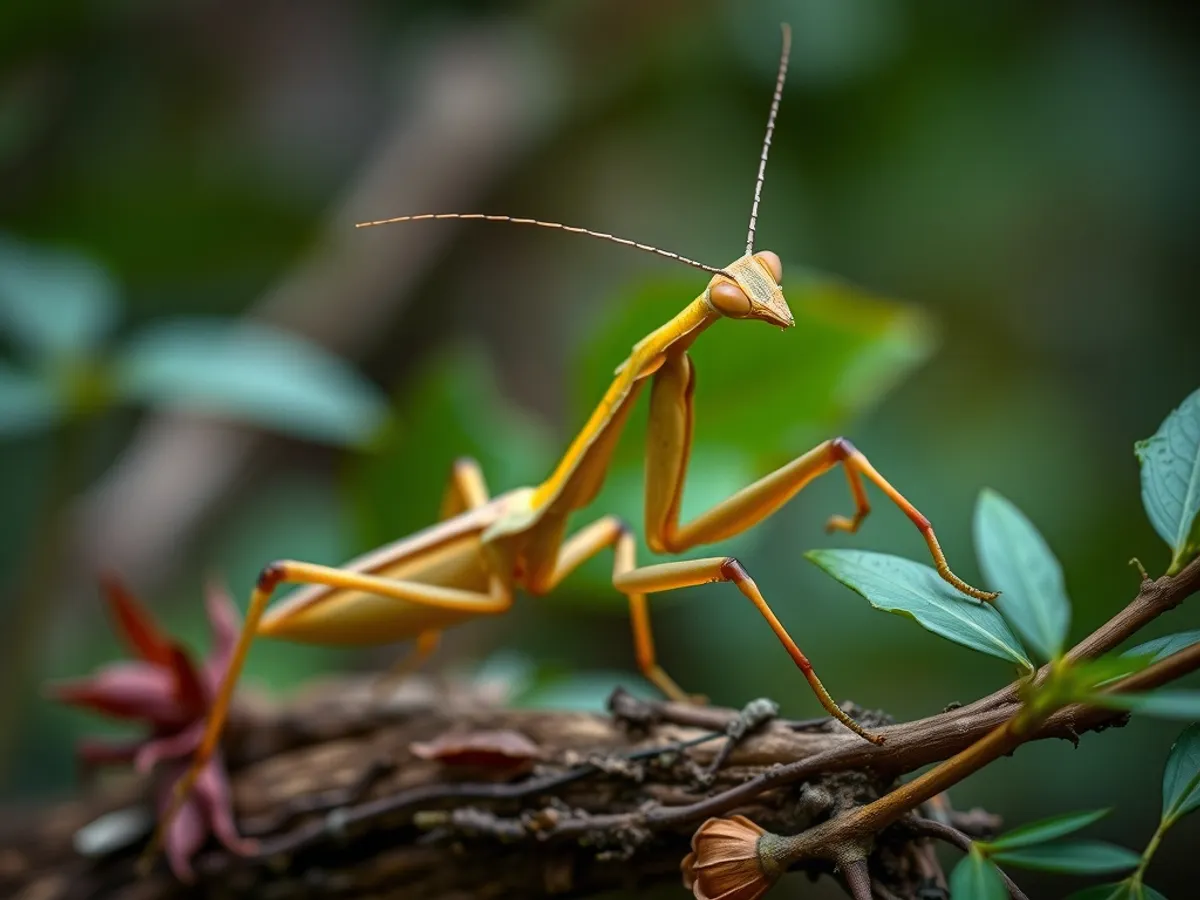
About the Wandering violin mantis
The wandering violin mantis is a striking insect known for its slender, leaf-like limbs and distinctive body shape that mimics dried twigs and leaves, providing excellent camouflage. Native to the Indian subcontinent and Southeast Asia, it prefers warm, humid environments within forests and shrublands. The mantis is named for its violin-shaped thorax and elongated appendages, which help it blend effortlessly into its surroundings. Its unique appearance not only aids in avoiding predators but also assists in ambushing unsuspecting prey. The species is admired among insect enthusiasts for its delicate structure and unusual movements.
Fascinating facts
Violin-Shaped Body
The mantis's thorax is elongated and flattened, resembling the body of a violin, which inspired its common name.
Master of Camouflage
Its twig- and leaf-like limbs allow it to blend seamlessly into foliage, making it nearly invisible to both predators and prey.
Communal Nymphs
Unlike many mantis species, young wandering violin mantises can live together in groups without displaying strong cannibalistic tendencies.
Detailed description
The wandering violin mantis (Gongylus gongylodes) is a visually remarkable mantid, instantly recognizable by its elongated, slender body and ornate, leaf-like appendages that extend from its legs and thorax. Adults typically measure between 9 and 11 cm in length, with females being slightly larger and more robust than the more gracile males. The thorax is laterally expanded and flattened, giving the insect its characteristic 'violin' shape, while the limbs are adorned with broad, flattened lobes that enhance its mimicry of dried twigs and leaves. The coloration ranges from pale brown to greenish hues, often with subtle mottling that further aids in camouflage. The head is triangular, with large, well-developed compound eyes providing a wide field of vision, and the antennae are long and filiform. This species is adapted for an ambush predatory lifestyle, remaining motionless for long periods and swaying gently to mimic vegetation moving in the breeze. Unlike many mantids, G. gongylodes is relatively tolerant of conspecifics, exhibiting low levels of cannibalism, especially when well-fed and kept in spacious environments. The wings of males are fully developed, enabling flight, while females possess shorter wings and are flightless. The species is primarily crepuscular, being most active at dawn and dusk, and relies heavily on visual cues for both hunting and mate recognition.
Did you know?
Despite its ghostly, fragile appearance, the wandering violin mantis is a skilled and voracious predator, capable of catching prey almost as large as itself.
Research & sources
Wikipedia summary
Gongylus gongylodes, also known as the wandering violin mantis, ornate mantis, or Indian rose mantis, is a species of praying mantis in the family Empusidae. Characterized by extremely slender limbs with large appendages, it is not a particularly aggressive species and often kept as a pet. The mantis is especially known for swaying its body back and forth to imitate a stick flowing in the wind. It primarily feeds on flying insects. Its native range is in southern India and Sri Lanka. It can reach up to 11 cm (4.3 in) long. The males of the species are capable of flight. They are a communal species, in that they are able to live and breed in large groups, without unnecessary cannibalism. Adult females are about 10cm and adult males are about 9 cm.
Behaviour & social structure
Gongylus gongylodes displays a suite of specialized behaviors centered around camouflage and ambush predation. Its signature swaying motion, often described as 'rocking,' is thought to confuse both predators and prey by simulating the movement of plant material in the wind. When hunting, the mantis remains motionless, waiting for flying insects such as flies, moths, and small wasps to come within reach before striking with its raptorial forelegs. Feeding is typically solitary, but the species can be kept communally with minimal aggression, especially among juveniles and subadults. Social interactions are limited, with most contact occurring during mating or competition for prey. Daily activity peaks during low-light periods, and individuals spend much of the day in concealment. Defensive behaviors include deimatic displays, where the mantis spreads its limbs and wings to appear larger, and rapid retreat if threatened.
Reproduction & life cycle
Reproduction in G. gongylodes follows the general mantid pattern but with some notable differences. Courtship is relatively subdued, with males approaching females cautiously to avoid predation, although sexual cannibalism is rare compared to other mantids. Mating typically occurs in the late wet season, coinciding with increased prey availability. After copulation, females lay oothecae (egg cases) containing 30–50 eggs, which are attached to twigs or leaves in concealed locations. Incubation lasts 4–6 weeks, depending on temperature and humidity. Nymphs emerge simultaneously and are highly cryptic, resembling small twigs. There is no parental care post-oviposition; the young are independent from hatching and undergo 6–8 molts before reaching adulthood, a process that takes 4–6 months under optimal conditions.
Adaptations & survival
The wandering violin mantis exhibits several remarkable adaptations for survival. Its extreme morphological mimicry, including laterally expanded thorax and lobed limbs, provides effective camouflage in leaf litter and among twigs. The swaying behavior enhances this deception, reducing detection by both predators and prey. The raptorial forelegs are highly specialized for grasping and subduing agile flying insects. Males' ability to fly allows them to disperse and locate mates over greater distances, while females' larger size and flightlessness may reduce predation risk and increase fecundity. The communal tolerance is unusual among mantids and may be an adaptation to environments with fluctuating prey availability, reducing the risk of cannibalism when food is scarce.
Cultural significance
While not as prominent in folklore as some other mantids, G. gongylodes is admired in regions of southern India and Sri Lanka for its delicate beauty and unusual appearance. In the global insect-keeping community, it is highly prized for its ornate morphology and relative ease of communal rearing. There are no significant traditional uses or mythological associations documented, but the species is sometimes featured in educational exhibits and nature documentaries highlighting insect camouflage and mimicry.
Recent research
Recent research on Gongylus gongylodes has focused on its behavioral ecology, particularly the evolutionary drivers of its communal tolerance and mimicry. Studies have investigated the biomechanics of its swaying motion and the neural mechanisms underlying its visual hunting strategies. Genetic analyses are ongoing to clarify its phylogenetic relationships within Empusidae. There is also interest in the species as a model for biomimetic design, inspiring robotics and camouflage technology. Captive breeding programs have provided insights into its developmental biology and reproductive strategies, contributing to improved husbandry protocols.
Videos
Habitat
Tropical and subtropical forests, shrublands


Conservation
The Wandering violin mantis is currently classified as Least Concern on the IUCN Red List.
Threats & challenges
Currently, Gongylus gongylodes is not considered threatened and is classified as Least Concern. However, localized threats include habitat loss due to deforestation, agricultural expansion, and pesticide use, which can reduce prey abundance and suitable microhabitats. The species is also collected for the pet trade, though captive breeding has reduced pressure on wild populations. Climate change poses a potential future risk by altering the distribution of suitable habitats. Population trends are stable in most of its native range, but ongoing monitoring is recommended, especially in areas undergoing rapid land-use change.
Taxonomy
Scientific name
Gongylus gongylodes
- Kingdom
- Animalia
- Phylum
- Arthropoda
- Class
- Insecta
- Order
- Mantodea
- Family
- Empusidae
- Genus
- Gongylus
- Species
- gongylodes
Community notes
Share your observations about the Wandering violin mantis.
No community notes yet. Be the first!
Discover more wildlife
More fascinating animals from the encyclopedia.