
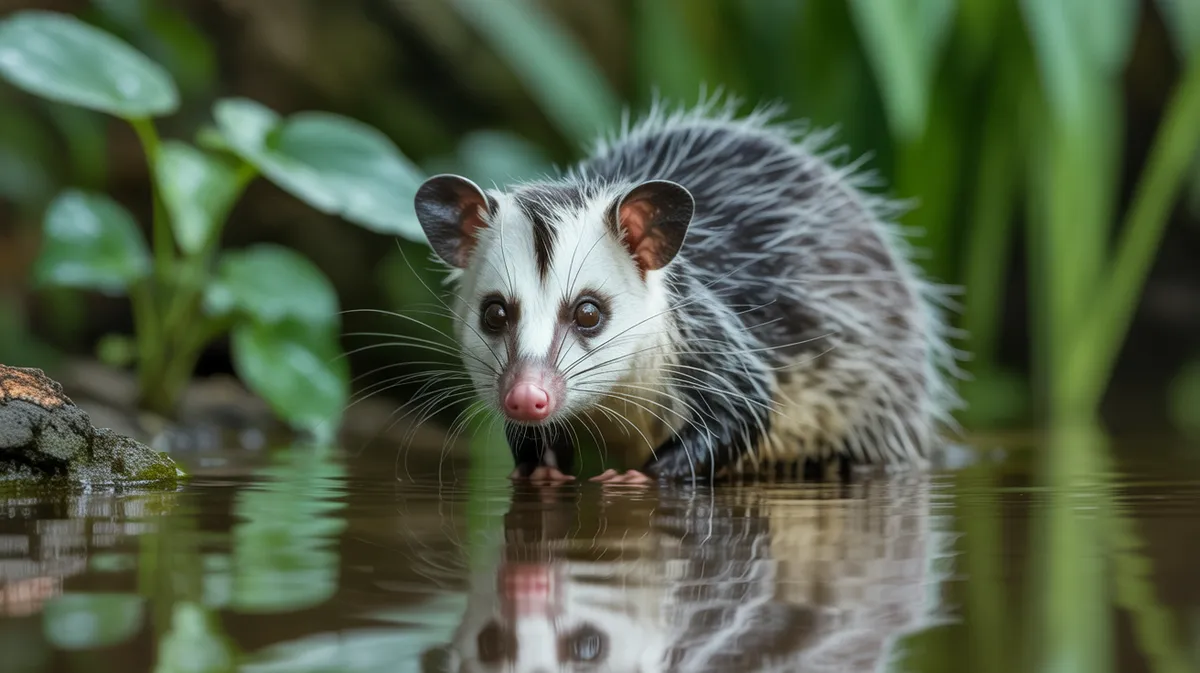
About the Water Opossum
The water opossum or yapok (Chironectes minimus) is the only truly semiaquatic marsupial in the world, and it lives along clear forest streams from southern Mexico to Argentina. Its adaptations are exactly the ones you would design. The hind feet are fully webbed and do the propulsion; the front feet are not webbed at all, and instead carry long, sensitive, splayed fingers with which the animal feels for prey. It hunts by swimming with its eyes closed, sweeping the forepaws through the water and among stones, and it catches crayfish, shrimp and small fish entirely by touch, which is why murky water is no handicap to it. Water-repellent fur and a long, rudder-like tail complete the package. The most remarkable feature is the pouch. A ring of muscle draws it closed and a sebaceous secretion waterproofs the seal, so the mother can dive with two or three young inside and they stay dry; the young survive the dives on the air trapped with them. Males also have a pouch, which is otherwise almost unheard of in marsupials, and they use it to tuck the scrotum away while swimming, apparently to streamline the body and protect it from cold water and snagging. The animal is nocturnal, secretive, and rarely seen even where it is common.
Fascinating facts
Webbed Swimmer
The Yapok's hind feet are fully webbed, making it an expert swimmer capable of agile movement in water.
Unique Pouch
Unlike most marsupials, both male and female Yapoks have pouches; the male's pouch protects his genitalia while swimming.
Nocturnal Hunter
Yapoks hunt mostly at night, using their sensitive whiskers to detect prey such as fish, crustaceans, and aquatic insects.
Detailed description
The water opossum (Chironectes minimus), or yapok, is a medium-sized marsupial, typically measuring 27–40 cm in body length with a tail nearly as long (32–43 cm), and weighing between 400–800 grams. Its dense, velvety fur is grayish with distinctive black and white markings, providing camouflage in dappled aquatic environments. The yapok is uniquely adapted for an aquatic lifestyle: its hind feet are fully webbed and fringed with stiff hairs, functioning as powerful paddles, while the forefeet are dexterous and unwebbed, enabling precise manipulation of prey. Both males and females possess a watertight pouch—an extremely rare trait among marsupials—protecting their young or, in males, the genitalia during swimming. The yapok is primarily nocturnal and crepuscular, emerging at dusk to forage along riverbanks and in shallow water. Solitary by nature, individuals maintain territories marked by scent glands. Their diet consists mainly of aquatic invertebrates, fish, crustaceans, and occasionally amphibians. The yapok’s streamlined body, flattened tail, and specialized fur reduce drag and insulate against cold water, while their large, sensitive vibrissae (whiskers) aid in detecting prey in murky conditions. They are agile swimmers, capable of remaining submerged for up to a minute. Yapoks construct burrows or use natural crevices near water for shelter and nesting.
Did you know?
The Yapok is the only marsupial in the world with both webbed feet and a waterproof pouch, specially adapted for an aquatic lifestyle.
Research & sources
Wikipedia summary
The water opossum, also locally known as the yapok, is a marsupial of the family Didelphidae. It is the only monotypic species of its genus, Chironectes. This semiaquatic creature is found in and near freshwater streams and lakes from Mexico through Central and South America to Argentina and is the most aquatic living marsupial. It is also the only extant marsupial species in which both sexes have a pouch. The now extinct thylacine, commonly referred to as the Tasmanian tiger, also exhibited this trait.
Behaviour & social structure
Water opossums are solitary and territorial, with home ranges that can extend several hundred meters along waterways. They are primarily nocturnal, spending daylight hours in dens or burrows close to water. Foraging activity peaks shortly after dusk and before dawn. Yapoks hunt by swimming and diving, using their sensitive whiskers to detect prey under rocks or in submerged vegetation. Prey is typically captured with the forepaws and consumed on land or on exposed rocks. They are opportunistic feeders, with diet composition varying seasonally and geographically. Social interactions are limited to the breeding season, and individuals communicate via vocalizations, scent marking, and occasional aggressive encounters. They are known for their agility in water, using undulating tail movements and webbed feet for propulsion, while their forelimbs are used for grasping and manipulating food.
Reproduction & life cycle
Breeding may occur year-round in equatorial regions, but tends to be seasonal in more temperate parts of their range, often coinciding with the rainy season. After a brief courtship, copulation occurs on land or in the water. Females have a gestation period of approximately 12–14 days, after which 1–5 tiny, altricial young are born and immediately crawl into the mother’s pouch. The young remain in the pouch for about 40–50 days, continuing to develop and nurse. After leaving the pouch, juveniles are carried on the mother’s back or remain in the den while she forages. Weaning occurs at around 80 days, and sexual maturity is reached at approximately 6–8 months. Parental care is provided solely by the female, with no involvement from the male after mating.
Adaptations & survival
The water opossum exhibits several remarkable adaptations for an aquatic lifestyle. Its hind feet are fully webbed and fringed, maximizing swimming efficiency, while the tail is laterally compressed and muscular, aiding in propulsion and steering. The fur is dense, short, and highly water-repellent, maintaining insulation and buoyancy. Both sexes possess a muscular, waterproof pouch—unique among extant marsupials—protecting young or, in males, the scrotum during swimming. The yapok’s vibrissae are highly developed, allowing detection of prey by touch in low-visibility water. Its nostrils and ears can close underwater to prevent water ingress. The animal’s coloration provides camouflage in riparian habitats, and its flexible, prehensile tail assists in climbing and carrying nesting material.
Cultural significance
The water opossum is rarely encountered by local people due to its secretive, nocturnal habits. In some indigenous cultures of South America, it is regarded as a mysterious or magical animal, sometimes associated with water spirits or omens. However, it has little direct economic or symbolic significance, and there are no widespread traditions of hunting or using the species for food or materials. Its unique appearance and aquatic habits have made it a subject of interest for naturalists and biologists since the 18th century.
Recent research
Recent research has focused on the water opossum’s unique reproductive anatomy, particularly the evolution of the male pouch and its role in aquatic adaptation. Studies using camera traps and environmental DNA (eDNA) have improved understanding of its distribution and habitat preferences. Ongoing research is investigating the impact of water pollution and habitat fragmentation on population genetics and health. Comparative studies with other semi-aquatic mammals are shedding light on convergent evolution of aquatic adaptations. There is also interest in the yapok’s sensory biology, especially the function of its vibrissae in underwater prey detection.
Videos
Habitat
Freshwater rivers and streams in tropical and subtropical forests
 Tropical Regions
Rainforest
Dense, wet forests with the highest biodiversity on Earth, containing more than half of the world's plant and animal species.
 Global
Forest
Wooded areas with significant tree cover and diverse plant and animal communities.
 Global
Freshwater
Lakes, rivers, and wetlands with diverse aquatic ecosystems.
Conservation
The Water Opossum is currently classified as Least Concern on the IUCN Red List.
Threats & challenges
Although currently listed as Least Concern by the IUCN, water opossum populations face localized threats. Habitat loss and degradation from deforestation, water pollution, and damming of rivers reduce suitable aquatic environments. Pesticide runoff and heavy metals can impact prey availability and health. In some areas, yapoks are accidentally caught in fishing nets or traps. They are sensitive to water quality and require intact riparian vegetation for denning and foraging. Population trends are difficult to assess due to their elusive nature, but declines have been noted in heavily disturbed regions. Conservation challenges include habitat fragmentation, lack of public awareness, and insufficient ecological data.
Taxonomy
Scientific name
Chironectes minimus
- Kingdom
- Animalia
- Phylum
- Chordata
- Class
- Mammalia
- Order
- Didelphimorphia
- Family
- Didelphidae
- Genus
- Chironectes
- Species
- minimus
Community notes
Share your observations about the Water Opossum.
No community notes yet. Be the first!
Discover more wildlife
More fascinating animals from the encyclopedia.