
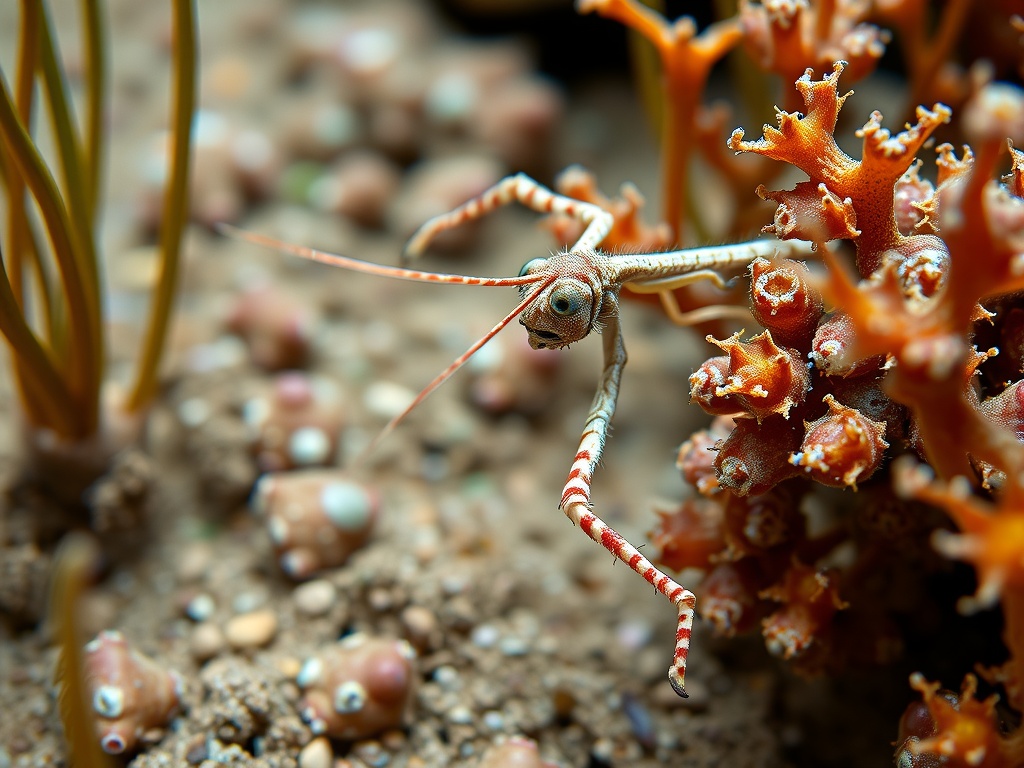
About the Weedy seadragon
The weedy or common seadragon (Phyllopteryx taeniolatus) drifts over kelp and seagrass along the southern Australian coast, and the leaf-like appendages that give it its name do no work at all in swimming. They are pure camouflage. Propulsion comes from a nearly transparent dorsal fin and a pair of tiny pectoral fins that beat up to around 30 times a second, so an animal that looks like a drifting piece of weed is in fact under precise control, and a diver often sees nothing but a faint blur along its back. Unlike its relatives the seahorses, a seadragon has no prehensile tail and cannot grip anything, so it must hold position by fin power alone and is helpless in heavy surge. It feeds by drawing mysid shrimp into a long, tubular, toothless snout with a sudden pipette-like suck. Reproduction follows the syngnathid rule that the male gestates, but the weedy seadragon has no pouch: instead the female deposits around 120 bright pink eggs directly onto a spongy patch of skin on the underside of the male's tail, where they are embedded and carried for about eight weeks until they hatch. Individuals carry unique spot patterns and are highly site-faithful, so citizen-science photo catalogues have tracked the same animals on the same reefs for years.
Fascinating facts
Unique Camouflage
Weedy seadragons have leaf-like appendages that help them blend in with seagrass and kelp, making them difficult for predators to spot.
Male Egg Care
Males carry fertilized eggs on the underside of their tails, providing oxygen and protection until the young hatch.
No Grasping Tail
Unlike seahorses, weedy seadragons cannot use their tails to grasp or anchor themselves to objects.
Detailed description
The weedy seadragon (Phyllopteryx taeniolatus) is a highly distinctive marine fish characterized by its elongated, slender body reaching up to 45 cm in length, adorned with small, leaf-like appendages along the trunk and tail. These appendages, less elaborate than those of the leafy seadragon, provide effective camouflage among kelp and seagrass. The body coloration is predominantly reddish to orange, with intricate yellow and purple vertical stripes and spots, enhancing its mimicry of drifting seaweed. The head is small with a long, tubular, toothless snout adapted for suction feeding, and the eyes are independently movable, aiding in prey detection. Dorsal and pectoral fins are nearly transparent and provide subtle propulsion and maneuverability, while the tail is non-prehensile, distinguishing it from seahorses. Weedy seadragons are slow, deliberate swimmers, relying on stealth and camouflage rather than speed. Their skin is covered in bony plates rather than scales, offering protection from predators. Sexual dimorphism is present: males are generally slimmer and darker, especially during the breeding season. The species is endemic to temperate coastal waters of southern Australia, typically inhabiting rocky reefs, seaweed beds, and seagrass meadows at depths of 3–50 meters.
Did you know?
Weedy seadragons lack a stomach and must eat almost constantly to survive.
Research & sources
Wikipedia summary
The common seadragon or weedy seadragon is a marine fish of the order Syngnathiformes, which also includes the similar pipefishes, seahorses, and trumpetfishes among other species. Adult common seadragons are a reddish colour, with yellow and purple striped markings; they have small, leaf-like appendages that resemble kelp or seaweed fronds, providing camouflage, as well as a number of short spines for protection. As with seahorses and the other syngnathids, the seadragon has a similarly tubular snout and a fused, toothless jaw into which it captures small invertebrate prey at lightning speed. Males have narrower bodies and are darker than females. Seadragons have a long dorsal fin along the back and small pectoral fins on either side of the neck, which provide balance. Weedy seadragons can reach 45 cm (18 in) in length.
Behaviour & social structure
Weedy seadragons are solitary or found in loose aggregations, with little evidence of strong social bonds outside of breeding pairs. They exhibit cryptic behavior, spending much of their time drifting or hovering among seaweed and seagrass, swaying gently to mimic the movement of vegetation. Their daily activity peaks during daylight hours, when they forage for small crustaceans, mysid shrimp, and zooplankton, using rapid suction feeding to capture prey. Hunting is a slow, methodical process, with individuals relying on their camouflage to approach prey undetected. They lack territoriality and do not defend specific areas, instead maintaining overlapping home ranges. Communication is limited, but courtship involves synchronized swimming and color changes. Predation risk is mitigated primarily through camouflage, as their slow movement makes escape difficult.
Reproduction & life cycle
Weedy seadragons exhibit a unique reproductive strategy among fishes: males are responsible for brooding the eggs. Breeding typically occurs from late spring to early summer (October to January in southern Australia). During courtship, males and females engage in elaborate displays, including parallel swimming and color intensification. The female deposits 120–250 bright pink eggs onto a specialized brood patch on the underside of the male's tail, where they adhere and are fertilized externally. The male incubates the eggs for approximately 4–6 weeks, during which he provides oxygenation and protection. Upon hatching, the fully formed juveniles are released into the water column and receive no further parental care. Juvenile survival rates are low, with high predation and dispersal by currents.
Adaptations & survival
Weedy seadragons possess several adaptations for survival in their temperate reef environments. Their cryptic coloration and leaf-like appendages provide exceptional camouflage, reducing predation risk. The rigid, bony body armor offers physical protection, while the tubular snout enables efficient suction feeding on small, elusive prey. Transparent fins minimize visual detection by predators and prey. Evolutionary specialization includes the development of a male brood patch for egg incubation, an adaptation shared with other syngnathids but unique in its external location. Their slow, energy-efficient swimming style is well-suited to habitats with abundant cover and low current.
Cultural significance
Weedy seadragons hold cultural significance as an emblematic species of southern Australia, featuring in local art, tourism, and conservation campaigns. They are the official marine emblem of the state of Victoria. Their unique appearance and reproductive behavior have made them popular in public aquaria worldwide, serving as ambassadors for marine conservation. There are no known traditional uses or mythological associations, but their rarity and beauty have inspired protective measures and public interest in marine biodiversity.
Recent research
Recent research on weedy seadragons has focused on population genetics, revealing limited gene flow between geographically separated populations, which has important implications for conservation management. Studies using underwater visual census and photo-identification have improved understanding of their site fidelity and movement patterns. Advances in captive breeding have been achieved in several aquaria, providing insights into reproductive biology and offering potential for ex situ conservation. Ongoing research is investigating the impacts of climate change on their habitats and the potential for assisted migration or habitat restoration to support declining populations.
Sources
Weedy Seadragon (Phyllopteryx taeniolatus): Biology and Conservation
Martin-Smith, K.M., Rouse, G.W., et al. (2023)
scientificVideos
Habitat
Temperate coastal reefs and seagrass beds

Conservation
The Weedy seadragon is currently classified as Near Threatened on the IUCN Red List.
Threats & challenges
The primary threats to weedy seadragon populations include habitat degradation from coastal development, pollution, and climate change, particularly the loss of kelp forests and seagrass beds. Collection for the aquarium trade, though regulated, has historically contributed to local declines. Their limited dispersal ability and specialized habitat requirements make populations vulnerable to fragmentation and localized extinctions. Climate-driven changes, such as warming seas and increased storm frequency, further threaten their habitats. The IUCN currently lists the species as Vulnerable, with population trends believed to be declining in some areas.
Taxonomy
Scientific name
Phyllopteryx taeniolatus
- Kingdom
- Animalia
- Phylum
- Chordata
- Class
- Actinopterygii
- Order
- Syngnathiformes
- Family
- Syngnathidae
- Genus
- Phyllopteryx
- Species
- taeniolatus
Where to see a weedy seadragon
4 zoos and aquariums in 1 country are recorded as keeping this species.
 Georgia Aquarium🇺🇸 Atlanta, United States
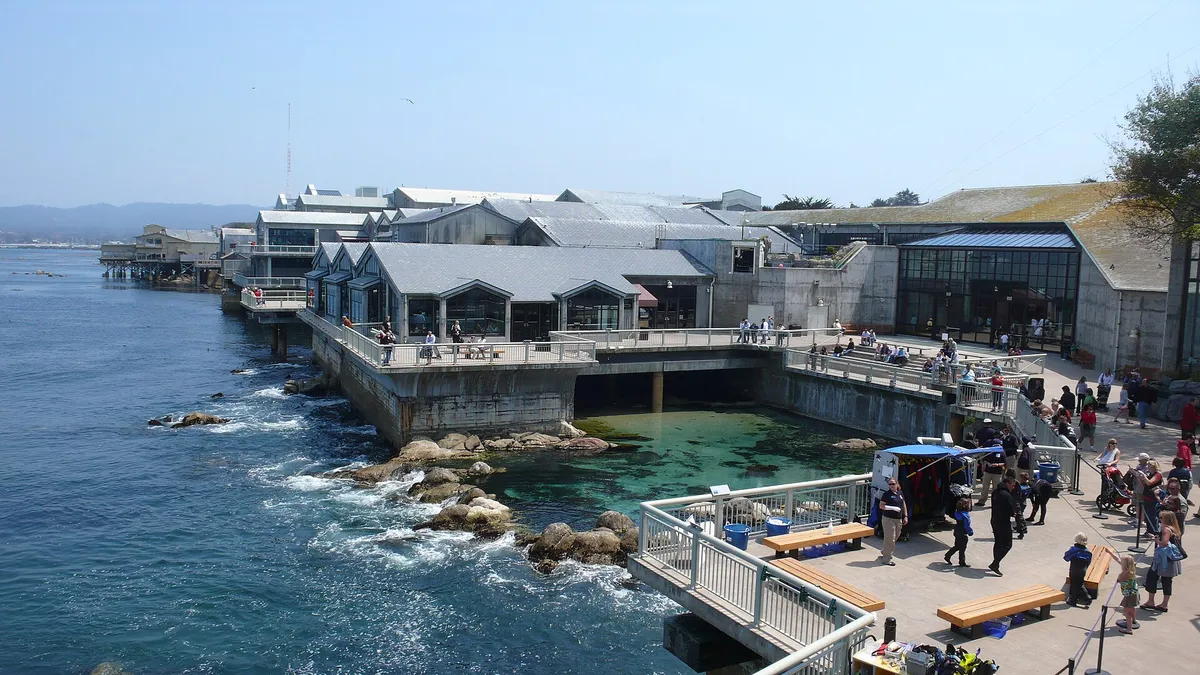 Monterey Bay Aquarium🇺🇸 Monterey, United States
 New England Aquarium🇺🇸 Boston, United States
 Aquarium of the Pacific🇺🇸 United States
Community notes
Share your observations about the Weedy seadragon.
No community notes yet. Be the first!
Discover more wildlife
More fascinating animals from the encyclopedia.