
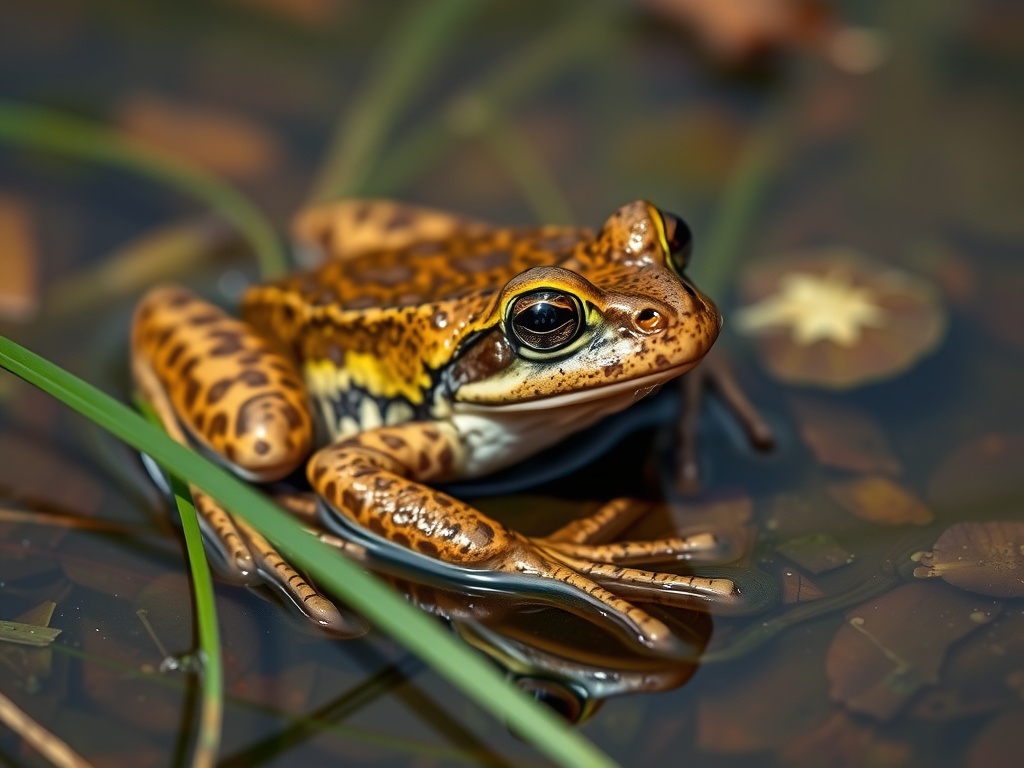
About the Western Chorus Frog
The Western Chorus Frog is a small, slender amphibian known for its distinctive, high-pitched trilling call that signals the arrival of spring in North America. Typically measuring under 4 cm in length, this frog exhibits color variations from gray to brown with three dark stripes running down its back. It inhabits a variety of moist environments, including temporary pools, marshes, and grassy wetlands. Despite its diminutive size, the Western Chorus Frog plays a crucial ecological role by controlling insect populations and serving as prey for a variety of larger animals.
Fascinating facts
Spring Singers
Western Chorus Frogs are among the first amphibians to call in the spring, often when snow and ice are still present.
Insect Eaters
Their diet consists primarily of small insects and invertebrates, helping to keep pest populations in balance.
Habitat Flexibility
They adapt well to a variety of habitats, including disturbed areas, making them more resilient than some other amphibian species.
Detailed description
The Western Chorus Frog (Pseudacris triseriata) is a diminutive member of the Hylidae family, typically measuring 19–38 mm (0.75–1.5 inches) in length. Its slender body is characterized by smooth skin, with coloration ranging from grayish to light brown or olive, often exhibiting three prominent dark dorsal stripes and a white or pale yellowish underside. A distinctive dark stripe runs from the snout through the eye to the groin. The toes are only slightly webbed, and adhesive toe pads are present but less developed than in tree-dwelling relatives, reflecting its semi-terrestrial habits. This species is renowned for its loud, trilling breeding call, which resembles the sound of running a finger along a plastic comb and can be heard from considerable distances during early spring. Western Chorus Frogs are primarily nocturnal, emerging at dusk to forage and vocalize. They are highly secretive outside the breeding season, often hiding under leaf litter or in grassy vegetation. Their cryptic coloration and small size provide effective camouflage against predators. The species is capable of surviving in a wide range of habitats, including ephemeral pools, which dry out seasonally, and this flexibility is key to its broad distribution across central and eastern North America.
Did you know?
Despite their name, Western Chorus Frogs are actually found across much of central and eastern North America, not just the western regions.
Research & sources
Wikipedia summary
The western chorus frog, also known as striped chorus frog, or midland chorus frog is a species of frog found in Canada and the United States.
Behaviour & social structure
Western Chorus Frogs are most active during the breeding season, when males congregate in shallow water bodies and form loose choruses to attract females. Outside of breeding, they are solitary and elusive, spending daylight hours concealed under debris, rocks, or vegetation to avoid desiccation and predation. Their diet consists mainly of small invertebrates such as ants, beetles, spiders, and springtails, which they capture using a rapid flick of their sticky tongue. Foraging typically occurs at night or during periods of high humidity. These frogs exhibit site fidelity to breeding pools, often returning to the same locations each year. Social interactions are generally limited to the breeding season, with males competing acoustically for mates. Aggressive encounters are rare but may include physical displacement or call interference. They are sensitive to vibrations and changes in humidity, which influence their activity patterns.
Reproduction & life cycle
Breeding occurs early in the spring, often as soon as ice melts from ponds and temperatures rise above freezing, typically from March to May depending on latitude. Males arrive at breeding sites first and begin calling to attract females. Amplexus (the mating embrace) is axillary, with the male grasping the female behind her forelimbs. Females lay between 500 and 1,500 eggs in small clusters attached to submerged vegetation or debris in shallow water. There is no parental care after egg-laying. The eggs hatch in 3–14 days, depending on water temperature, and the tadpoles undergo rapid development to metamorphosis, often completing transformation into froglets within 6–8 weeks. This accelerated development is an adaptation to the temporary nature of many breeding pools, which may dry up before late summer.
Adaptations & survival
Pseudacris triseriata exhibits several adaptations for survival in variable and sometimes harsh environments. Its cryptic coloration and small size reduce predation risk. The species can tolerate a wide range of temperatures and is among the earliest amphibians to breed in spring, taking advantage of temporary pools before predators such as fish become established. Rapid larval development minimizes the risk of desiccation in ephemeral habitats. The frogs are capable of limited freeze tolerance, surviving brief periods of subfreezing temperatures by producing cryoprotectants such as glucose in their tissues. Their vocalizations are adapted for propagation over open water and through dense vegetation, maximizing mate attraction in noisy environments.
Cultural significance
The Western Chorus Frog is widely recognized as a harbinger of spring in North America, with its distinctive call often cited in local folklore and naturalist writings. Its presence is celebrated in environmental education programs as an indicator of wetland health. While it does not hold major roles in indigenous mythology or traditional medicine, its ecological importance and seasonal vocalizations have made it a familiar and appreciated component of rural and suburban soundscapes.
Recent research
Recent research on Pseudacris triseriata has focused on its population genetics, revealing significant cryptic diversity and prompting taxonomic reevaluation in some regions. Studies have examined the effects of agricultural contaminants on larval development and immune function, highlighting the species' sensitivity to environmental change. Bioacoustic research has detailed the structure and variability of its mating calls, contributing to understanding of speciation and reproductive isolation within the Pseudacris genus. Ongoing monitoring programs track population trends and inform conservation strategies, particularly in areas where habitat loss is acute.
Sources
Videos
Habitat
Freshwater wetlands, marshes, grasslands, woodland edges, and temporary pools
 Various Continental Regions
Grassland
Open areas dominated by grasses rather than trees, supporting numerous herbivores and their predators.
 Global
Forest
Wooded areas with significant tree cover and diverse plant and animal communities.
 Global
Freshwater
Lakes, rivers, and wetlands with diverse aquatic ecosystems.
Conservation
The Western Chorus Frog is currently classified as Least Concern on the IUCN Red List.
Threats & challenges
While the Western Chorus Frog is currently listed as Least Concern by the IUCN, localized populations face significant threats. Habitat loss and fragmentation due to urbanization, agriculture, and wetland drainage are primary concerns. Pesticide and pollutant runoff can negatively affect both adults and developing larvae. Climate change poses additional risks by altering precipitation patterns and reducing the availability of suitable breeding sites. Road mortality during seasonal migrations and the introduction of predatory fish to breeding ponds also contribute to population declines in some areas. Despite these challenges, the species' adaptability and broad range have allowed it to persist in many regions.
Taxonomy
Scientific name
Pseudacris triseriata
- Kingdom
- Animalia
- Phylum
- Chordata
- Class
- Amphibia
- Order
- Anura
- Family
- Hylidae
- Genus
- Pseudacris
- Species
- triseriata
Community notes
Share your observations about the Western Chorus Frog.
No community notes yet. Be the first!
Discover more wildlife
More fascinating animals from the encyclopedia.