
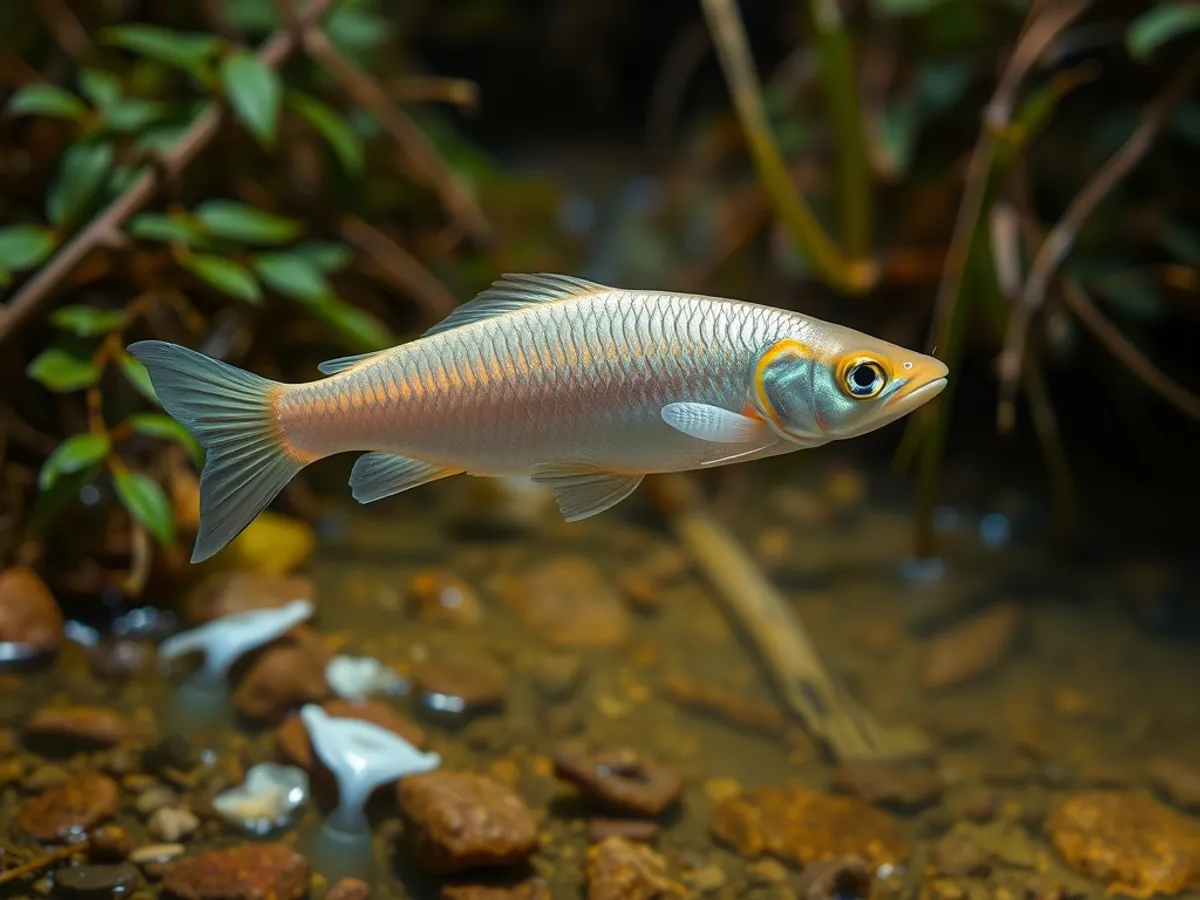
About the White cloud mountain minnow
The White cloud mountain minnow is a small, colorful freshwater fish native to streams of the White Cloud Mountains in Guangdong, China. Known for their iridescent bodies and red-tipped fins, these fish are popular in home aquariums due to their hardiness and peaceful nature. In the wild, they inhabit cool, clear streams with abundant vegetation. Despite their adaptability, wild populations have declined due to habitat loss and over-collection, though they remain common in captivity.
Fascinating facts
Colorful Appearance
White cloud mountain minnows have a shimmering greenish-silver body with a bright red tail and distinctive white fin tips.
Native Habitat
They are endemic to the mountain streams of southern China, particularly in the White Cloud Mountain area near Guangzhou.
Cold-Water Tolerance
Unlike many tropical fish, they can withstand relatively cool water, making them suitable for unheated aquariums.
Detailed description
The White cloud mountain minnow (Tanichthys albonubes) is a diminutive cyprinid fish, typically reaching an adult length of 2.5–4 cm, with a slender, laterally compressed body. Its coloration is striking, featuring an iridescent, silvery-green lateral stripe running from the eye to the base of the tail, contrasted by translucent fins tipped with red or orange. The dorsal and anal fins often display a yellow or white margin, enhancing their visual appeal. This species possesses a terminal mouth adapted for surface and mid-water feeding, and lacks barbels, distinguishing it from many other cyprinids. White cloud mountain minnows are highly social, forming loose shoals in the wild, which provides protection from predators and facilitates coordinated foraging. Their natural habitat consists of cool, slow-flowing streams with dense aquatic vegetation and rocky substrates, where water temperatures range from 16–22°C. They are diurnal, exhibiting peak activity during daylight hours. The species is renowned for its hardiness, tolerating a wide range of water conditions, which has contributed to its popularity in the aquarium trade. In the wild, their populations are fragmented, and they are now rarely encountered in their native range due to habitat degradation and over-collection.
Did you know?
The species was once thought extinct in the wild until remnant populations were rediscovered in remote parts of its native range.
Research & sources
Behaviour & social structure
White cloud mountain minnows are peaceful, schooling fish that exhibit strong shoaling behavior, often swimming in synchronized groups of 6–20 individuals. This social structure reduces individual predation risk and enhances foraging efficiency. They are opportunistic omnivores, feeding primarily on small aquatic invertebrates, insect larvae, zooplankton, and algae. In the wild, they actively forage throughout the day, using their keen eyesight to detect prey near the water surface and among vegetation. Aggression is minimal, with only occasional displays of fin-flaring or chasing during breeding or when establishing minor social hierarchies. These minnows are highly responsive to environmental changes, often altering their activity patterns in response to water temperature and light levels. At night, they seek shelter among plants or under rocks, reducing movement to conserve energy and avoid nocturnal predators.
Reproduction & life cycle
Tanichthys albonubes are egg-scattering spawners with no parental care. Breeding typically occurs in the spring and early summer when water temperatures rise above 18°C. Males display intensified coloration and chase females, performing courtship displays that involve circling and fin spreading. Females release 20–100 adhesive eggs per spawning event, which are fertilized externally as they fall among fine-leaved aquatic plants or substrate crevices. Incubation lasts 36–48 hours at optimal temperatures (20–22°C), after which the fry become free-swimming within 3–4 days. Larvae are planktonic initially, feeding on infusoria and microcrustaceans. Sexual maturity is reached within 6–8 months under favorable conditions. In captivity, these fish breed readily, often without intervention, provided dense vegetation or spawning mops are available.
Adaptations & survival
White cloud mountain minnows are adapted to cool, oxygen-rich streams, with a high tolerance for temperature fluctuations (as low as 14°C), which is unusual among tropical aquarium fish. Their streamlined bodies and small size enable them to navigate dense vegetation and evade predators. The iridescent lateral stripe may serve as a visual cue for shoal cohesion and mate recognition, while also providing camouflage by reflecting ambient light. Their omnivorous diet and flexible feeding strategies allow them to exploit a variety of food sources, enhancing survival in fluctuating environments. Rapid reproductive cycles and high fecundity enable quick population recovery following disturbances. Behavioral plasticity, such as shoaling and shelter-seeking, further increases their resilience to environmental stressors.
Cultural significance
The White cloud mountain minnow holds a special place in the aquarium hobby, often referred to as the 'poor man's neon tetra' due to its vibrant coloration and affordability. Discovered in the 1930s by Chinese Boy Scout leader Tan Kan Fei, the species was named in honor of its native White Cloud Mountain locality. In China, it is sometimes associated with good fortune and harmony, reflecting its peaceful nature and shoaling behavior. There are no significant roles in folklore or traditional medicine, but its popularity has contributed to increased awareness of freshwater biodiversity and conservation issues.
Recent research
Recent genetic studies have clarified the phylogenetic relationships within the genus Tanichthys, leading to the identification of several closely related species in Vietnam and southern China. Research into their thermal tolerance has highlighted their potential as a model organism for studying cold adaptation in cyprinids. Conservation genetics work is ongoing to assess the genetic diversity of remnant wild populations versus captive stocks. Studies on their reproductive biology in captivity have informed best practices for sustainable breeding, reducing pressure on wild populations. Ecological research has also examined their role in stream food webs and their interactions with native and invasive species.
Sources
Tanichthys albonubes (White Cloud Mountain Minnow): Taxonomy, Ecology, and Conservation
Freyhof, J. & Herder, F. (2020)
scientificTanichthys albonubes: A Review of Its Biology and Conservation
Fang, F. & Kottelat, M. (2000)
scientificVideos
Habitat
Cool, clear freshwater streams with dense vegetation
 Elevated Terrain
Mountain
High-altitude environments with varying climates and specialized wildlife adapted to rugged terrain and thin air.
 Global
Forest
Wooded areas with significant tree cover and diverse plant and animal communities.
 Global
Freshwater
Lakes, rivers, and wetlands with diverse aquatic ecosystems.
Conservation
The White cloud mountain minnow is currently classified as Near Threatened on the IUCN Red List.
Threats & challenges
The primary threats to wild populations of Tanichthys albonubes include habitat loss from urbanization, pollution, and stream modification in their native range in southern China. Over-collection for the aquarium trade historically contributed to population declines, though captive breeding has largely supplanted wild capture in recent decades. The species is classified as Near Threatened by the IUCN due to its restricted and fragmented distribution, with some populations potentially extirpated. Invasive species, such as introduced predatory fish, further exacerbate pressures. Conservation challenges include habitat restoration, protection of remaining natural streams, and prevention of further environmental degradation. While the species is abundant in captivity, reintroduction efforts are complicated by ongoing habitat loss and genetic bottlenecks in wild populations.
Taxonomy
Scientific name
Tanichthys albonubes
- Kingdom
- Animalia
- Phylum
- Chordata
- Class
- Actinopterygii
- Order
- Cypriniformes
- Family
- Cyprinidae
- Genus
- Tanichthys
- Species
- albonubes
Community notes
Share your observations about the White cloud mountain minnow.
No community notes yet. Be the first!
Discover more wildlife
More fascinating animals from the encyclopedia.