
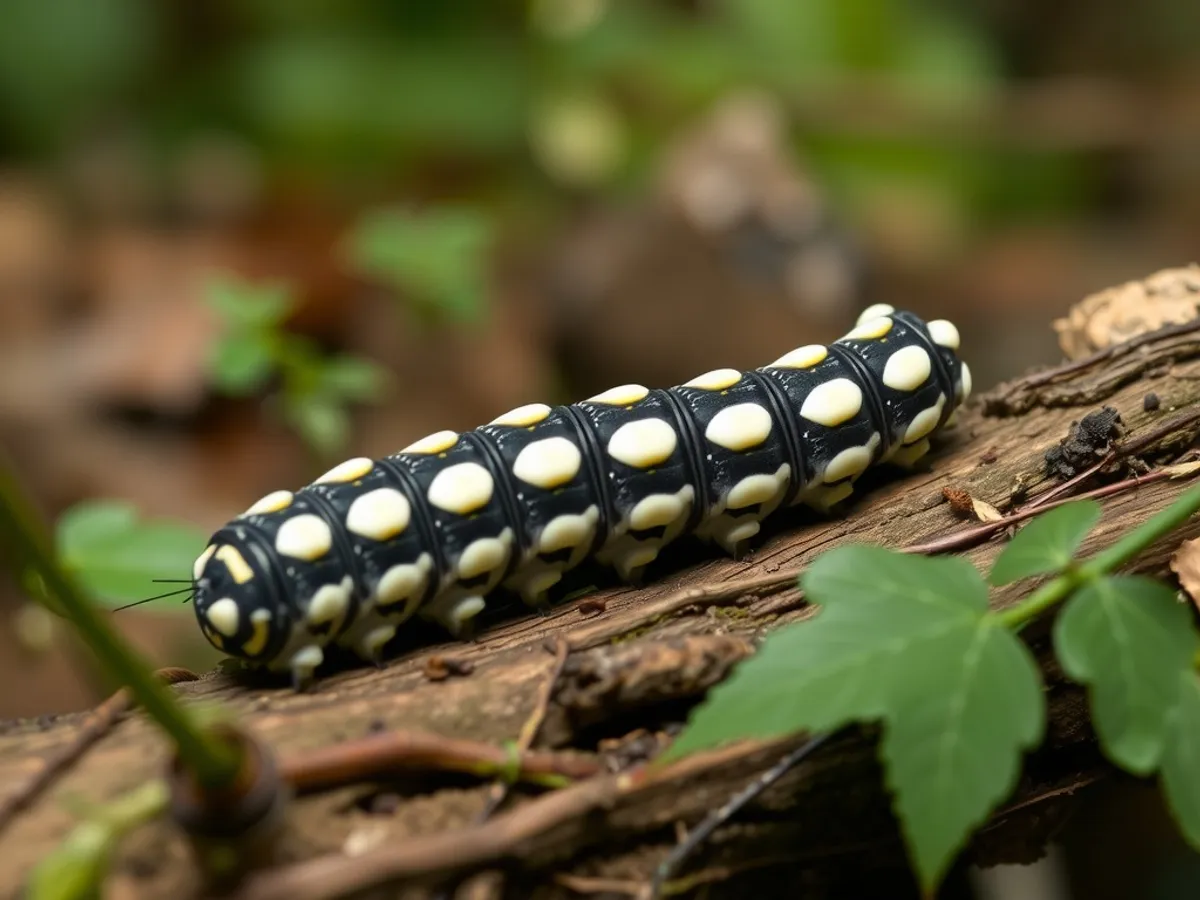
About the White-spotted Puffer Caterpillar
The white-spotted puffer caterpillar is the larval stage of the Imperial Fruit-sucking Moth (Phyllodes imperialis), known for its unusual and striking appearance. This caterpillar is famous for its mimicry, featuring prominent white spots and a swollen, puffy body that closely resembles the head of a snake as a defensive adaptation. Found primarily in the forests of Australia and parts of Southeast Asia, it feeds on a variety of native fig species. Its unique look serves as a warning to predators, helping it avoid being eaten before it metamorphoses into a large, cryptic moth.
Fascinating facts
Master of Mimicry
This caterpillar can inflate the front of its body, displaying false eyespots to resemble a snake's head and scare away predators.
Fig Leaf Diet
It primarily feeds on the leaves of native fig trees, making it an important part of its local ecosystem.
Metamorphosis Marvel
After its caterpillar stage, it transforms into the impressive Imperial Fruit-sucking Moth, which is well-camouflaged in adulthood.
Detailed description
The White-spotted Puffer Caterpillar (Phyllodes imperialis) is the larval stage of a large noctuid moth, notable for its extraordinary mimicry and defensive adaptations. The caterpillar typically measures 60–80 mm in length at maturity and is characterized by a robust, swollen thoracic region that mimics the head of a snake, complete with false 'eye spots' and a pronounced neck-like constriction. Its dorsal surface is a vibrant green to brown, adorned with conspicuous white spots and irregular markings that enhance its camouflage among fig foliage. When threatened, the caterpillar retracts its true head and inflates its anterior segments, accentuating the snake-like illusion. This species is solitary and primarily nocturnal, feeding on the leaves of Ficus species, which provide both nutrition and a degree of chemical defense. The caterpillar undergoes several molts before pupating in a loosely spun cocoon among leaf litter. Its cryptic coloration and mimicry serve as primary defenses against avian and reptilian predators. The adult moth is large, with a wingspan of up to 120 mm, and exhibits cryptic bark-like wing patterns. The lifecycle from egg to adult spans approximately 6–8 weeks, depending on environmental conditions.
Did you know?
Despite its snake-like appearance, the white-spotted puffer caterpillar is completely harmless and survives solely by eating leaves.
Research & sources
Behaviour & social structure
Phyllodes imperialis caterpillars are primarily solitary and exhibit a crepuscular to nocturnal feeding pattern, minimizing exposure to diurnal predators. They spend daylight hours motionless on the underside of leaves, relying on their mimicry for protection. When disturbed, they display a defensive posture by arching their anterior body and exposing the false eye spots, sometimes accompanied by gentle swaying to enhance the snake mimicry. Feeding occurs mainly at night, with the caterpillar consuming the softer, younger leaves of host fig trees. There is no evidence of social behavior or aggregation among larvae, and cannibalism is rare. The caterpillar's frass is often dropped away from the feeding site to reduce detection by predators and parasitoids.
Reproduction & life cycle
The reproductive cycle begins with the female moth laying clusters of 20–50 pale green eggs on the underside of host plant leaves, typically during the early wet season (October–March in Australia). Eggs hatch within 7–10 days, and larvae progress through five instars over 3–4 weeks. Pupation occurs in a loose cocoon constructed from silk and leaf debris on the forest floor, lasting 2–3 weeks. There is no parental care; all life stages are independent after oviposition. In tropical regions, multiple generations may occur annually, while subtropical populations may be more seasonal.
Adaptations & survival
The most remarkable adaptation of Phyllodes imperialis is its Batesian mimicry, where the caterpillar's swollen thorax and eye spots closely resemble a snake's head, deterring visually oriented predators such as birds and lizards. The coloration and patterning provide both disruptive camouflage and aposematic signals. The caterpillar also sequesters secondary plant compounds from its fig diet, which may provide some chemical defense. Behavioral adaptations include nocturnal feeding and frass-dropping to avoid detection. The adult moth's cryptic wing patterns mimic tree bark, aiding in concealment during daytime rest.
Cultural significance
While not widely featured in folklore, the striking appearance of the caterpillar has made it a subject of interest among naturalists and photographers. In some indigenous Australian cultures, large moths and their caterpillars are considered indicators of seasonal change, though there are no specific myths directly associated with Phyllodes imperialis. Its mimicry is often cited in educational materials as a classic example of defensive adaptation in caterpillars.
Recent research
Recent research has focused on the genetic and developmental basis of snake mimicry in Phyllodes imperialis, with studies revealing that the eye spot patterning is controlled by a complex interplay of regulatory genes. Ongoing ecological studies are examining the impact of habitat fragmentation on host plant availability and caterpillar survival. There is also interest in the chemical ecology of the species, particularly regarding the sequestration of fig-derived compounds and their role in predator deterrence. Citizen science initiatives in Australia have contributed valuable distribution data, aiding in conservation assessments.
Sources
Defensive mimicry in the caterpillar of Phyllodes imperialis (Lepidoptera: Erebidae): Morphology and behavior
J. A. Endler, M. E. Young (2020)
scientificHost plant associations and larval ecology of Phyllodes imperialis in Australia
Australian National Insect Collection (2018)
scientificMimicry and Defensive Strategies in the Larvae of Phyllodes imperialis
Common, I.F.B. & Edwards, E.D. (1991)
scientificPhyllodes imperialis: Species Profile
Australian Faunal Directory, Department of Climate Change, Energy, the Environment and Water
conservationVideos
Habitat
Forest

Conservation
The White-spotted Puffer Caterpillar is currently classified as Least Concern on the IUCN Red List.
Threats & challenges
Currently assessed as Least Concern, Phyllodes imperialis faces localized threats from habitat loss due to deforestation and urbanization, particularly in Southeast Asia. The reliance on native Ficus species makes it vulnerable to changes in forest composition and the introduction of invasive plant species. Pesticide use in agricultural areas may also impact larval survival. Natural enemies include parasitic wasps and flies, as well as predatory birds and reptiles. Climate change may alter the phenology and distribution of both the moth and its host plants, but populations remain stable in protected forest areas.
Taxonomy
Scientific name
Phyllodes imperialis
- Kingdom
- Animalia
- Phylum
- Arthropoda
- Class
- Insecta
- Order
- Lepidoptera
- Family
- Erebidae
- Genus
- Phyllodes
- Species
- imperialis
Community notes
Share your observations about the White-spotted Puffer Caterpillar.
No community notes yet. Be the first!
Discover more wildlife
More fascinating animals from the encyclopedia.