
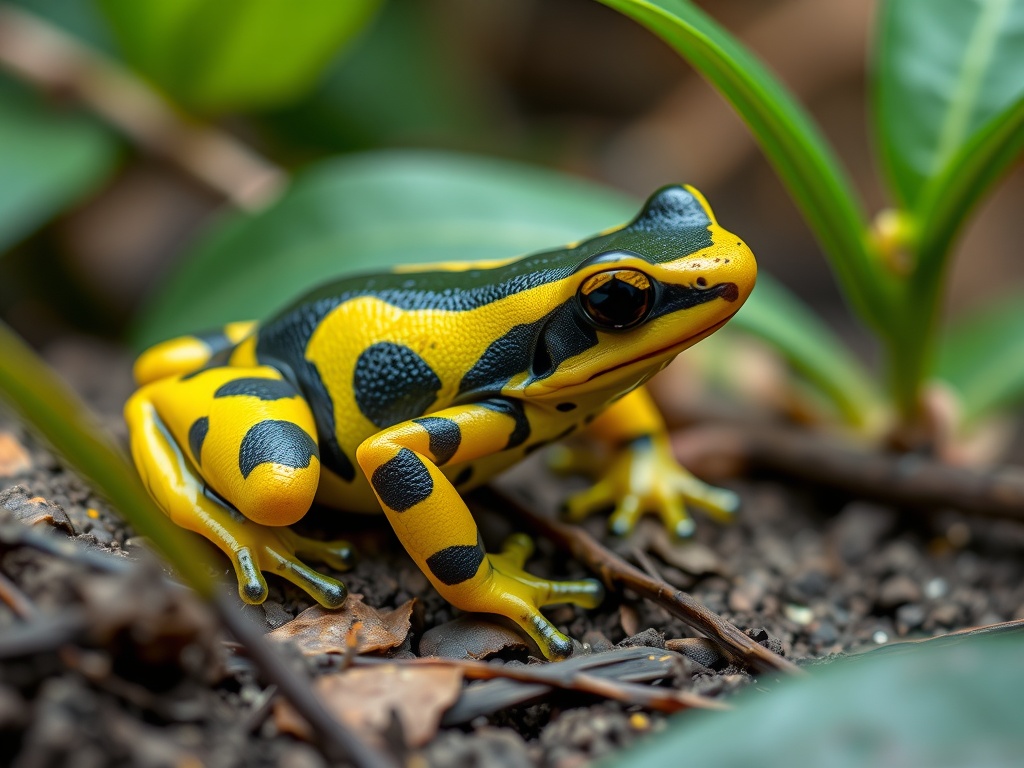
About the Yellow-banded Poison Dart Frog
The Yellow-banded Poison Dart Frog is a striking amphibian known for its vividly contrasting black and yellow bands. Native to the humid lowland rainforests of northern South America, this small frog uses its bright coloration as a warning to predators about its potent skin toxins. These toxins are derived from its diet in the wild and serve as an effective chemical defense. While toxic in the wild, captive-bred frogs typically lack these poisons due to dietary differences.
Fascinating facts
Bright Warning Colors
Their bold yellow and black patterns serve as aposematic coloration, warning predators of their toxicity.
Specialized Diet
In the wild, their diet primarily consists of ants, termites, and small insects that contribute to their skin toxins.
Vocal Amphibian
Males often call loudly to attract mates, making them one of the noisiest poison dart frogs.
Detailed description
The Yellow-banded Poison Dart Frog (Dendrobates leucomelas) is a small, vividly colored amphibian, typically measuring between 3 and 5 centimeters in length and weighing approximately 3 grams. Its striking aposematic coloration consists of bold yellow bands or blotches contrasted against a deep black background, serving as a visual deterrent to potential predators. The skin contains potent alkaloid toxins, primarily batrachotoxins, which are sequestered from their diet of ants, mites, and other arthropods in the wild. Anatomically, D. leucomelas possesses expanded toe pads that facilitate climbing and adherence to smooth, moist surfaces in its rainforest habitat. This species is diurnal, with activity peaking during the humid daylight hours. Socially, they are semi-gregarious, often found in small groups, especially during the breeding season. Males are territorial and use a distinctive, trilling call to establish dominance and attract mates. Reproduction involves complex courtship rituals, and females lay clutches of 2–12 eggs in moist terrestrial microhabitats. Parental care is notable: males often guard the eggs, and both parents may transport tadpoles to ephemeral water sources. The species is highly adapted to the fluctuating humidity of its environment, capable of entering a state of estivation during dry periods.
Did you know?
Captive Yellow-banded Poison Dart Frogs lose their toxicity because they do not consume the same toxin-producing insects found in their native rainforest environment.
Research & sources
Behaviour & social structure
Yellow-banded Poison Dart Frogs are primarily terrestrial but exhibit arboreal tendencies, frequently climbing low vegetation. Their foraging behavior is active and visually guided, relying on acute vision to detect small invertebrate prey. They consume a variety of ants, termites, beetles, and mites, with a preference for alkaloid-rich species that contribute to their toxicity. Social interactions are generally peaceful outside the breeding season, but males become territorial and may engage in physical displays or vocal contests. Daily routines include basking in filtered sunlight, foraging, and seeking shelter under leaf litter or in bromeliads during periods of low humidity. These frogs exhibit site fidelity, often returning to the same microhabitats. Communication is primarily acoustic, with males producing a rapid, high-pitched trill to mark territory and attract females.
Reproduction & life cycle
Breeding in D. leucomelas is closely tied to seasonal rainfall, typically peaking during the wet season (April to November). Males establish and defend calling sites, often near suitable egg-laying locations. Courtship involves tactile and vocal interactions, with the male leading the female to a moist, concealed site for oviposition. Females lay clutches of 2–12 eggs on damp substrate, such as leaf litter or within bromeliad axils. The male guards the eggs, keeping them moist by transporting water or urinating on them. After 10–14 days, the eggs hatch into tadpoles, which are often carried singly on the back of a parent to small water bodies, such as phytotelmata or tree holes. Larval development lasts 50–70 days, after which metamorphosis occurs. Parental care is extensive, with adults sometimes providing unfertilized eggs as food for the developing tadpoles.
Adaptations & survival
D. leucomelas exhibits several key adaptations for survival in its humid, dynamic environment. Its aposematic coloration is an evolutionary response to predation, signaling toxicity to would-be predators. The skin secretes lipophilic alkaloid toxins, which are derived from dietary sources and serve as a potent chemical defense. Expanded toe pads and a prehensile grip facilitate climbing and navigating wet, slippery surfaces. The species can tolerate periods of reduced humidity by entering estivation, reducing metabolic activity until favorable conditions return. Behavioral adaptations include site fidelity, complex vocalizations for territory and mate attraction, and elaborate parental care strategies that increase offspring survival in unpredictable environments.
Cultural significance
While not as prominent in indigenous mythology as some other dendrobatids, the Yellow-banded Poison Dart Frog has become an emblematic species in the global amphibian conservation movement. Its striking appearance makes it a popular subject in ecotourism, educational programs, and the exotic pet trade (where only captive-bred individuals are legal). Unlike some related species, D. leucomelas has not been traditionally used by indigenous peoples for poison extraction. In popular culture, it symbolizes the fragility and diversity of tropical rainforest ecosystems.
Recent research
Recent research has focused on the chemical ecology of D. leucomelas, particularly the origin and diversity of its skin alkaloids, which vary geographically and with diet. Studies have demonstrated that captive frogs lose their toxicity within months when fed non-alkaloid-rich diets, confirming the dietary origin of their toxins. Ongoing genetic research is investigating population structure and phylogeography, revealing significant genetic diversity across its range. Behavioral studies have explored the species' complex vocalizations and parental care, contributing to broader understanding of amphibian social systems. Conservation research is monitoring the impact of habitat fragmentation and climate change on reproductive success and population viability.
Sources
Dendrobates leucomelas (Yellow-banded Poison Frog): Natural History and Ecology
Myers, C.W., Daly, J.W., and Malkin, B. (1978)
scientificDendrobates leucomelas: The IUCN Red List of Threatened Species 2020
IUCN SSC Amphibian Specialist Group
conservationVideos
Habitat
Tropical rainforest
 Tropical Regions
Rainforest
Dense, wet forests with the highest biodiversity on Earth, containing more than half of the world's plant and animal species.
 Global
Forest
Wooded areas with significant tree cover and diverse plant and animal communities.
 Global
Freshwater
Lakes, rivers, and wetlands with diverse aquatic ecosystems.
Conservation
The Yellow-banded Poison Dart Frog is currently classified as Least Concern on the IUCN Red List.
Threats & challenges
Although currently listed as Least Concern by the IUCN, D. leucomelas faces localized threats from habitat loss due to deforestation, agricultural expansion, and mining in its native range (Venezuela, northern Brazil, Guyana, and eastern Colombia). The illegal pet trade poses an additional risk, though captive breeding programs have reduced wild collection pressure. Climate change, with its potential to alter rainfall patterns and humidity, may impact breeding success and habitat suitability. Populations are generally stable, but fragmentation and environmental degradation could pose future challenges, especially in areas outside protected reserves.
Taxonomy
Scientific name
Dendrobates leucomelas
- Kingdom
- Animalia
- Phylum
- Chordata
- Class
- Amphibia
- Order
- Anura
- Family
- Dendrobatidae
- Genus
- Dendrobates
- Species
- leucomelas
Where to see a yellow-banded poison dart frog
5 zoos and aquariums in 1 country are recorded as keeping this species.
 National Zoological Park🇺🇸 Washington, United States
 New England Aquarium🇺🇸 Boston, United States
 North Carolina Zoo🇺🇸 Asheboro, United States
 Sacramento Zoo🇺🇸 Sacramento, United States
 Birmingham Zoo🇺🇸 United States
Community notes
Share your observations about the Yellow-banded Poison Dart Frog.
No community notes yet. Be the first!
Discover more wildlife
More fascinating animals from the encyclopedia.