
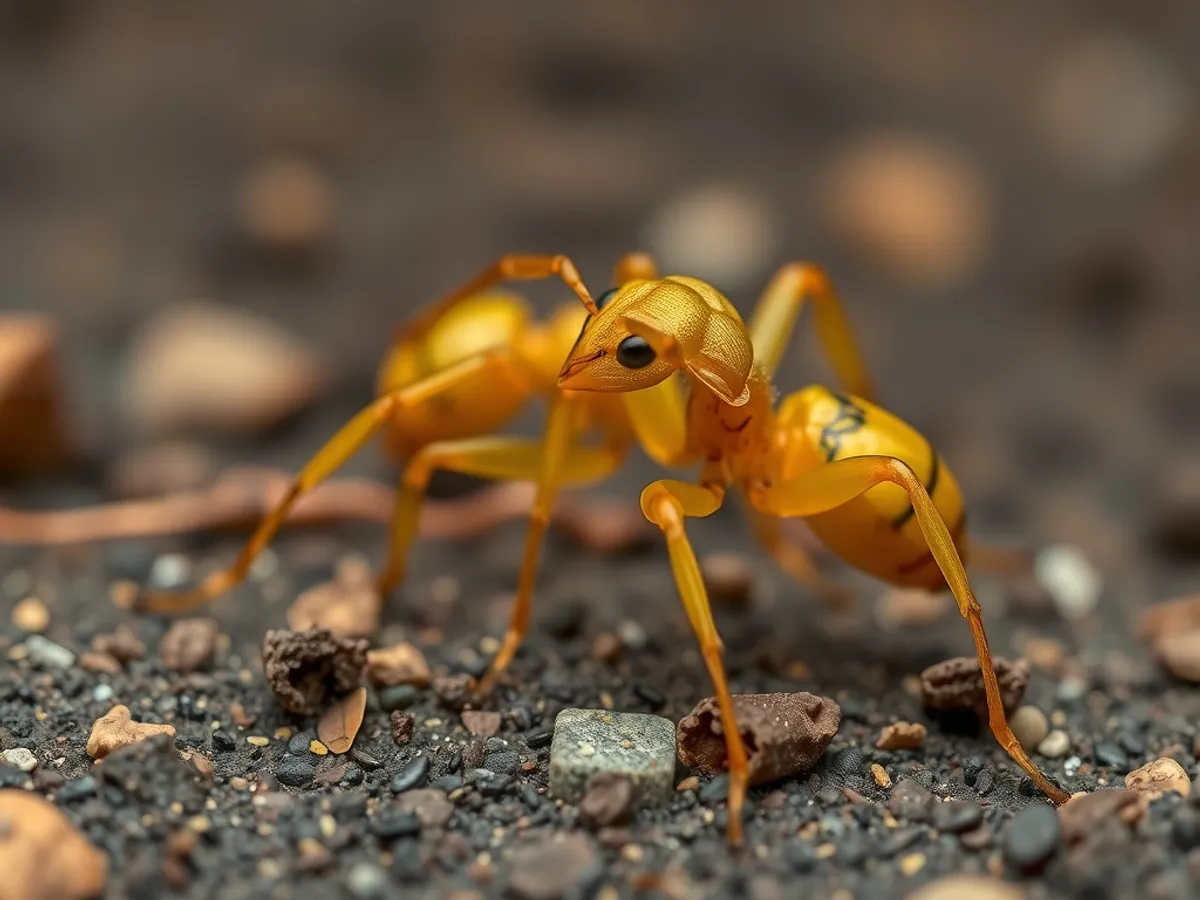
About the Yellow Crazy Ant
The yellow crazy ant (Anoplolepis gracilipes) takes its name from its erratic, jerky, seemingly panicked walk, and it is one of the most destructive invasive species on Earth. It has no sting. Instead it sprays formic acid from the tip of the abdomen, and it uses this in overwhelming numbers, because in invaded territory it forms supercolonies: unrelated queens and workers do not fight, so colony boundaries dissolve and ant densities can reach 20 million workers per hectare. Christmas Island, in the Indian Ocean, showed what that means. Crazy ants arrived some time last century and, by the 1990s, supercolonies had formed and were spraying acid into the eyes and gills of the island's red land crabs, blinding and killing an estimated 10 to 20 million of them. The crabs had been the island's dominant herbivore, eating seedlings and clearing the forest floor, so their removal transformed the rainforest: leaf litter piled up, seedlings survived that never would have, and the understorey changed structurally. The ants were fuelled throughout by farming introduced scale insects for honeydew, so the invasion sustained itself, a process ecologists named invasional meltdown. Control has combined targeted baiting with a biological control agent, a tiny wasp, released against the scale insects to cut the ants' sugar supply.
Fascinating facts
Erratic Movement
Yellow Crazy Ants are called 'crazy' because of their unpredictable and rapid movements, which make them appear to run in a disorderly fashion.
Invasive Impact
They are considered one of the world's worst invasive species, having caused severe ecological damage in places like Christmas Island.
Multiple Queens
Colonies often have multiple queens, allowing them to grow to extremely large sizes and making them particularly resilient to control efforts.
Detailed description
The Yellow Crazy Ant (Anoplolepis gracilipes) is a slender, medium-sized ant, with workers typically measuring 4–5 mm in length and queens reaching up to 15 mm. Their bodies are a pale yellow to brownish-yellow, with exceptionally long legs and antennae, giving them a spindly appearance. The species is named for its rapid, erratic movements, especially when disturbed. Colonies are polygynous, often containing multiple queens and millions of workers, which allows for rapid population growth and colony expansion. The ants lack a functional stinger but possess a highly effective acidopore at the tip of the abdomen, which they use to spray formic acid as a defense and to subdue prey. Their mandibles are well-developed for both predation and scavenging. Yellow Crazy Ants are highly adaptable, thriving in a wide range of habitats from primary forests to urban areas, and are particularly successful in disturbed environments. They form extensive foraging trails, often climbing vegetation and entering canopy layers, which increases their ecological impact. Their ability to form supercolonies—large, interconnected networks of nests—enables them to dominate invaded ecosystems and outcompete native ant species.
Did you know?
Yellow Crazy Ants have caused ecological disasters on some islands by killing millions of land crabs and altering forest ecosystems.
Research & sources
Wikipedia summary
The yellow crazy ant, also known as the long-legged ant or Maldive ant, is a species of ant, thought to be native to West Africa or Asia. They have been accidentally introduced to numerous places in the world's tropics.
Behaviour & social structure
Yellow Crazy Ants are primarily diurnal but can be active at night, especially in humid conditions. Workers exhibit highly cooperative foraging behavior, forming conspicuous trails that can extend for tens of meters. They are opportunistic omnivores, feeding on a wide range of food sources including insects, small vertebrates, seeds, nectar, honeydew from tended hemipterans (such as scale insects and aphids), and human food waste. The ants are aggressive towards other ant species and can rapidly overwhelm prey or competitors through sheer numbers and coordinated attacks. Social interactions within colonies are complex, with frequent trophallaxis (food sharing) and grooming. Alarm pheromones trigger rapid, chaotic movement, which is the origin of their 'crazy' descriptor. Colonies frequently relocate nests in response to environmental changes or resource availability, demonstrating high mobility and adaptability.
Reproduction & life cycle
Reproduction in Anoplolepis gracilipes is characterized by polygyny, with multiple queens laying eggs within a single colony. Nuptial flights are rare; instead, new colonies are often formed by budding, where a group of workers and one or more queens leave the main colony to establish a new nest nearby. Queens are highly fecund, capable of laying hundreds of eggs per day. Eggs hatch into larvae after approximately 1–2 weeks, with the larval stage lasting 2–3 weeks before pupation. Pupae are naked (not enclosed in cocoons), and the pupal stage lasts another 2–3 weeks before emerging as adult ants. There is no fixed breeding season in tropical environments; reproduction can occur year-round, with peaks often coinciding with periods of high resource availability. Parental care is provided collectively by workers, who feed and groom the brood.
Adaptations & survival
Yellow Crazy Ants exhibit several key adaptations that contribute to their invasive success. Their polygynous and polydomous social structure (multiple queens and nests) enables rapid colony expansion and resilience to disturbance. The ability to spray formic acid provides effective defense against predators and aids in subduing prey. Their long legs and antennae facilitate rapid movement and efficient foraging over complex terrain, including vegetation and leaf litter. Behavioral flexibility allows them to exploit a wide variety of food sources and nesting sites. They also display high tolerance to environmental stressors, such as desiccation and habitat disturbance, and can survive in both natural and human-modified landscapes.
Cultural significance
The Yellow Crazy Ant is not traditionally significant in folklore or mythology, but its notoriety as a pest has led to increased public awareness in invaded regions. In some areas, it has become a symbol of the unintended consequences of global trade and species introductions. Its impact on agriculture and natural ecosystems has prompted community-led eradication and management programs, and it is often cited in educational campaigns about invasive species.
Recent research
Recent research has focused on the ecological impacts of Yellow Crazy Ant invasions, particularly on island ecosystems. Studies have documented their role in altering nutrient cycling, displacing native ant fauna, and facilitating outbreaks of sap-sucking insects by protecting them from predators. Genetic studies have revealed low genetic diversity in introduced populations, suggesting that their invasive success is due more to social and behavioral traits than genetic variability. Ongoing research includes the development of targeted biological control agents, such as microsporidian pathogens and phorid flies, as well as improved baiting and management strategies. The species is also a model organism for studying supercolony formation and the evolution of invasive traits in social insects.
Videos
Habitat
Tropical and subtropical forests, plantations, and disturbed habitats
 Various Continental Regions
Grassland
Open areas dominated by grasses rather than trees, supporting numerous herbivores and their predators.
 Tropical Regions
Rainforest
Dense, wet forests with the highest biodiversity on Earth, containing more than half of the world's plant and animal species.
 Global
Forest
Wooded areas with significant tree cover and diverse plant and animal communities.
Conservation
The Yellow Crazy Ant is currently classified as Least Concern on the IUCN Red List.
Threats & challenges
Currently, Anoplolepis gracilipes faces few natural predators or diseases in its introduced ranges, contributing to its invasive success. However, in some regions, biological control efforts using parasitoid flies and pathogens are being explored. The primary conservation challenge is the ant's impact on native biodiversity, particularly on islands where they have caused dramatic declines in native invertebrates, reptiles, and even ground-nesting birds. For example, on Christmas Island, Yellow Crazy Ants have decimated populations of the endemic red land crab (Gecarcoidea natalis), leading to cascading ecological effects. Human activities, such as habitat modification and accidental transport, continue to facilitate their spread. While the species is not threatened globally, its management is a significant concern for conservationists and land managers in affected regions.
Taxonomy
Scientific name
Anoplolepis gracilipes
- Kingdom
- Animalia
- Phylum
- Arthropoda
- Class
- Insecta
- Order
- Hymenoptera
- Family
- Formicidae
- Genus
- Anoplolepis
- Species
- gracilipes
Community notes
Share your observations about the Yellow Crazy Ant.
No community notes yet. Be the first!
Discover more wildlife
More fascinating animals from the encyclopedia.