
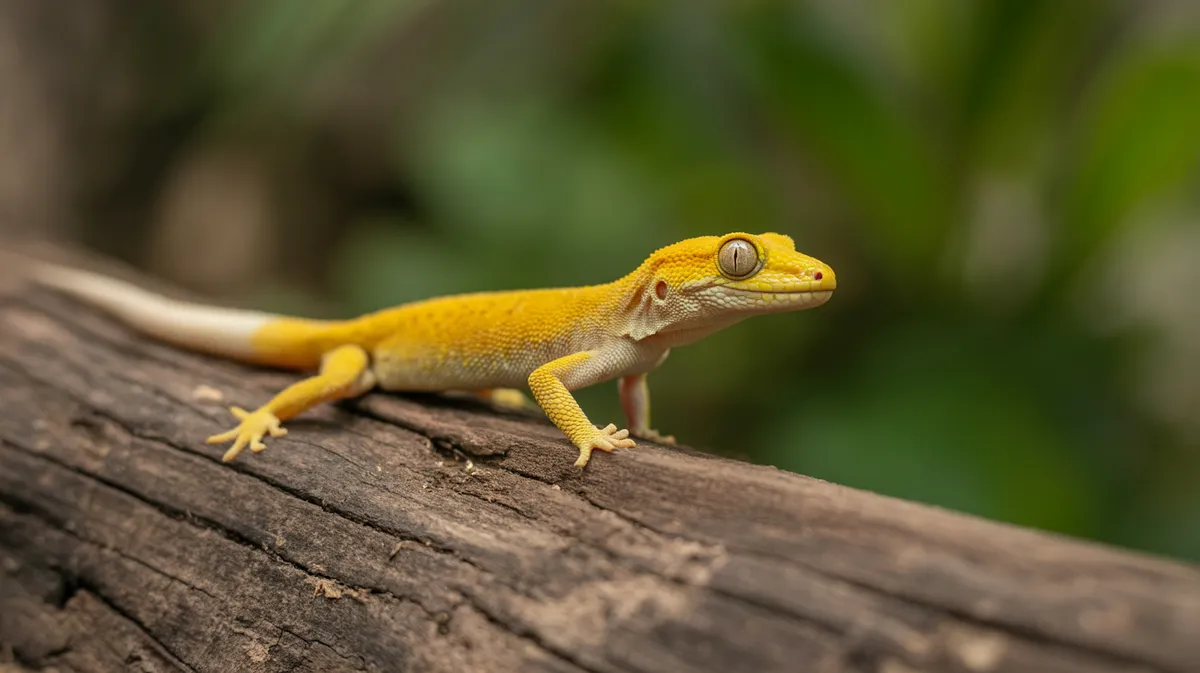
About the Yellow-headed Gecko
The Yellow-headed Gecko is a small, diurnal lizard known for its distinctive bright yellow or orange head, especially pronounced in adult males. Native to Central America, northern South America, and some Caribbean islands, it is often found darting along tree trunks, walls, and rocks in warm, humid environments. This gecko is agile and quick, feeding primarily on small insects and arthropods. Unlike many other geckos, it lacks adhesive toe pads, relying instead on its nimbleness and speed to escape predators. Its vibrant coloration serves as both a signal during territorial disputes and as camouflage among sun-dappled foliage.
Fascinating facts
Sexual Dimorphism
Only adult males develop the striking yellow or orange head, while females and juveniles are more cryptically colored for camouflage.
Daytime Activity
Unlike many geckos, the Yellow-headed Gecko is diurnal, hunting and basking in sunlight during the day.
Habitat Flexibility
This gecko adapts well to human-altered habitats and can frequently be found in gardens, on fences, and even inside buildings.
Detailed description
The Yellow-headed Gecko (Gonatodes albogularis) is a small, diurnal lizard, typically measuring 4–7 cm in snout-to-vent length, with a total length reaching up to 10 cm including the tail. Males are strikingly colored, with bright yellow or orange heads, contrasting with a blue-gray to black body and white throat, while females and juveniles are more cryptically patterned in shades of brown and gray, aiding in camouflage. The skin is covered in fine granular scales, and unlike many geckos, the toes end in sharp claws rather than adhesive pads, reflecting their adaptation to rough surfaces rather than smooth vertical ones. The head is relatively large and robust, with prominent eyes featuring vertical pupils, indicating adaptation to bright daylight activity. The tail is moderately long and can be autotomized (shed) as a defense mechanism. This species is primarily terrestrial and scansorial, often seen on tree trunks, rocks, and human structures. Its keen vision is adapted for detecting movement and color, which is crucial for both foraging and social interactions. The gecko’s coloration, especially in males, plays a key role in intraspecific communication and territorial displays.
Did you know?
Yellow-headed Geckos can often thrive in urban environments and may be found living on the walls of buildings in their native range.
Research & sources
Wikipedia summary
Gonatodes albogularis, which has been called a number of vernacular names in English, is a smallish species of gecko found in warm parts of Central and South America, Cuba, Hispaniola and Jamaica. They prefer to live in tropical dry forest habitats. It is sexually dimorphic: the male is colourful, while the female is a more drab grey. The fingers do not have lamellar pads for climbing smooth surfaces like many other geckos but instead have normal claws like most lizards. At one time the species had a breeding population in southern Florida, especially Key West, but this population appears to have died out by the early 1990s. They are believed to be able to tell the difference between brightness and hues of conspecifics. Males are incredibly aggressive with territory defense against both other males and potential predators.
Behaviour & social structure
Gonatodes albogularis is primarily solitary and highly territorial, especially among males, who engage in visual displays such as head-bobbing, lateral body flattening, and rapid color changes to assert dominance or deter rivals. These lizards are diurnal, with peak activity during the early morning and late afternoon when temperatures are moderate. Their hunting strategy is largely sit-and-wait, relying on their excellent vision to detect small insects and arthropods, which they capture with quick lunges. They may also actively forage among leaf litter and bark crevices. Social interactions are limited outside the breeding season, with males aggressively defending territories from other males and sometimes even from larger predators. Females are less territorial and may overlap ranges, especially in resource-rich areas. Both sexes use visual cues for recognition and communication, and recent studies suggest they can distinguish not only brightness but also specific hues of conspecifics.
Reproduction & life cycle
The Yellow-headed Gecko exhibits a polygynous mating system, with males defending territories that may encompass the home ranges of several females. Courtship involves visual displays and tactile cues, with the male approaching the female and performing head-bobs and body undulations. Breeding typically coincides with the rainy season, which varies regionally but often peaks from late spring to early autumn. Females lay single, hard-shelled eggs, sometimes in communal nesting sites, with clutches produced several times per year depending on environmental conditions. The incubation period ranges from 60 to 90 days, influenced by ambient temperature and humidity. There is no parental care post-oviposition; hatchlings are independent from birth and resemble miniature adults, though with more subdued coloration. Sexual maturity is reached within 8–12 months.
Adaptations & survival
Gonatodes albogularis displays several notable adaptations: the absence of adhesive toe pads is compensated by strong claws and muscular limbs, allowing efficient climbing on rough bark and rocks. Their cryptic coloration in females and juveniles provides camouflage against predators, while the bright coloration in males serves as both a warning and a territorial signal. The ability to autotomize the tail provides an effective escape mechanism. Their acute color vision is unusual among reptiles and is used for social signaling and prey detection. Diurnal activity patterns reduce competition with nocturnal geckos and exploit a different set of prey resources. Their tolerance of disturbed habitats, including urban areas, reflects ecological flexibility.
Cultural significance
While not a major figure in local folklore or mythology, the Yellow-headed Gecko is sometimes noted in Caribbean and Central American cultures as a harmless and beneficial insect-eater. Its presence in gardens and homes is generally tolerated or even welcomed. In some regions, it is occasionally collected for the pet trade, though it is not as popular as larger or more colorful gecko species. There are no known traditional medicinal or symbolic uses.
Recent research
Recent research has focused on the visual ecology of Gonatodes albogularis, revealing advanced color discrimination abilities and the role of visual signals in social interactions. Studies using spectrophotometry and behavioral assays have demonstrated that males use their bright coloration in both mate attraction and territorial disputes. Genetic studies are clarifying the taxonomy and phylogeography of the species, which includes several subspecies with distinct ranges and morphological traits. Ongoing research is investigating the impact of urbanization on behavior, diet, and population genetics, as well as the species’ resilience to environmental change. Notably, the extinction of the Florida population has been studied as a case of failed introduction and the limits of ecological plasticity.
Sources
Gonatodes albogularis (Yellow-headed Gecko): Natural History, Behavior, and Visual Ecology
Vitt, L.J., Zani, P.A., Avila-Pires, T.C.S. (2002)
scientificVideos
Habitat
Tropical and subtropical forests, woodlands, and urban areas


Conservation
The Yellow-headed Gecko is currently classified as Least Concern on the IUCN Red List.
Threats & challenges
Currently classified as Least Concern by the IUCN, Gonatodes albogularis faces localized threats from habitat loss due to deforestation, urbanization, and agricultural expansion, particularly in parts of its range where dry forests are being converted. Introduced predators, such as cats and rats, can impact populations in urban and peri-urban areas. Climate change poses a potential long-term threat by altering habitat suitability and seasonal breeding cues. Despite these pressures, the species remains widespread and adaptable, with stable populations in many areas. The extinction of introduced populations in southern Florida highlights the species’ sensitivity to environmental changes and competition with native fauna.
Taxonomy
Scientific name
Gonatodes albogularis
- Kingdom
- Animalia
- Phylum
- Chordata
- Class
- Reptilia
- Order
- Squamata
- Family
- Sphaerodactylidae
- Genus
- Gonatodes
- Species
- albogularis
Community notes
Share your observations about the Yellow-headed Gecko.
No community notes yet. Be the first!
Discover more wildlife
More fascinating animals from the encyclopedia.