
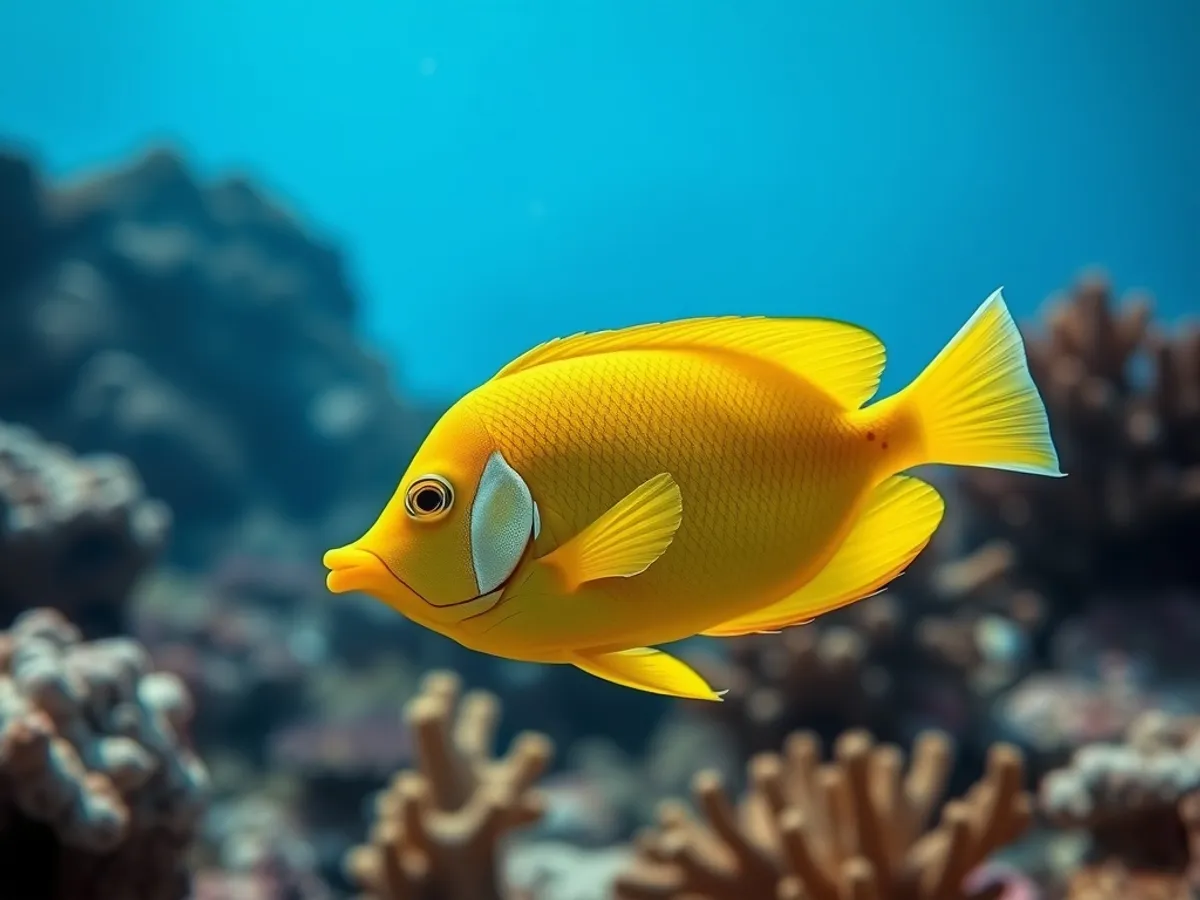
About the Yellow tang
The yellow tang is a vibrant, tropical marine fish recognized for its striking, bright yellow coloration and distinctive disc-shaped body. Native to the reefs of the Pacific Ocean, especially around the Hawaiian Islands, this species is popular in the aquarium trade for its hardiness and active swimming behavior. Yellow tangs are herbivorous, feeding mostly on algae, which helps maintain the health of coral reefs by preventing algal overgrowth. They are generally found in shallow, clear lagoons and reefs, often seen grazing singly or in small groups. Despite pressures from collection for aquariums, wild populations remain stable due to effective management and conservation efforts.
Fascinating facts
Reef Dwellers
Yellow tangs are most commonly found in the clear, warm waters around the Hawaiian Islands, where they inhabit coral reefs and lagoons.
Algae Eaters
Their diet consists mainly of filamentous algae, helping to prevent algae from smothering coral reefs and maintaining ecosystem balance.
Color Changers
At night or when stressed, yellow tangs display a lighter color and a prominent white stripe along their side as a form of camouflage.
Detailed description
The yellow tang (Zebrasoma flavescens) is a medium-sized marine fish, typically reaching a standard length of 15–20 cm (6–8 inches), with some individuals growing up to 22 cm. Its laterally compressed, disc-shaped body is a brilliant, uniform yellow, which provides camouflage among corals and sunlit waters. The species is characterized by a long, protruding snout adapted for grazing on filamentous algae in crevices and on reef surfaces. A distinctive feature is the sharp, retractable white scalpel-like spine (or 'scalpel') located on each side of the caudal peduncle, used for defense and territorial disputes. The dorsal fin is sail-like and continuous, contributing to its common name 'sailfin tang.' Yellow tangs possess small, ctenoid scales and a terminal mouth with specialized teeth for scraping algae. They have large eyes positioned high on the head, enhancing their field of vision to detect predators. The species exhibits a high degree of site fidelity, often maintaining small home ranges within shallow (2–46 m) coral-rich lagoons and outer reef slopes. Their vibrant coloration can fade at night or under stress, becoming pale with a noticeable white lateral stripe. The yellow tang is diurnal, spending daylight hours actively foraging and seeking shelter in reef crevices at night.
Did you know?
In the wild, yellow tangs can live up to 30 years, far longer than most people expect for such a small fish.
Research & sources
Wikipedia summary
The yellow tang, also known as the lemon sailfin, yellow sailfin tang or somber surgeonfish, is a species of marine ray-finned fish belonging to the family Acanthuridae which includes the surgeonfishes, unicornfishes and tangs. Bright yellow in color, it is one of the most popular marine aquarium fish, though in its natural state, it lives in reefs. The yellow tang spawns around a full moon, eats algae, and has a white barb, located just before the tail fin, to protect itself.
Behaviour & social structure
Yellow tangs are primarily solitary but may form loose aggregations, especially in areas with abundant food resources. They are highly territorial, with males defending feeding territories against conspecifics using displays and, if necessary, their caudal spines. Feeding occurs throughout the day, with individuals grazing continuously on turf algae, macroalgae, and occasionally detritus, playing a crucial role in controlling algal growth on reefs. Social hierarchies can develop in denser populations, with dominant individuals securing prime feeding grounds. At night, yellow tangs seek shelter in reef crevices to avoid nocturnal predators. They exhibit cleaning behaviors, both as clients and cleaners, sometimes removing ectoparasites from other fish. Juveniles are more likely to form small groups for protection, while adults are more territorial. Their activity is closely tied to light levels, with reduced movement at dusk and dawn.
Reproduction & life cycle
Yellow tangs are broadcast spawners, with reproduction typically synchronized to lunar cycles, peaking around the full moon. Spawning occurs in groups, often at dusk, when males and females ascend into the water column to release gametes simultaneously, increasing fertilization success and reducing predation risk. There is no parental care; fertilized eggs are pelagic, drifting with currents. The eggs hatch within 24–48 hours, and the larvae remain planktonic for approximately 50–60 days, one of the longest larval durations among surgeonfishes, before settling onto reefs as juveniles. Sexual maturity is reached at about 9–12 months. Spawning aggregations may involve temporary suspension of territoriality, with both sexes participating in group spawning events.
Adaptations & survival
Yellow tangs exhibit several adaptations for survival in coral reef environments. Their bright yellow coloration provides effective camouflage among sunlit corals and algae, while the ability to pale at night reduces visibility to predators. The elongated snout and specialized, spatulate teeth are adaptations for scraping algae from hard substrates. The sharp, retractable caudal spine serves as a defensive weapon against predators and rivals. Their laterally compressed bodies allow them to maneuver easily through narrow reef crevices. The extended pelagic larval stage facilitates wide dispersal, enhancing genetic exchange between populations. Additionally, their digestive tract is adapted for processing fibrous algae, with a long intestine and symbiotic gut bacteria aiding in cellulose breakdown.
Cultural significance
The yellow tang holds significant value in the aquarium trade, being one of the most popular and recognizable marine fish globally. Its vibrant color and hardiness make it a favorite among aquarists. In Hawaii, the species is a symbol of healthy reefs and is featured in local art and tourism materials. The yellow tang has also become an ambassador species for reef conservation, highlighting the importance of sustainable collection and reef protection. There are no known traditional medicinal or culinary uses, as the species is not commonly consumed.
Recent research
Recent research has focused on the population genetics and connectivity of yellow tang populations across the Pacific, revealing high gene flow facilitated by their long larval duration. Studies have also examined the ecological role of yellow tangs in controlling algal growth and maintaining coral health. Advances in captive breeding techniques have been achieved in recent years, reducing pressure on wild populations and making aquaculture a viable alternative for the aquarium trade. Ongoing monitoring in Hawaii has demonstrated the effectiveness of marine protected areas in supporting population recovery. There is growing interest in the species' resilience to environmental change and its potential as an indicator of reef ecosystem health.
Sources
Zebrasoma flavescens: Biology, Ecology, and Conservation
Randall, J.E. & Clements, K.D. (2001)
scientificZebrasoma flavescens – The IUCN Red List of Threatened Species
Abesamis, R., Choat, J.H., McIlwain, J., Clements, K.D., et al. (2012)
conservationVideos
Habitat
Coral reefs and lagoons

Conservation
The Yellow tang is currently classified as Least Concern on the IUCN Red List.
Threats & challenges
While the yellow tang is currently listed as Least Concern by the IUCN, it faces several localized threats. Overcollection for the aquarium trade, particularly in Hawaii, has historically impacted populations, though recent regulations and marine protected areas have led to recovery in many regions. Habitat degradation due to coral bleaching, pollution, and coastal development poses ongoing risks. Climate change, resulting in ocean warming and acidification, threatens the coral reef ecosystems on which yellow tangs depend. Disease outbreaks and invasive species, such as certain algae, may also impact food availability. Despite these challenges, effective management and enforcement of collection limits have stabilized populations in key areas.
Taxonomy
Scientific name
Zebrasoma flavescens
- Kingdom
- Animalia
- Phylum
- Chordata
- Class
- Actinopterygii
- Order
- Acanthuriformes
- Family
- Acanthuridae
- Genus
- Zebrasoma
- Species
- flavescens
Where to see a yellow tang
1 zoo and aquarium in 1 country are recorded as keeping this species.

Community notes
Share your observations about the Yellow tang.
No community notes yet. Be the first!
Discover more wildlife
More fascinating animals from the encyclopedia.