
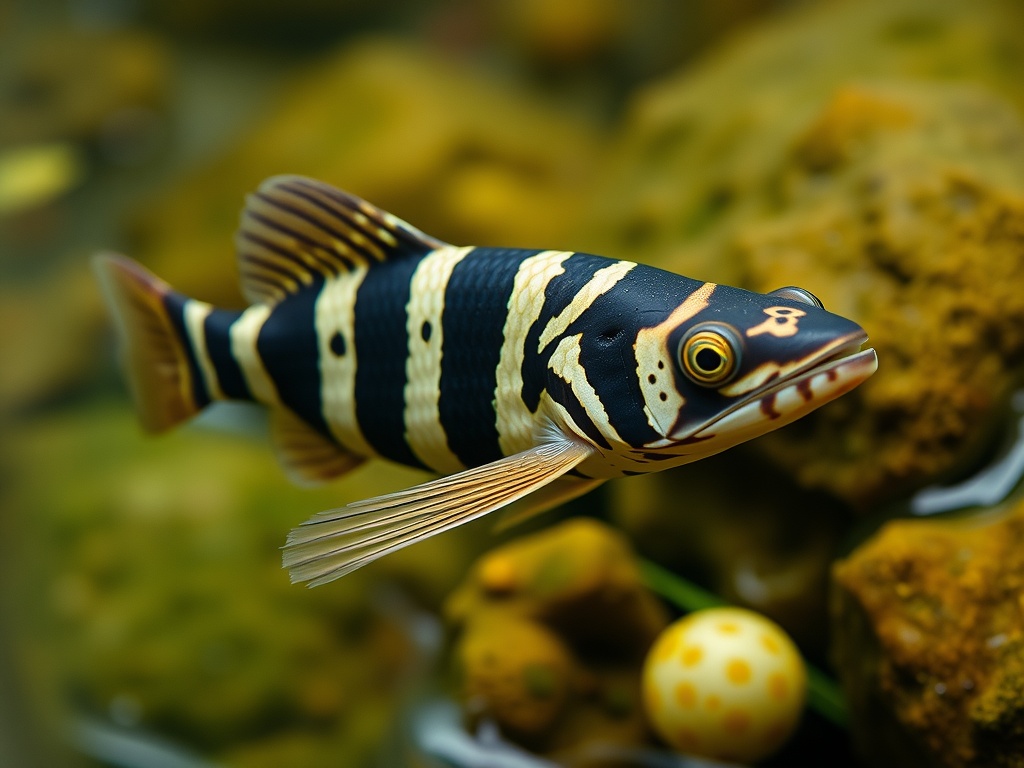
About the Zebra pleco
The Zebra pleco is a small, strikingly patterned freshwater catfish native to the Xingu River in Brazil. Distinguished by its bold black and white stripes, this species is highly sought after in the aquarium trade due to its unique appearance and relatively small size. It is a nocturnal, bottom-dwelling fish that prefers fast-flowing, oxygen-rich waters with plenty of hiding places among rocks and crevices. The Zebra pleco is relatively peaceful and tends to be shy, making it best suited for calm, well-maintained aquariums. Due to habitat loss and overcollection, it is considered endangered in the wild.
Fascinating facts
Native to Xingu River
Zebra plecos are found exclusively in the Xingu River in Brazil, making their habitat extremely limited.
Threatened by Dams
The construction of the Belo Monte Dam has drastically reduced their natural range, contributing to their endangered status.
Aquarium Rarity
Due to their beauty and rarity, Zebra plecos are highly prized among aquarists, often commanding high prices.
Detailed description
The Zebra pleco (Hypancistrus zebra) is a small, visually striking catfish, reaching an adult standard length of approximately 6.4 cm (2.5 inches). Its most distinctive feature is its bold, alternating black and white horizontal stripes, which extend from the snout across the body and onto the fins, providing effective camouflage among the rocky substrates of its native habitat. The body is dorsoventrally flattened with a broad head and a ventrally located mouth adapted for suction, enabling the fish to cling to rocks in fast-flowing water. The dorsal and pectoral fins are well-developed and aid in stabilization against strong currents. The species possesses odontodes (dermal teeth) on the cheeks and pectoral fin spines, which may play a role in intraspecific interactions. Zebra plecos are primarily nocturnal, exhibiting peak activity during the night when they emerge from crevices to forage. Socially, they are relatively peaceful but may display territoriality, especially among males during the breeding season. In the wild, they are found exclusively in the Rio Xingu's 'big bend' area, where water is warm (26–30°C), highly oxygenated, and flows rapidly over rocky beds. Their diet consists of a mix of small invertebrates, biofilm, and detritus, reflecting their omnivorous feeding habits. The species is adapted to a cryptic lifestyle, spending much of the day hidden among rocks and only venturing out under low light conditions.
Did you know?
Zebra plecos are endemic to a single stretch of the Xingu River, and their habitat is now severely threatened by the construction of hydroelectric dams.
Research & sources
Wikipedia summary
The zebra pleco is a species of catfish endemic to a small section of the Rio Xingu in Brazil. It occurs in the big bend area of the river, downstream from the town of Altamira, Para. It was first described in 1991. It gets its name from its black and white stripes, resembling the colouration of a zebra. This species grows to a length of 6.4 centimetres (2.5 in) SL. This species was exported from Brazil in 1987 for sale as aquarium fish. However, currently, the Brazilian government bans the export of certain fish species, including H. zebra.
Behaviour & social structure
Zebra plecos are secretive and crepuscular to nocturnal, spending daylight hours concealed in rocky crevices or under submerged structures. They are bottom-dwellers, using their specialized suckermouths to adhere to rocks and graze on biofilm, small crustaceans, insect larvae, and detritus. In captivity and in the wild, they exhibit a preference for protein-rich foods, often scavenging for meaty items. Social interactions are generally peaceful, though males can become territorial, especially when competing for optimal breeding caves. They communicate through subtle body postures and fin displays, and will occasionally engage in gentle pushing or shoving to establish dominance. Zebra plecos are not active swimmers; instead, they move deliberately across the substrate, often using their pectoral fins to anchor themselves in strong currents. Their daily routine involves periods of rest interspersed with foraging, primarily during the night.
Reproduction & life cycle
Breeding in Hypancistrus zebra is cave-spawning and typically occurs during the rainy season in their native habitat, when water temperatures and flow rates rise. Males select and defend narrow crevices or caves, which serve as spawning sites. Courtship involves the female entering the male's cave, where she lays a clutch of 7–15 relatively large, yellowish eggs. The male then fertilizes the eggs and assumes sole responsibility for their care, fanning them with his fins to ensure adequate oxygenation and prevent fungal growth. Incubation lasts 7–10 days, after which the larvae hatch and remain in the cave, absorbing their yolk sacs for another 7–10 days before becoming free-swimming. Parental care ends once the fry leave the cave. In captivity, successful breeding requires replicating natural water conditions, including high oxygen levels, warm temperatures (28–30°C), and strong current.
Adaptations & survival
The Zebra pleco exhibits several adaptations to its fast-flowing, oxygen-rich environment. Its flattened body and enlarged pectoral fins enable it to maintain position against strong currents, while the ventral suckermouth allows for secure attachment to rocks. The striking black and white coloration provides disruptive camouflage among the dappled light and shadows of rocky riverbeds. Nocturnal habits reduce predation risk and competition for food. The species' ability to extract oxygen efficiently from highly aerated water is facilitated by well-developed gill structures. Reproductive strategies, such as cave spawning and male parental care, enhance offspring survival in a habitat where eggs and fry would otherwise be vulnerable to being swept away.
Cultural significance
While the Zebra pleco does not have a significant role in traditional indigenous cultures, it has become an icon in the global aquarium hobby due to its unique appearance and rarity. Its desirability has led to high market values and a dedicated following among aquarists, who often refer to it by its 'L-number' (L046) in the Loricariidae hobbyist community. The species' plight has also raised awareness about the conservation of Brazil's unique freshwater biodiversity and the impacts of hydroelectric development on endemic fauna.
Recent research
Recent research has focused on the species' reproductive biology, captive breeding techniques, and the ecological impacts of river modification in the Xingu basin. Studies have highlighted the importance of microhabitat specificity, with Zebra plecos showing strong fidelity to rocky substrates with high water flow. Genetic analyses are ongoing to assess population structure and inform conservation strategies. Captive breeding programs, both in Brazil and internationally, have achieved success, offering hope for ex situ conservation and potential reintroduction efforts. The species also serves as a model for studying adaptation to rheophilic (fast-flowing water) environments among Neotropical catfishes.
Sources
Hypancistrus zebra Isbrücker & Nijssen, 1991: Taxonomy, Distribution, and Natural History
Isbrücker, I.J.H. & Nijssen, H. (1991)
scientificHypancistrus zebra: Assessment and Conservation Status
Instituto Chico Mendes de Conservação da Biodiversidade (ICMBio), IUCN Red List (2022)
conservationVideos
Habitat
Fast-flowing freshwater rivers

Conservation
The Zebra pleco is currently classified as Endangered on the IUCN Red List.
Threats & challenges
The primary threats to Hypancistrus zebra are habitat destruction and hydrological changes caused by dam construction, particularly the Belo Monte Dam on the Rio Xingu, which has altered water flow, temperature, and oxygenation in its native range. Overcollection for the international aquarium trade historically contributed to population declines, prompting Brazil to ban wild exports of the species. Pollution, sedimentation, and deforestation in the Xingu basin further degrade habitat quality. The IUCN lists the species as Critically Endangered, with populations continuing to decline due to ongoing habitat loss and fragmentation. Conservation challenges include enforcement of trade restrictions, habitat protection, and the need for in situ and ex situ breeding programs to bolster wild populations.
Taxonomy
Scientific name
Hypancistrus zebra
- Kingdom
- Animalia
- Phylum
- Chordata
- Class
- Actinopterygii
- Order
- Siluriformes
- Family
- Loricariidae
- Genus
- Hypancistrus
- Species
- zebra
Community notes
Share your observations about the Zebra pleco.
No community notes yet. Be the first!
Discover more wildlife
More fascinating animals from the encyclopedia.