
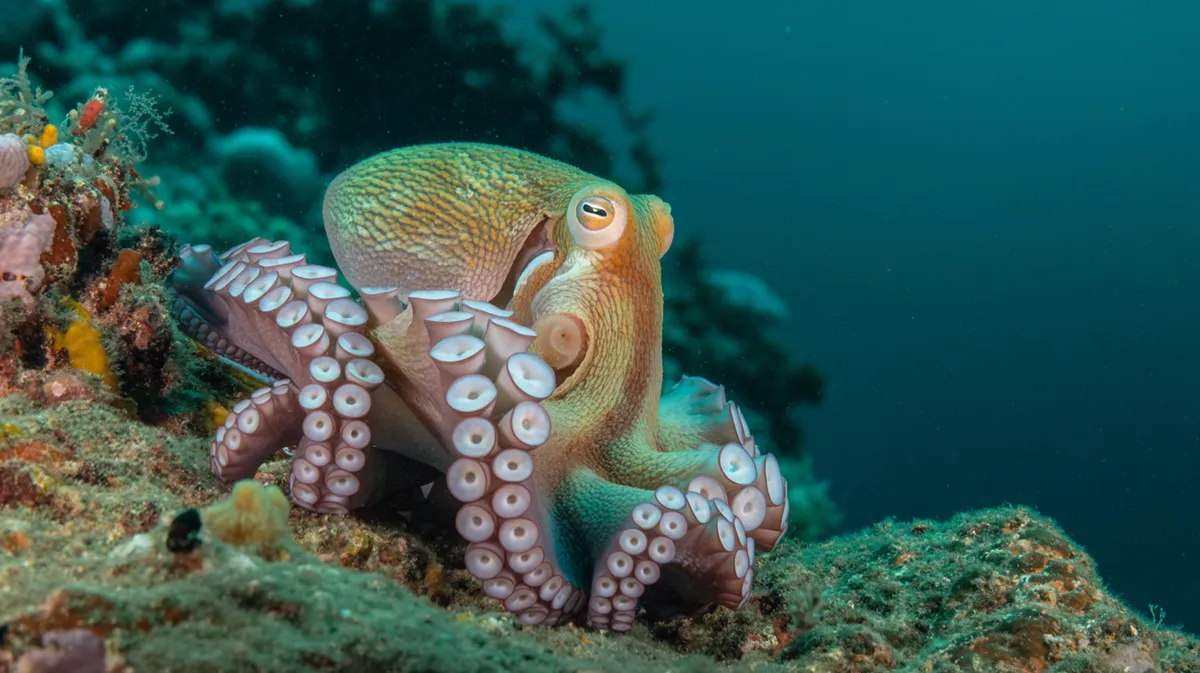
An octopus lives a secret life on the reef — a soft-bodied genius with no bones, blue blood, and the ability to vanish against any background in an instant. It has perhaps the most alien mind on Earth, and it spends its day solving problems, hiding, and hunting. In this entry of our A Day in the Life series, we follow a common octopus through twenty-four hours on the reef.
Most of its drama unfolds at the edges of the day, when the light is low and the hunting is good. See also the ocean's apex hunter in a day in the life of a great white shark and the relentless a day in the life of a hummingbird.
Before dawn
As the night's hunting winds down, our octopus jets back toward its den — a crevice or hollow it has chosen for safety. It often drags a few shells and stones to wall up the entrance behind it, building a barricaded fortress.
Inside, surrounded by the discarded shells of past meals, it settles in to wait out the dangerous daylight hours.
A good den is so valuable that an octopus may defend the same one for weeks, and a tidy pile of empty shells outside — a "midden" — is often the only clue a den is occupied.
Sunrise
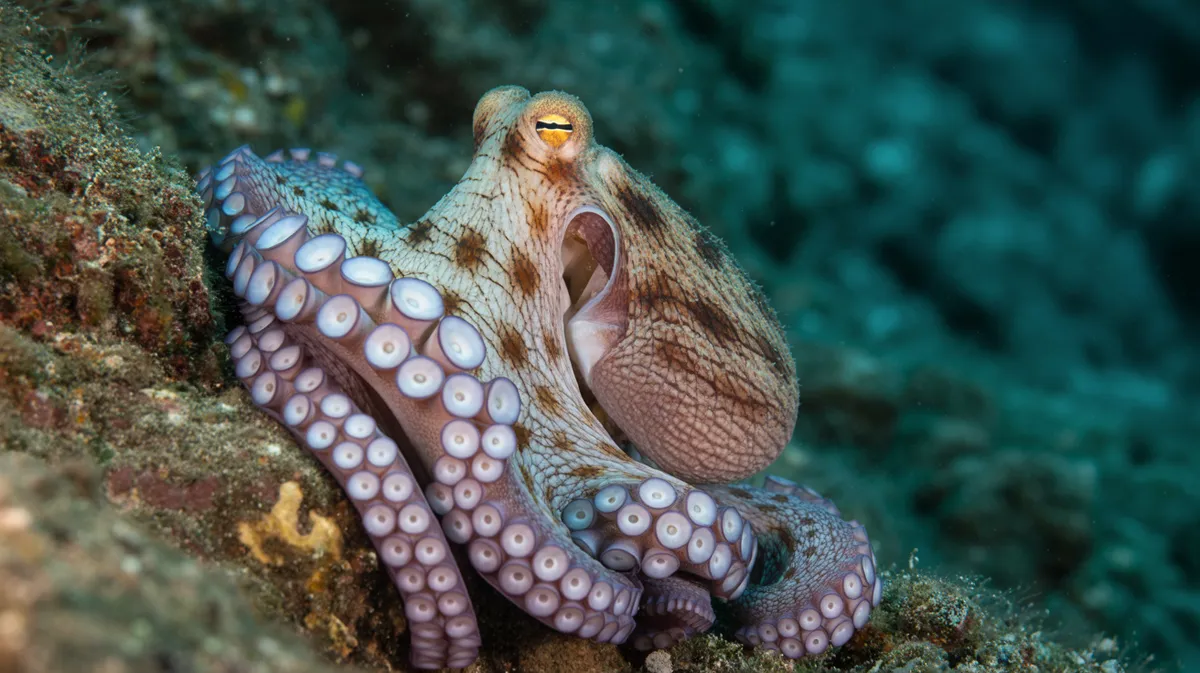
With the reef brightening, the octopus becomes a master of disappearing. Using millions of pigment cells and texture-changing muscles in its skin, it matches the exact colour and even the bumpy surface of the rock around it.
Tucked in its den and camouflaged so completely that a passing predator's eye slides right over it, the octopus rests — though "rest" for an octopus may include vivid colour changes thought to accompany something like dreaming.
It pulls off this vanishing act despite being colour-blind, sensing light through its skin and matching its surroundings using cues scientists are still working to understand.
Midday
Through the bright hours the octopus mostly stays hidden, conserving energy and avoiding the many fish that would happily eat it. But it remains alert, its remarkable eyes watching the reef beyond the den entrance.
If an easy meal — a crab, a shrimp — wanders close enough, an arm may shoot out to snatch it without the octopus ever leaving home.
Its three hearts and blue, copper-based blood are tuned for cold, low-oxygen water, but they also tire easily, which is one more reason it spends the bright hours resting.
Afternoon
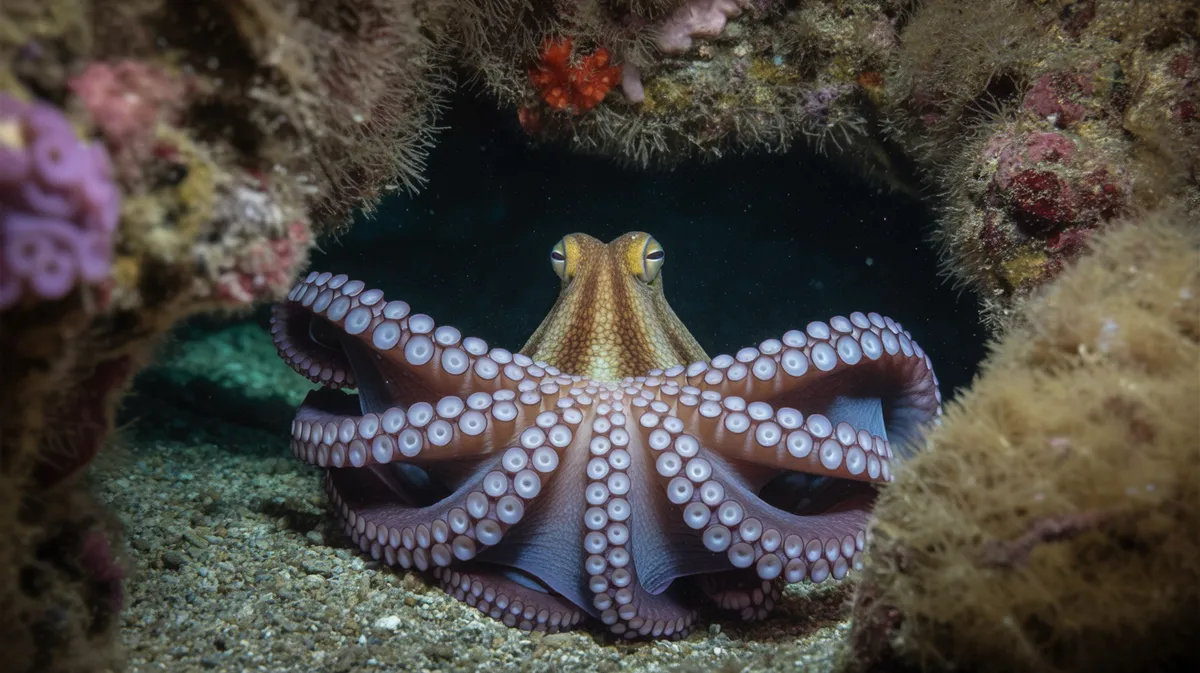
An octopus's den is constantly under threat, and intruders are met with a clear warning. It can flush dark with anger, spread its arms to look bigger, and, if truly pressed, fire a cloud of ink to cover an escape.
Two-thirds of its neurons are spread through its arms, so even while the octopus keeps watch, each arm can taste and explore the den almost independently.
Each sucker can taste as well as grip, so an octopus effectively samples the chemistry of everything it touches as it keeps its den in order.
Dusk
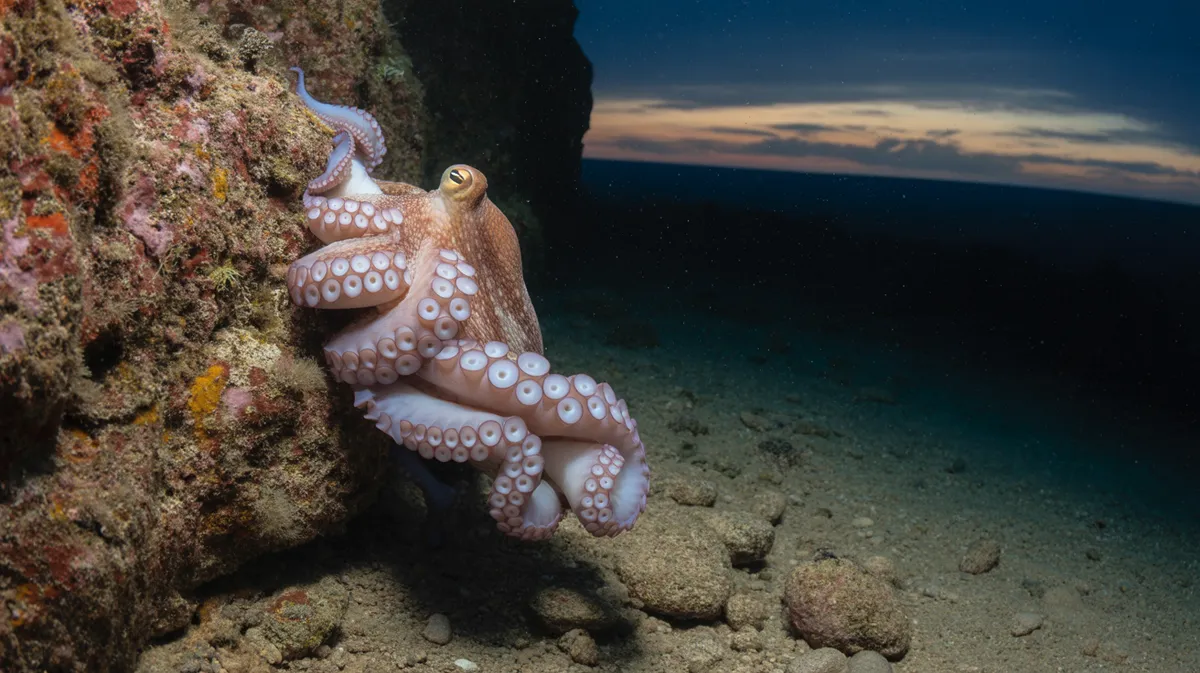
As the light fades, the octopus emerges. It pours its boneless body out of the den — able to squeeze through any gap larger than its only hard part, its beak — and sets off across the reef to hunt.
It moves by crawling on its arms and by jetting water for quick bursts, flushing and rippling with colour as it goes.
With no shell or skeleton to protect it, this nightly venture into the open is a real gamble against the moray eels and large fish that would love to make a meal of it.
After dark
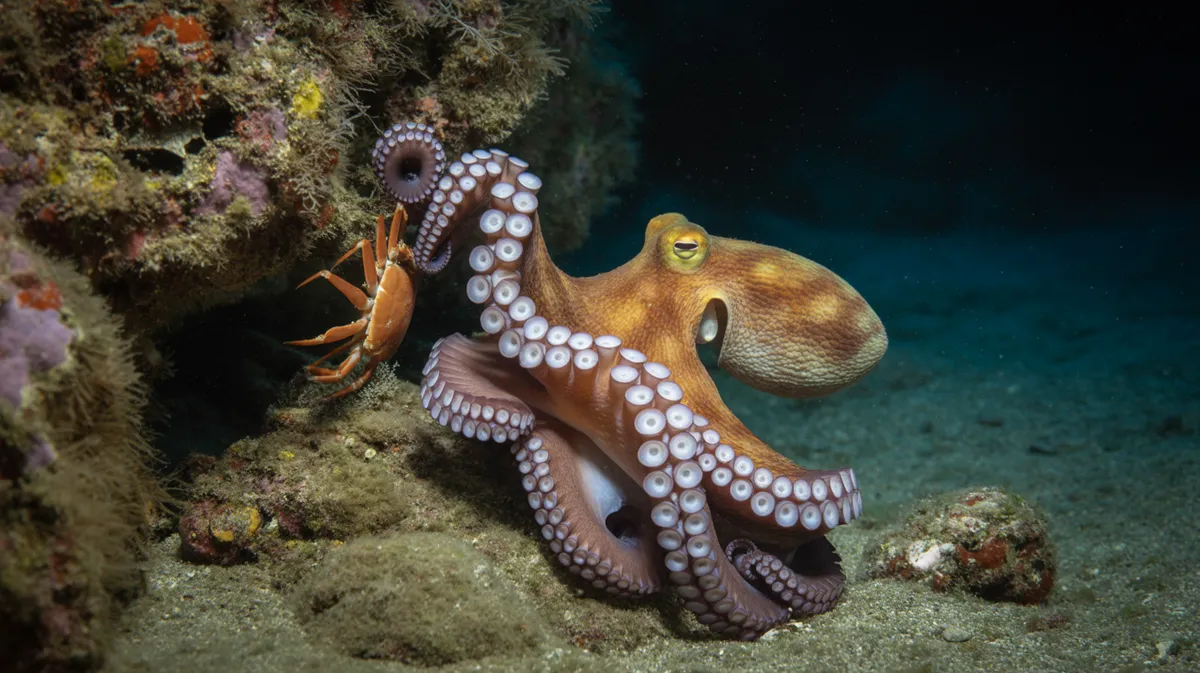
Night is the octopus's hunting prime. It stalks crabs and shellfish, using its arms to probe every crack, and famously solves problems to reach a meal — prying, twisting, and unscrewing its way to prey.
It hunts with strategy too, sometimes draping its webbed arms over a coral head like a net to trap everything hiding beneath, before carrying the catch back home to eat in safety.
Octopuses have even been filmed carrying coconut shells to use as portable armour — one of the few invertebrates known to use tools.
A Mind That Learns
What makes an octopus's day so unlike any other animal's is that it is constantly learning. Octopuses solve novel problems, remember solutions, and improve with practice.
They have distinct personalities — some bold and inquisitive, others shy and cautious — and keepers report that individuals recognise particular people, greeting some and squirting water at others.
They are also notorious escape artists, methodically probing a tank for weaknesses and slipping through any gap larger than their beak. All of it, remarkably, is packed into a life that lasts only a year or two.
What a day reveals
An octopus's day is a constant balance of hiding and hunting, lived by an intelligence that evolved completely separately from our own. Astonishingly, this brilliant animal packs its entire life — learning, hunting, and a single bout of reproduction — into just a year or two before it dies.
Frequently asked questions
Are octopuses active at night? Many are most active at dusk and after dark, hiding in a den during the bright daylight hours.
How do octopuses hide? They change the colour and texture of their skin to match almost any background almost instantly.
How smart are octopuses? Highly — they solve problems, use tools, and have most of their neurons spread through their arms.
How long do octopuses live? Usually just one to two years, dying soon after reproducing.
How many hearts does an octopus have? Three — two for the gills, one for the body.
Are octopuses dangerous? Almost all are harmless. The blue-ringed octopus is the notable, deadly exception.
Can octopuses see colour? Surprisingly, they appear to be colourblind — yet they match colours superbly.
Next in the series: the savanna's sprinter in a day in the life of a cheetah, and a brutal Antarctic day in a day in the life of an emperor penguin.