
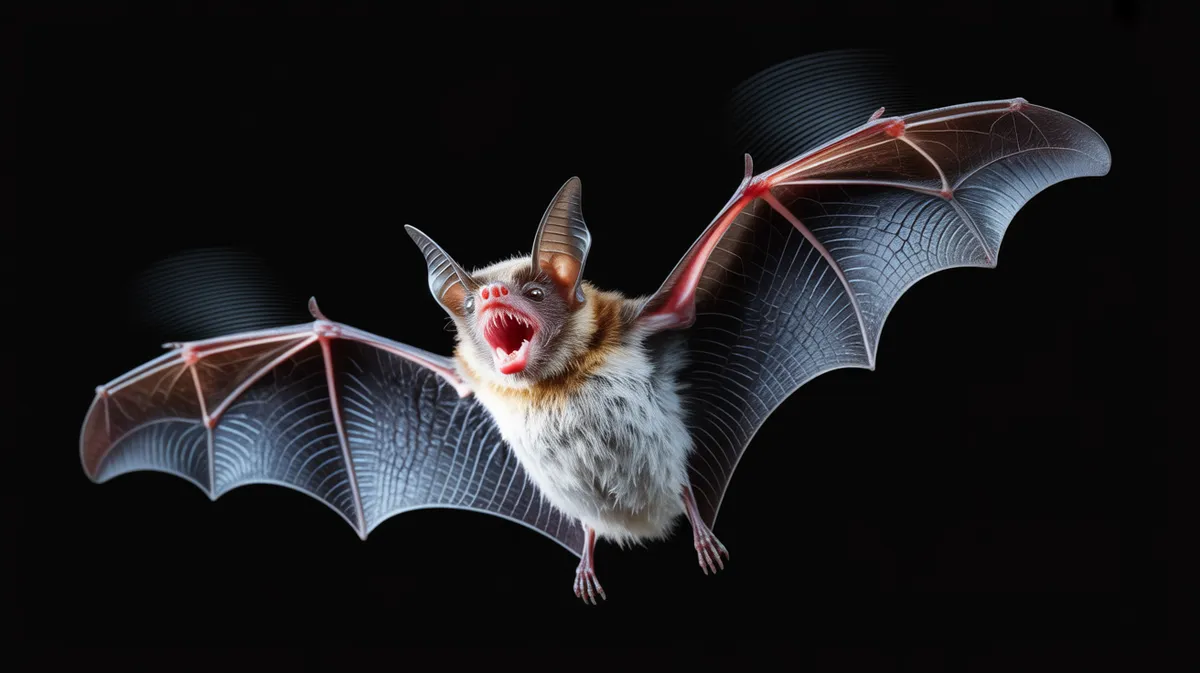
On a moonless night, a bat threads through a tangle of branches at speed and plucks a mosquito out of the air — all in pitch darkness. It does this not by seeing the world but by listening to it, building a detailed three-dimensional picture out of echoes. In this entry of our Through Animal Eyes series, we explore how bats "see" with sound.
It's a sense that turns silence into a vivid map of the night. See also the heat-vision in how sharks sense electricity and the scent-world of how dogs smell the world.
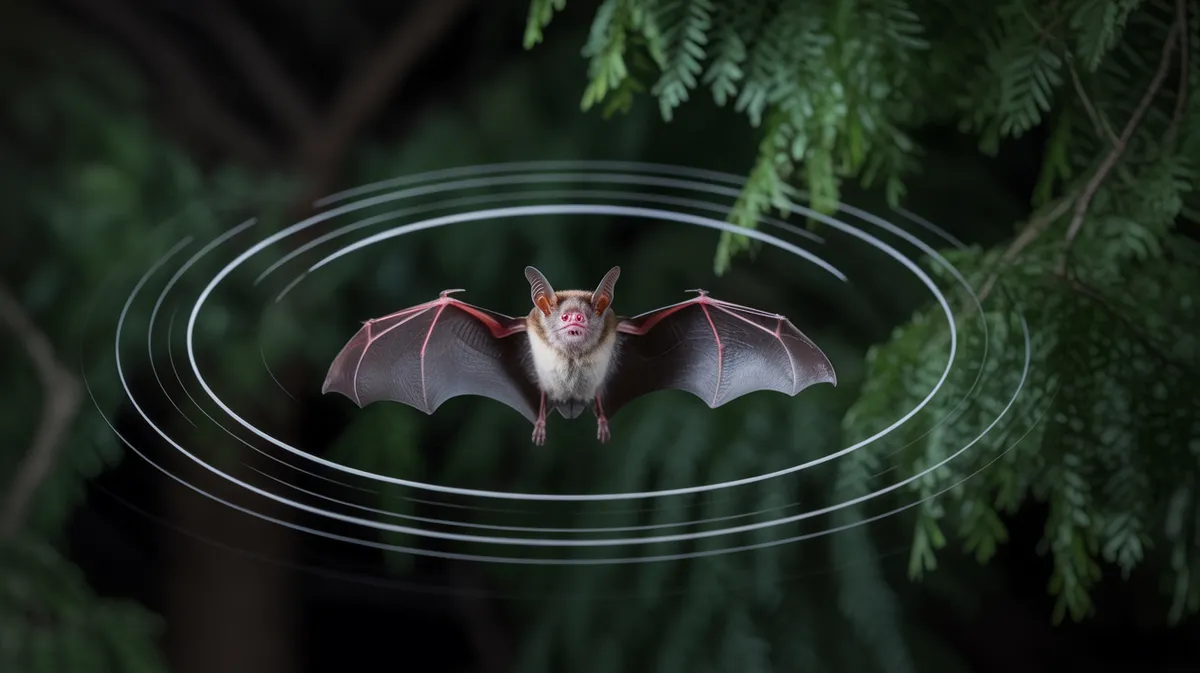
Painting the world with echoes
An echolocating bat emits a stream of high-pitched calls, most of them far above the range of human hearing, then listens intently for the echoes that bounce back off objects around it.
The time it takes for an echo to return reveals exactly how far away something is — a longer delay means a more distant object.
By firing off call after call and timing every returning echo, the bat assembles a constantly updating, three-dimensional model of its surroundings, all built from sound.
Some bats call through their mouths and others through their noses, and the elaborate facial folds of many species help shape and aim these sound beams.
Reading a returning echo
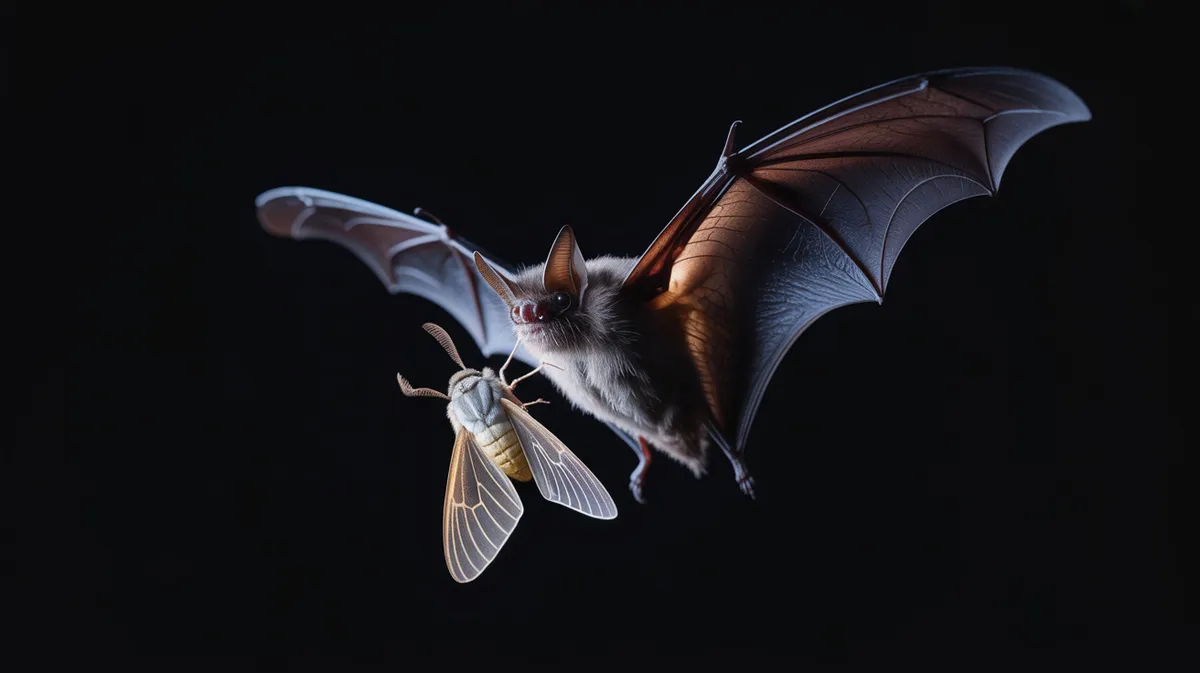
An echo carries far more than distance. Its loudness, pitch, and the tiny differences between what each ear hears tell the bat an object's size, shape, texture, and direction.
Some bats even read the Doppler shift — the way a pitch changes when something moves — to detect not just an insect but the flutter of its beating wings.
From these subtle clues a bat can tell a tasty moth from a falling leaf or an inedible twig, all in complete darkness.
A few bats are so precise they can detect something as fine as a single human hair stretched across their flight path.
The feeding buzz
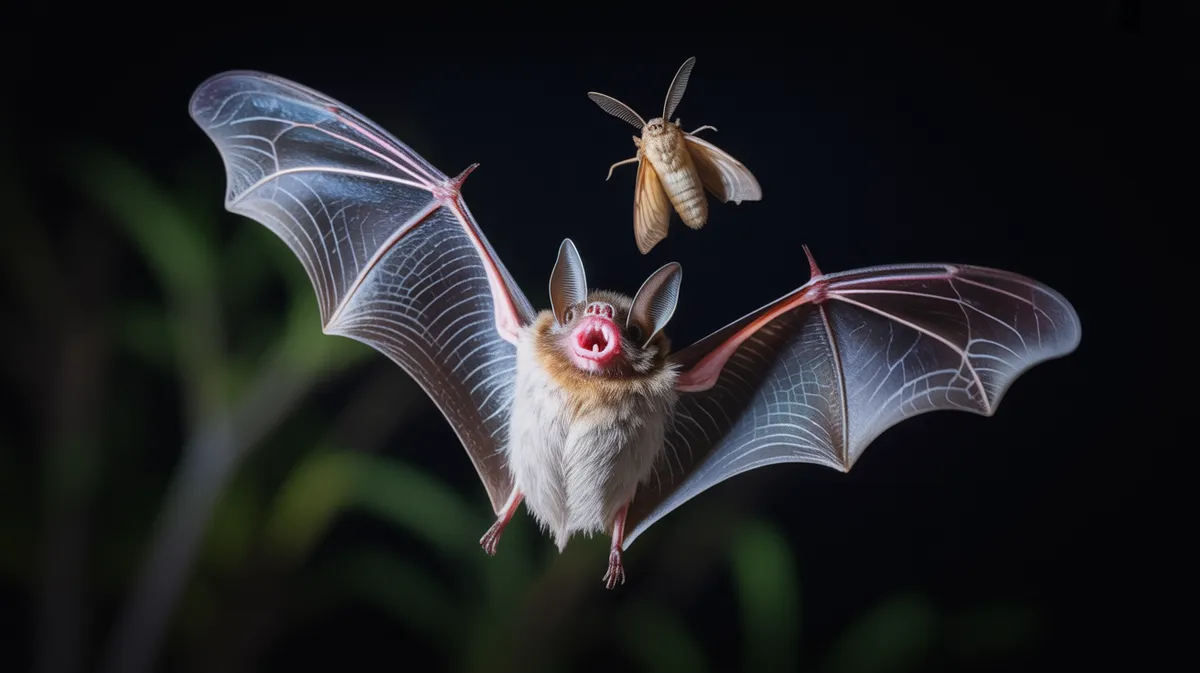
Listen to a hunting bat on special equipment and you'll hear its calls speed up dramatically as it closes in on prey, rising into a rapid "feeding buzz."
By cranking up its call rate to hundreds of pulses a second, the bat gets near-continuous updates on its target's exact position in the final moment of the chase.
This burst of information lets it make split-second corrections and snatch a dodging insect mid-flight.
To avoid being deafened by their own intense calls, bats briefly contract a tiny muscle in the ear with each pulse, muting their hearing for a split second.
Not blind after all
For all its skill with sound, a bat is not blind — every bat species can see, and many see quite well. Echolocation is an extraordinary addition to vision, not a replacement for it.
In good light some bats rely heavily on their eyes, switching to sound when darkness or clutter makes seeing difficult.
It means a bat moves through the world with two complementary ways of perceiving it, blending sight and sound as conditions demand.
Fruit bats, which mostly feed by sight and smell, often have especially large, capable eyes and many don't echolocate at all.

An evolutionary arms race
Bats' sonar has driven a remarkable arms race with their prey. Many moths have evolved ears tuned precisely to the frequencies of bat calls, letting them hear an approaching hunter and dive for cover.
Some tiger moths fight back with sound of their own, producing rapid clicks that may startle a bat, warn of their bad taste, or even jam its sonar.
Across the night sky, an invisible duel of sound and counter-sound plays out between predator and prey.
Some bats have countered by quietly lowering their call volume into a "stealth" mode, hunting moths that would otherwise hear them coming.
Echolocation Beyond Bats
Bats are the most famous echolocators, but they are far from the only ones. Dolphins and toothed whales build detailed sound pictures of their world, and can even distinguish objects by their internal structure.
A few birds have converged on the same trick. Oilbirds and cave swiftlets echolocate with audible clicks to navigate the pitch dark of their roosting caves — cruder than a bat's sonar, but built for the same job.
Most remarkably, some blind people have learned to do it, producing tongue clicks and reading the returning echoes to sense walls, doorways, and obstacles. Brain scans show them processing those echoes in the visual cortex — literally seeing with sound.
What it's like to be a bat
To perceive the world as a bat does is to experience darkness not as emptiness but as a richly detailed space, sketched moment to moment in echoes. It's a way of "seeing" with the ears so precise that a bat can navigate and hunt where our eyes would leave us utterly lost.
Frequently asked questions
How does echolocation work? A bat emits high-pitched calls and times the returning echoes to build a 3D picture of distance, size, shape, and direction.
Are bats blind? No — all bats can see, and many see well. Echolocation supplements their vision rather than replacing it.
Can prey defend against bat sonar? Yes — some moths hear bat calls and evade them, and certain tiger moths click to confuse or jam the bat.
Are bats blind? No — every bat can see, and many see well. Echolocation supplements vision.
How accurate is echolocation? Precise enough for some bats to detect a wire as fine as a human hair.
Do bats deafen themselves when calling? They briefly mute their own hearing with a tiny ear muscle on each pulse.
Do all bats echolocate? No — many fruit bats rely mainly on sight and smell instead.
How high-pitched are bat calls? Mostly ultrasonic — far above the upper limit of human hearing.
What is the "feeding buzz"? A rapid burst of calls as a bat closes on prey, giving it near-continuous updates.
Can moths escape bats? Some can. Many hear the calls and dive away, and some tiger moths click back to jam the sonar.
Continue with how the star-nosed mole sees by touch, or revisit how mantis shrimp see.