
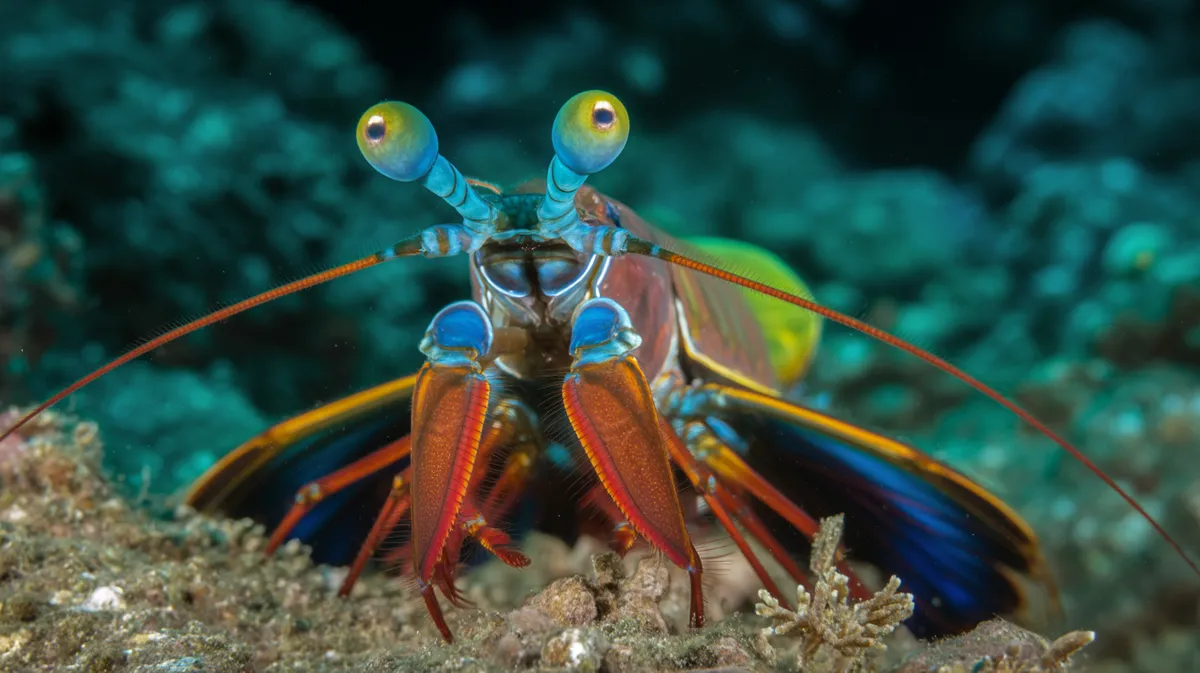
On a coral reef lives a small, pugnacious crustacean with what may be the most extraordinary eyes in the entire animal kingdom. The mantis shrimp sees colours, movements, and even properties of light that humans can't begin to perceive, all through a visual system unlike anything else in nature. In this entry of our Through Animal Eyes series, we look at the world through the bizarre eyes of the mantis shrimp.
It's a way of seeing so alien that scientists are still working out exactly what it's for. See also the ultraviolet world of how birds see ultraviolet and the twilight vision of how cats see the world.
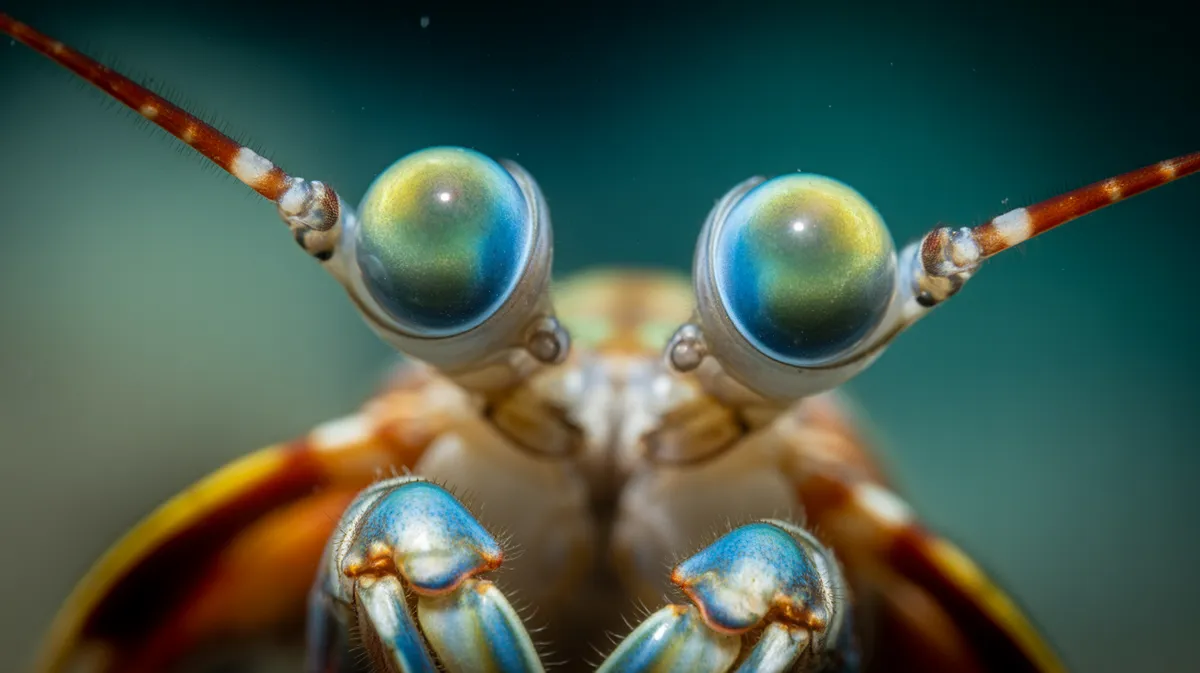
Sixteen kinds of colour receptor
Human eyes detect colour using three types of cone cell. The mantis shrimp has up to sixteen different photoreceptor types, twelve of them dedicated to colour.
You might assume this lets it see a rainbow far richer than ours — but the truth is stranger. Experiments suggest mantis shrimp are actually rather poor at telling very similar colours apart.
Instead of finely comparing wavelengths the way our brains do, they seem to recognise colours directly and almost instantly, trading subtle discrimination for blistering speed.
Four of its receptor types are tuned to ultraviolet light alone, so on top of everything else it sees well into a range that's completely invisible to us.
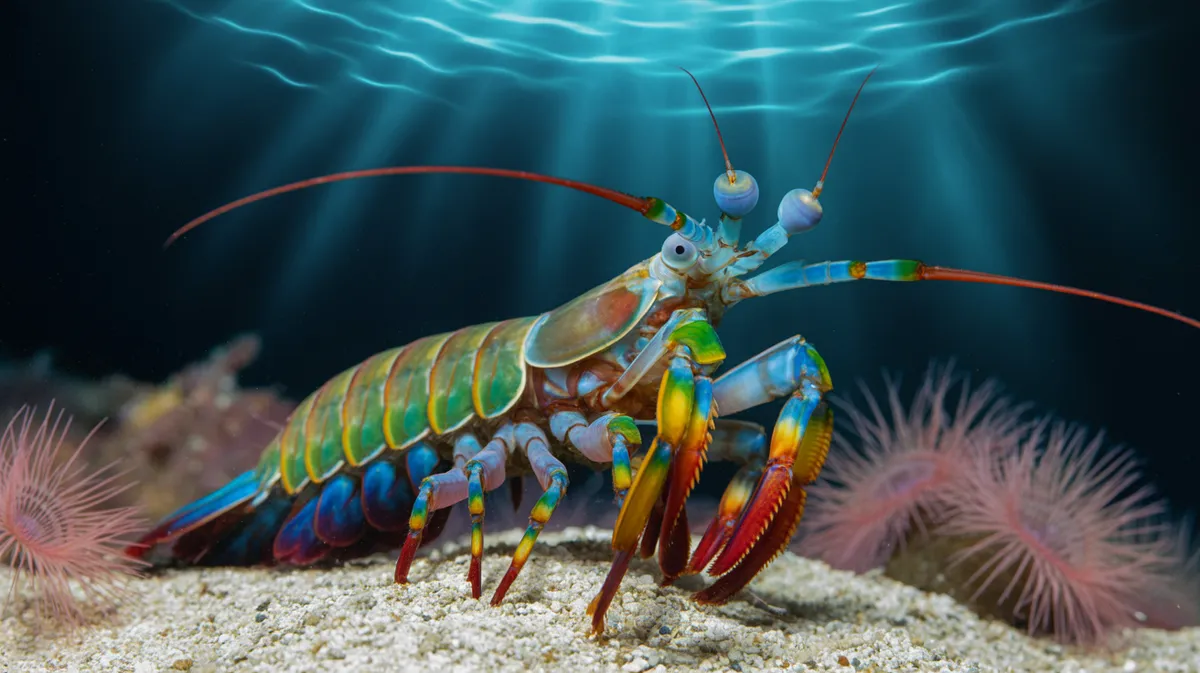
Eyes on independent stalks
Each of the mantis shrimp's eyes sits on a moving stalk and swivels completely independently of the other, scanning the reef in two directions at once.
Stranger still, each single eye is split into three regions that view the same point, giving each eye its own depth perception — so a mantis shrimp has, in effect, three-dimensional vision in each eye separately.
This lets it judge distance to a target with just one eye, a useful trick for an animal that strikes in the blink of an eye.
This wandering, all-around gaze means a mantis shrimp can keep watch for predators on one side while tracking prey on the other.
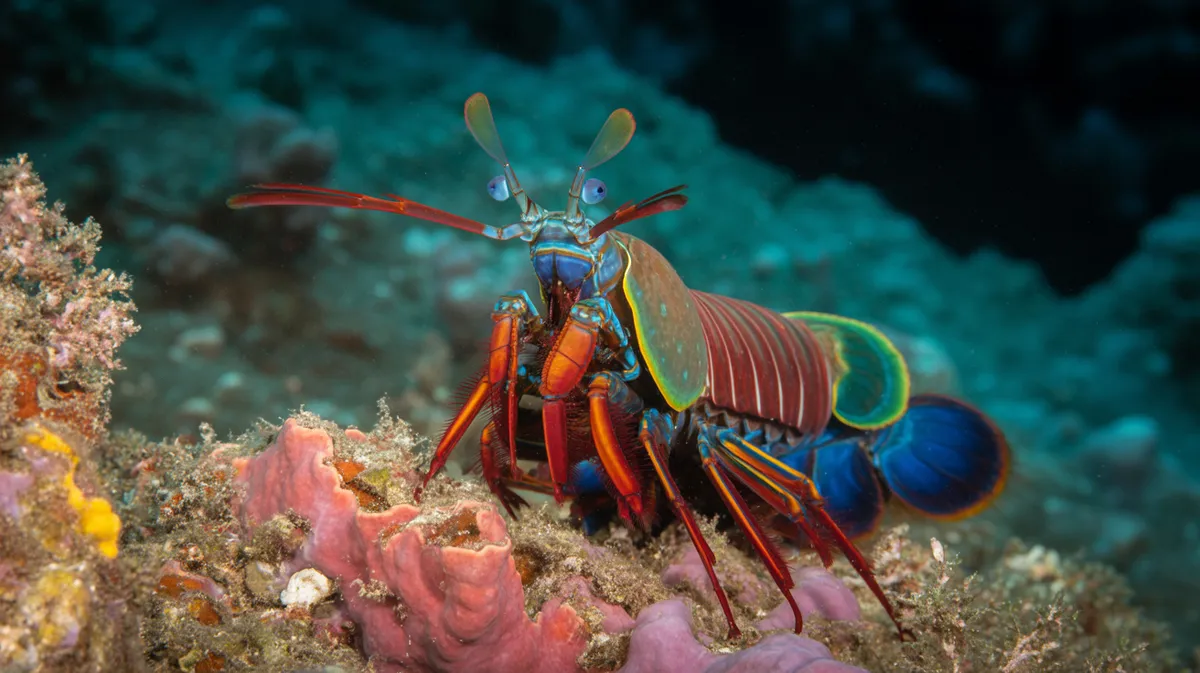
Seeing polarized light
Beyond colour, mantis shrimp can see the polarisation of light — the orientation in which light waves vibrate, something completely invisible to us.
Most remarkably, they're the only animals known to detect circularly polarised light, a property so obscure most people have never heard of it.
Parts of the mantis shrimp's own body reflect this circular polarisation, which means they may have a private communication channel, sending signals to one another that no predator or rival can see.
Researchers are even studying the mantis shrimp eye to design better cameras and medical scanners that could spot cancerous tissue by its polarisation.
A scanner for colour
The colour-detecting part of the eye is arranged in a narrow band, and the mantis shrimp sweeps this band across a scene rather like a flatbed scanner reading a page, or a spectrometer measuring light.
This scanning approach may be how it identifies colours so quickly without lots of brainpower devoted to comparison.
It's a fundamentally different strategy from ours — less about analysis, more about rapid, direct recognition.
It's a bit like the difference between carefully mixing paint to match a shade and simply recognising a familiar colour the instant you see it.
Eyes for a lightning hunter
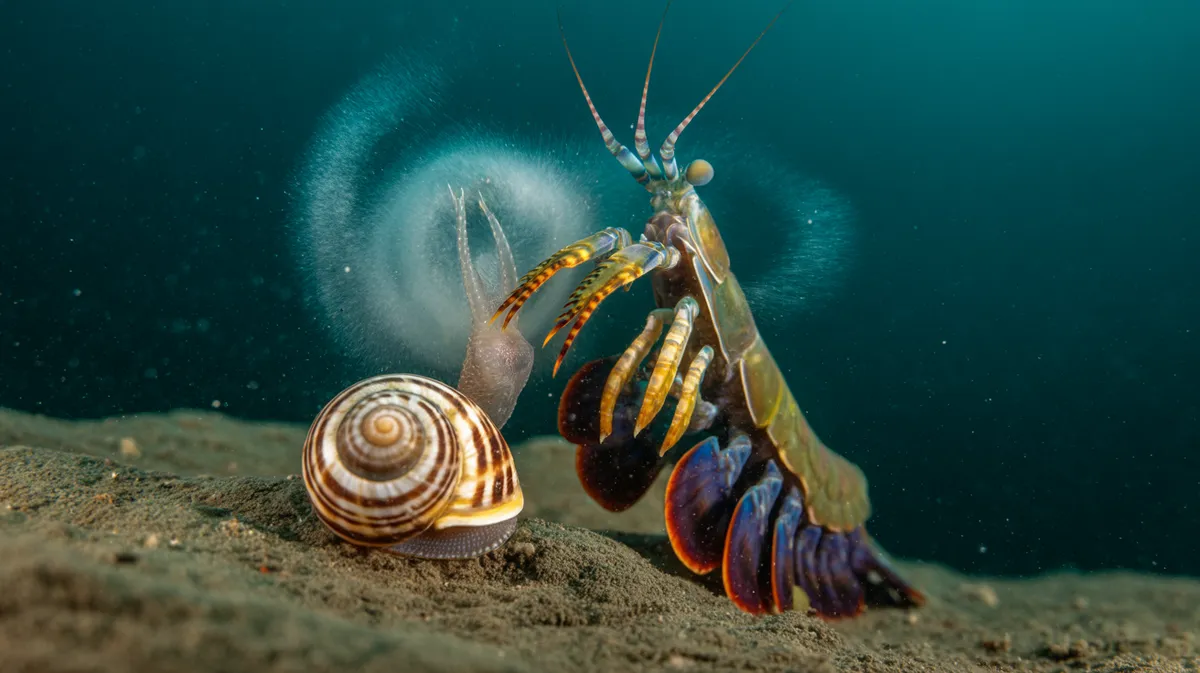
All of this serves an animal famous for one of the fastest movements in nature: a club-like strike that can smash a snail's shell or a crab's armour in milliseconds. On a crowded, colourful reef, instant target identification is everything.
Quick colour recognition, all-around vision, single-eye depth perception, and a secret polarised signalling system add up to a sensory toolkit built for a tiny, lightning-fast predator.
The mantis shrimp doesn't see a richer version of our world — it sees a genuinely different one.
That strike accelerates so fast it briefly boils the surrounding water, so a hunter wielding it can afford no hesitation in identifying its target.
The Viral Story — and What It Got Wrong
The mantis shrimp became an internet celebrity on the strength of a single claim: with 16 photoreceptors to our three, it must see a rainbow of colours we cannot even imagine.
It is a wonderful idea, and it is almost certainly wrong. When researchers actually tested the animals, training them to pick between colours, the mantis shrimp performed surprisingly badly at telling similar shades apart — far worse than a human.
The truth is stranger than the myth. The mantis shrimp does not analyse colour by comparing signals the way our brain does; it appears to recognise colour directly and almost instantly, trading fine discrimination for blistering speed. It does not see more colours — it sees them differently.
What it's like to be a mantis shrimp
To see as a mantis shrimp does is to perceive light itself in dimensions we have no words for — polarised signals shimmering on a reef, colours recognised in an instant, depth judged with a single swivelling eye. It's perhaps the strongest reminder in all of nature that our own vision captures only a sliver of what's really there.
Frequently asked questions
How many colours can a mantis shrimp see? It has up to 16 photoreceptor types, but surprisingly it's poor at telling similar colours apart — it recognises colour fast rather than finely.
Can mantis shrimp see polarized light? Yes — including circularly polarised light, which no other animal is known to detect.
Why do mantis shrimp have such complex eyes? Likely for instant target recognition during their lightning-fast strikes, plus private polarised signalling.
How many photoreceptors does a mantis shrimp have? Up to 16, compared with three types of cone in humans.
Can mantis shrimp see polarized light? Yes — including circular polarisation, which no other animal is known to detect.
How powerful is the mantis shrimp's strike? Fast and forceful enough to briefly boil the water and crack a snail shell.
Do they really see 16 colours better than us? No — that popular claim is a myth; they are actually poor at telling similar colours apart.
Next, hunting in pure darkness: how bats see with sound, and seeing by touch in how the star-nosed mole sees by touch.