
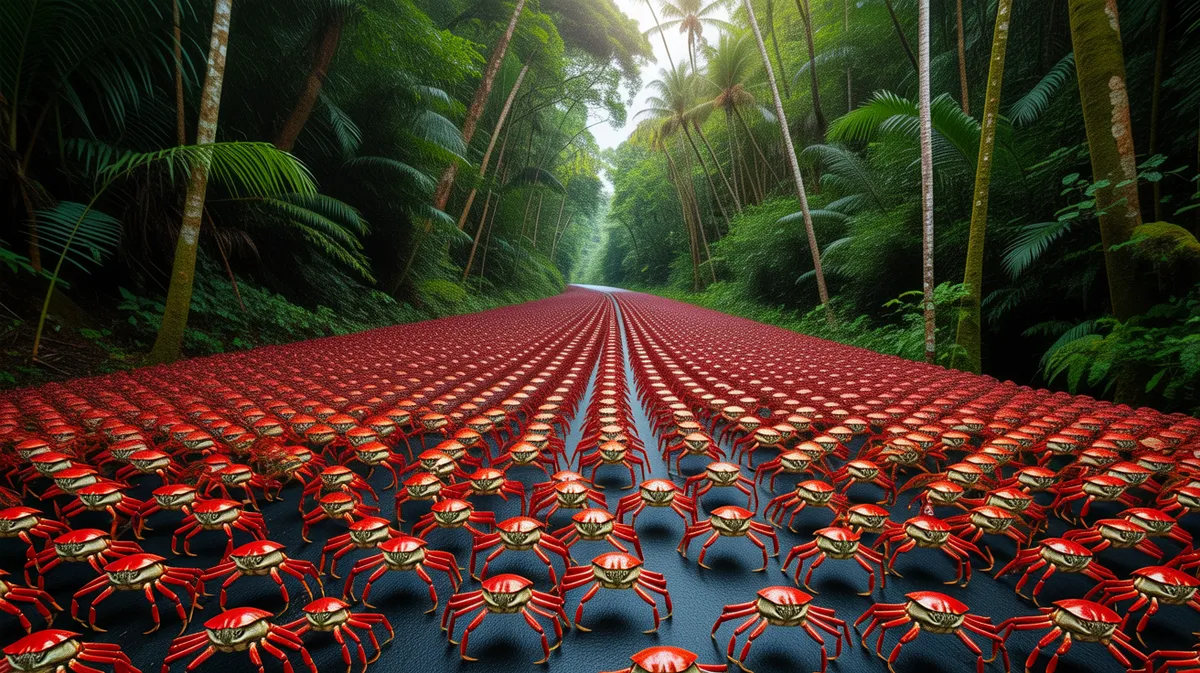
Once a year, on a remote island in the Indian Ocean, the forest floor turns to a moving carpet of scarlet as tens of millions of crabs pour out of the trees and march to the sea. The red crab migration of Christmas Island is one of the most spectacular mass movements of animals on the planet. In this entry of our The Great Migrations series, we join the crabs on their journey.
It's a migration measured not in distance but in sheer, overwhelming numbers. See also the mega-herds of the wildebeest migration and the homeward sea turtle.
A river of red
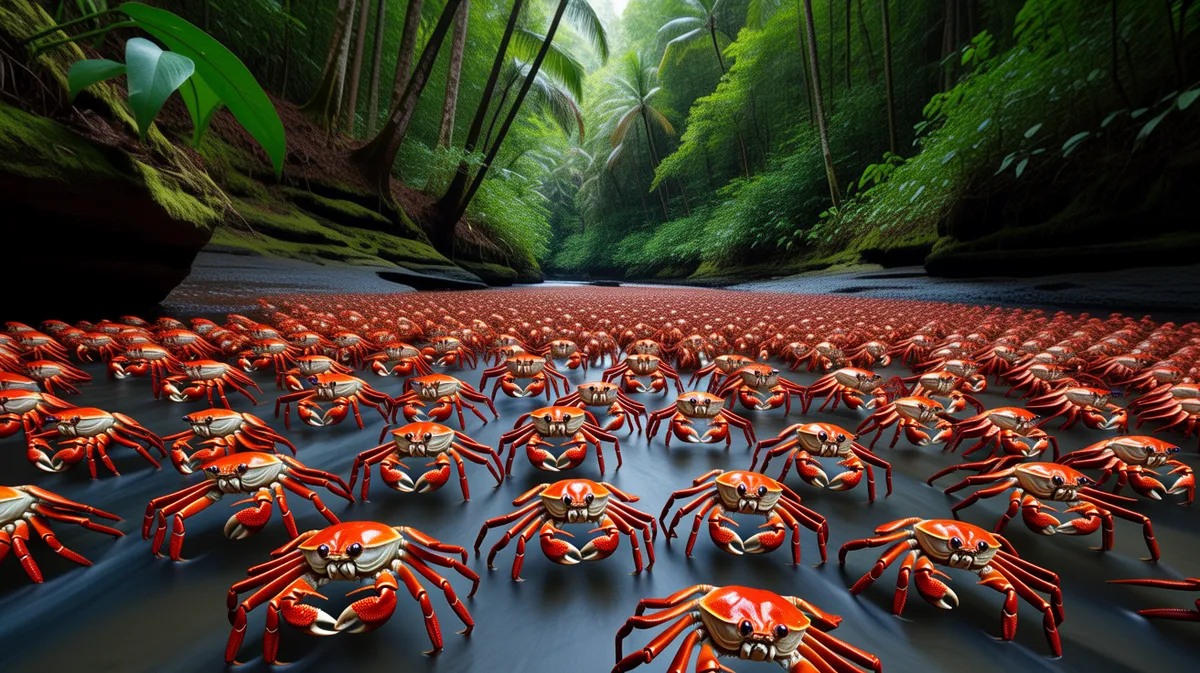
Christmas Island is home to an estimated 40 to 50 million red land crabs, which spend most of the year hidden in the rainforest. Then, with the arrival of the wet season, they all set off at once.
The result is astonishing: rivers of red crabs flow across roads, gardens, and cliffs, covering the ground so thickly that the land itself seems to move.
It is one of the greatest natural spectacles anywhere on Earth, and it happens on a single small island.
The crabs are so numerous that they are considered a keystone species of the island, their burrowing and leaf-eating shaping the entire rainforest floor.
Timed to the moon
The migration's timing is remarkably precise, governed by the rains and the moon. The crabs set out with the first serious rainfall of the wet season, which keeps their bodies moist for the overland journey.
But the truly critical moment — spawning — is locked to the lunar cycle. The whole population aims to release its eggs into the sea on a specific phase of the moon.
Millions of crabs across the island coordinate their journeys to arrive at the coast at exactly the right tide.
This lunar timing means the whole spectacle can be predicted well in advance, drawing scientists and film crews from around the world each year.
The journey to the sea
The march can take over a week, as the crabs make their way down from the forested plateau to the shore. The males generally lead the way, arriving first.
On reaching the coast, the males dig burrows in which mating takes place, and the females then take over the burrows to brood their eggs.
The overland trek is perilous, exposing the crabs to heat, dehydration, and, along the roads, the danger of passing traffic.
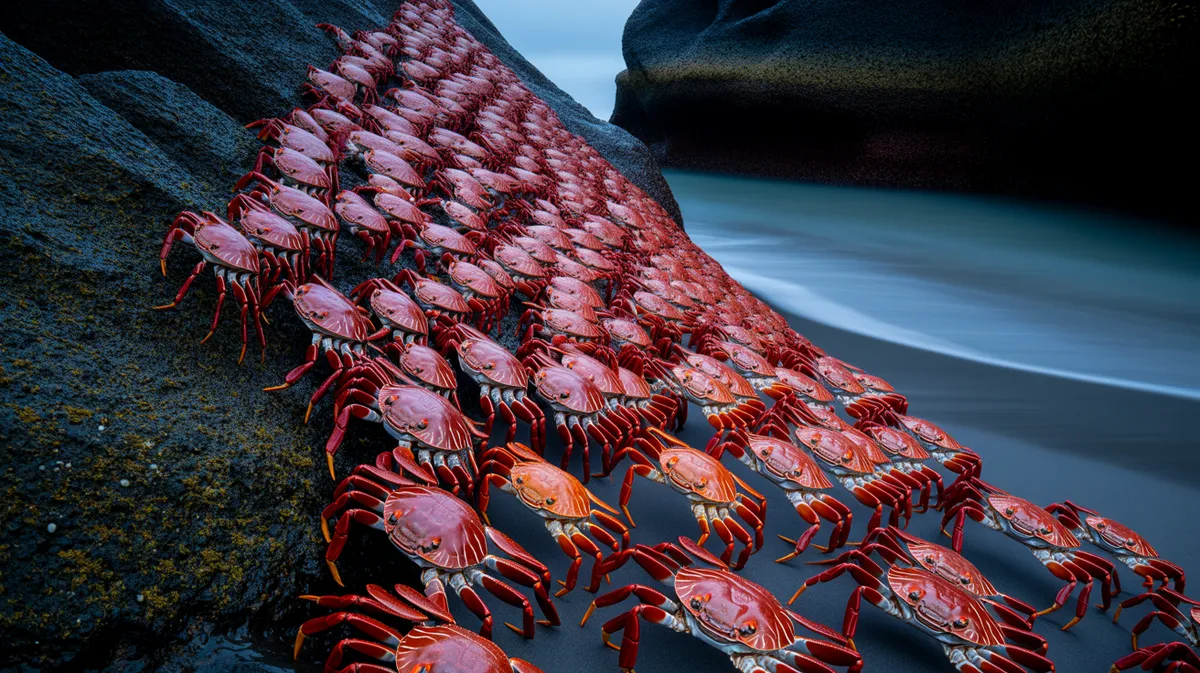
Along the way the crabs must also descend steep sea cliffs, clambering down the bare rock in their millions to reach the shore.
Spawning at the tide
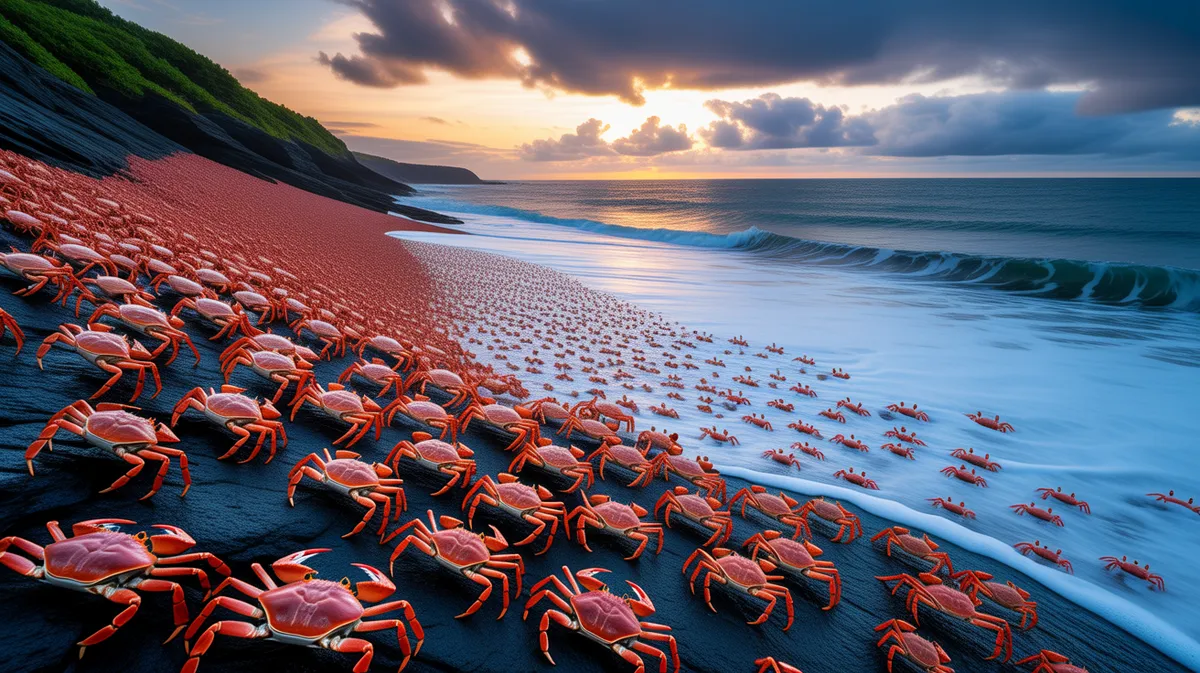
The climax comes at the water's edge. On the chosen morning, before dawn at a receding high tide, the females gather at the shoreline and release their eggs into the ocean.
Each female may carry around 100,000 eggs, so an unimaginable number are cast into the sea all at once.
The eggs hatch the instant they touch the water, and clouds of tiny larvae are swept out into the ocean.
The females release their eggs with a distinctive shaking motion at the water's edge, timed so the outgoing tide sweeps the larvae safely out to sea.
The return of the babies
For the next month the larvae develop out at sea, and most are eaten by fish and other predators — in many years, almost none survive. But every so often, the ocean gives back.
When conditions are right, the survivors return as a wave of tiny crabs, and the shoreline and forest turn red once more as millions of baby crabs march inland.
These occasional bumper years are what keep the island's vast crab population going.
When a big return does happen, the tiny crabs — each the size of a fingernail — swarm up the beaches and cliffs in a red tide flowing the other way.
Protecting the march
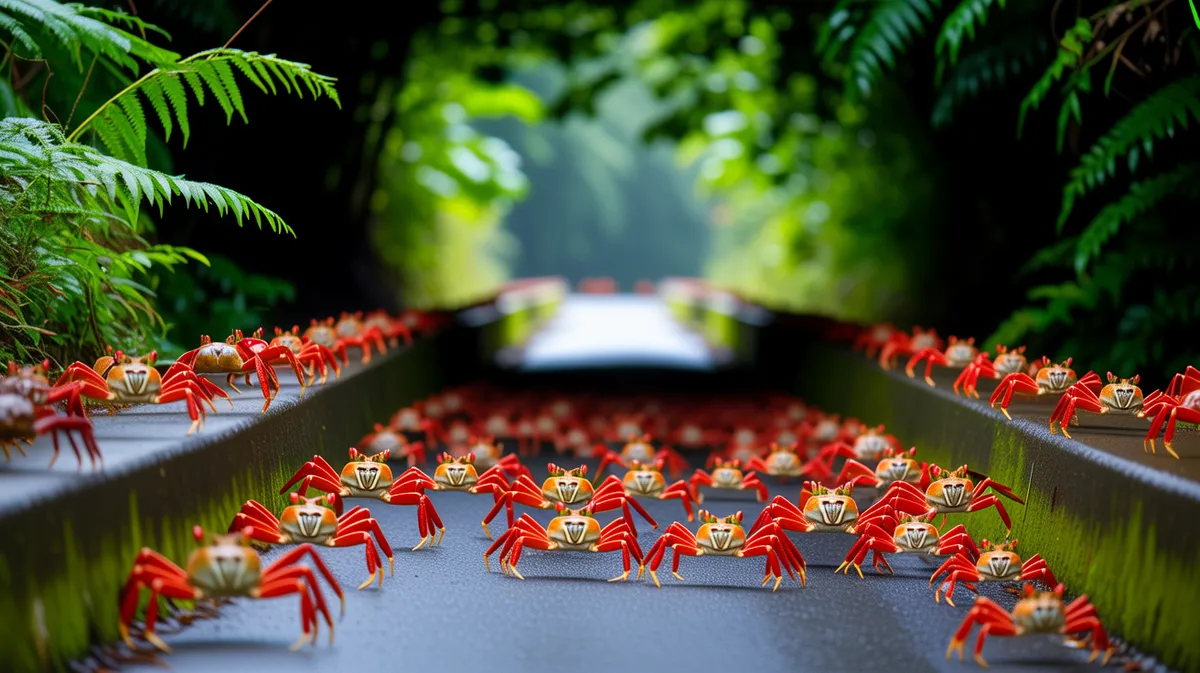
Because the crabs must cross roads to reach the sea, people have gone to remarkable lengths to protect them. Roads are closed during the migration, and special crab bridges and underpasses have been built to guide the crabs safely across.
The greatest threat now comes from an invasive species — the yellow crazy ant — which has killed crabs in huge numbers in parts of the island.
Safeguarding this migration has become a point of pride and careful effort for the island community.
Rangers even use leaf blowers to gently sweep crabs off the roads, while temporary barriers funnel them toward the bridges built just for them.
Seeing It for Yourself
The red crab migration is one of the few great wildlife events that can be predicted almost to the day, because it is locked to the rains and the lunar cycle.
It typically begins with the first substantial downpours of the wet season, usually around October to December, and the spawning is timed to a precise phase of the moon and the turn of the tide.
Christmas Island effectively reorganises itself around the crabs. Roads close, staff sweep crabs to safety, and visitors walk among rivers of scarlet. It is a rare case of a community rearranging its own life to let a migration pass.
The greatest spectacle you've never seen
The red crab migration turns an entire island into a stage for one of nature's most jaw-dropping events. In its rivers of scarlet flowing to the sea and back, it shows that a migration doesn't need to be long to be utterly unforgettable.
Frequently asked questions
How many crabs migrate on Christmas Island? An estimated 40–50 million red land crabs march from the forest to the sea each year.
When does the red crab migration happen? With the first wet-season rains, timed so the crabs spawn on a specific moon phase and tide.
How are the crabs protected? Roads are closed and special crab bridges and underpasses help them cross safely to the sea.
How long does the migration take? The march to the coast can take over a week, with the whole event unfolding over several weeks.
Are the crabs dangerous? Not at all. They may pinch if handled, but they have no interest in people.
What is threatening the crabs? The invasive yellow crazy ant, which has killed many millions of crabs in parts of the island.
That's five more of the planet's great migrations. Revisit the Arctic tern and the dragonfly that crosses an ocean — and watch for more in the The Great Migrations series.