
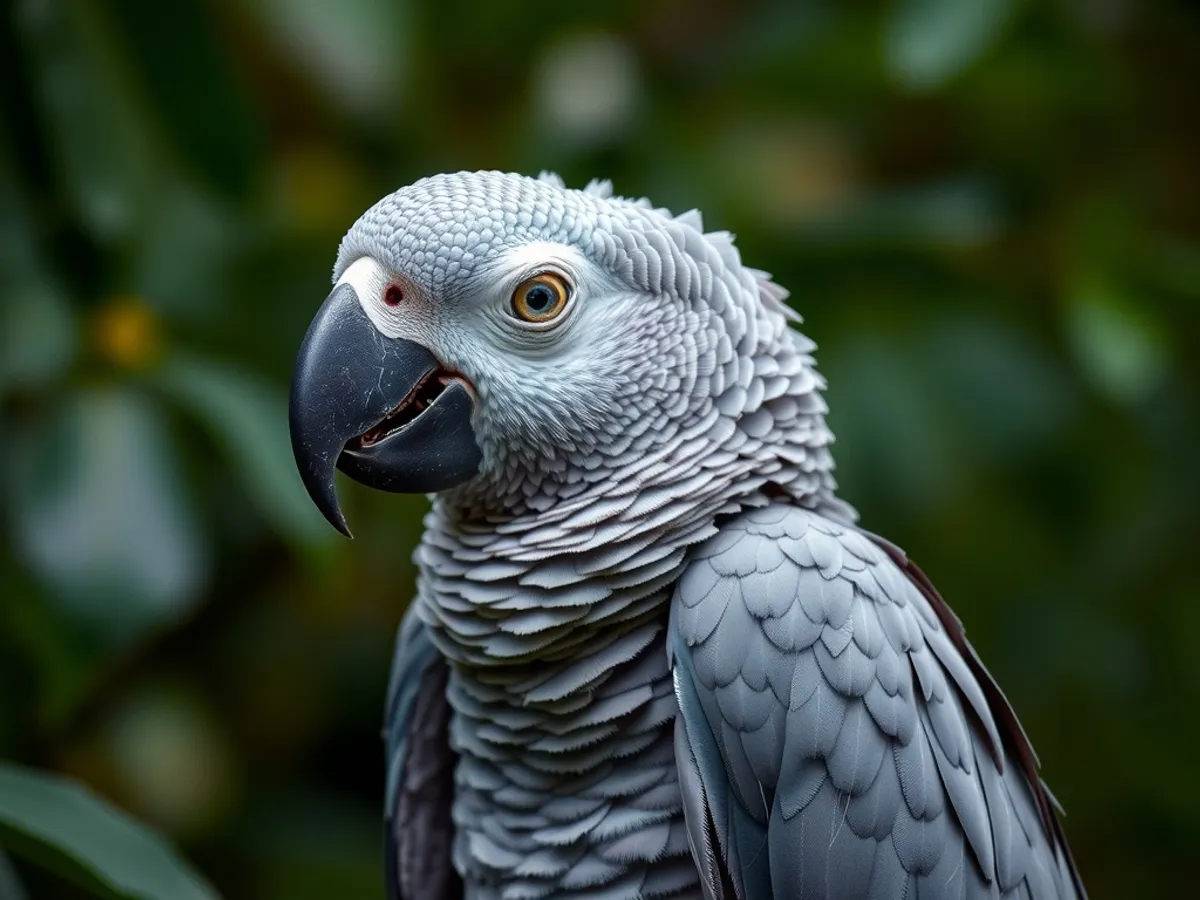
About the African Grey Parrot
The African grey is the parrot that changed what science was prepared to say about animal minds. Over three decades, Irene Pepperberg's grey, Alex, learned to label around a hundred objects, colours, shapes and materials, and — crucially — to combine those categories: shown a tray, he could answer which object was both green and three-cornered, which requires holding two attributes in mind at once. He grasped same and different as abstract concepts, and he understood none, a functional zero, which he produced spontaneously when asked which colour differed among a set of identical objects. He is also the only non-human animal on record to have asked an existential question, when he saw himself in a mirror and asked what colour he was. Greys are long-lived, often past fifty, and intensely social, which is exactly why they suffer so badly alone: a bored grey plucks out its own feathers. The demand created by that intelligence has been ruinous, and trapping for the pet trade, combined with habitat loss, has pushed the species onto the endangered list.
Fascinating facts
Genius Bird
African Grey Parrots are widely regarded as the most intelligent parrot species, capable of problem-solving, counting, and even understanding abstract concepts.
Master Mimic
They are exceptional mimics, able to learn and repeat hundreds of words, phrases, and sounds with uncanny accuracy.
Forest Dwellers
In the wild, African Grey Parrots inhabit dense rainforests, where they feed on fruits, nuts, seeds, and occasionally bark and leaves.
Detailed description
The African Grey Parrot (Psittacus erithacus) is a medium-sized parrot, typically measuring 33–40 cm (13–16 in) in length and weighing between 400–600 grams (14–21 oz). It is characterized by its uniform silver-grey plumage, pale facial mask, and a distinctive bright red tail. The beak is strong and black, adapted for cracking hard seeds and nuts, while the eyes are pale yellow in adults, transitioning from dark grey in juveniles. African Grey Parrots are highly intelligent, with advanced problem-solving abilities, complex vocalizations, and exceptional mimicry skills, including the ability to reproduce human speech and environmental sounds. In the wild, they form large, cohesive flocks, exhibiting strong social bonds and complex communication. Their wings are broad and rounded, allowing for agile flight through dense rainforest canopies. The species is sexually monomorphic, with males and females appearing similar, although subtle differences in body size and head shape may be discerned upon close examination. African Grey Parrots are primarily arboreal, spending most of their time in the forest canopy, where they forage for a diverse diet of seeds, nuts, fruits, and occasionally leafy matter. Their lifespan in the wild is estimated at 23–30 years, but in captivity, they can live over 50 years with proper care. The species is renowned for its cognitive complexity, rivaling that of great apes and cetaceans, making it a subject of extensive scientific research.
Did you know?
The African Grey Parrot is considered the best talking parrot in the world, with some individuals able to mimic not only words but also human-like voices and sounds such as phones ringing or microwaves beeping.
Research & sources
Wikipedia summary
The grey parrot, also known as the Congo grey parrot, is an African parrot in the family Psittacidae. It was previously also known as the African grey parrot until the Timneh parrot, previously treated as a subspecies, was elevated to a full species.
Behaviour & social structure
African Grey Parrots are diurnal, with peak activity occurring in the early morning and late afternoon. They are highly social, often seen in flocks ranging from a few individuals to several hundred, especially at communal roosting or feeding sites. These parrots engage in allopreening (mutual grooming), which reinforces social bonds and maintains feather condition. Their vocal repertoire is extensive, including whistles, squawks, and mimicry of other species or environmental sounds. Foraging is primarily arboreal, with individuals using their strong beaks and dexterous feet to manipulate food items. They exhibit food caching and selective feeding, often discarding unripe or toxic seeds. Play behavior is common, especially among juveniles, and includes object manipulation and aerial acrobatics. African Greys are known for their cautious nature, often acting as sentinels and alerting the flock to potential dangers with alarm calls. In captivity, they require significant mental stimulation to prevent behavioral issues such as feather plucking or stereotypies.
Reproduction & life cycle
Breeding in the wild typically coincides with the onset of the rainy season, varying regionally but often between October and May. African Grey Parrots are monogamous, forming long-term pair bonds. Courtship involves mutual preening, feeding, and synchronized vocalizations. Nests are usually constructed in tree cavities, often high above the ground for protection from predators. The female lays 3–5 white eggs, which she incubates for approximately 28–30 days while the male provides food. After hatching, chicks are altricial and remain in the nest for about 10–12 weeks, during which both parents participate in feeding and care. Fledglings remain dependent on their parents for several weeks post-fledging, gradually learning to forage and integrate into the flock. Sexual maturity is reached at 3–5 years of age.
Adaptations & survival
African Grey Parrots possess several adaptations for survival in dense forest environments. Their zygodactyl feet (two toes facing forward, two backward) allow for strong grasping and manipulation of food and objects. Their powerful, curved beaks are specialized for cracking hard nuts and seeds, while their keen eyesight aids in locating food and detecting predators. Cognitively, they exhibit advanced vocal learning and problem-solving abilities, which facilitate complex social interactions and adaptability to changing environments. Their cryptic grey coloration provides camouflage among tree branches and dappled light, reducing predation risk. Socially, their flocking behavior enhances vigilance and predator detection, while communal roosting offers thermoregulatory and safety benefits.
Cultural significance
African Grey Parrots have long held significance in African cultures, often regarded as symbols of wisdom and communication due to their vocal abilities. In some regions, their feathers and body parts are used in traditional rituals or medicine. Globally, they are among the most popular companion birds, prized for their intelligence and capacity for speech. Their presence in art, literature, and folklore underscores their status as icons of avian intelligence. However, their popularity in the pet trade has contributed to their decline in the wild, highlighting the complex relationship between cultural value and conservation.
Recent research
Recent scientific studies have focused on the cognitive abilities of African Grey Parrots, particularly their understanding of concepts such as numeracy, object permanence, and vocal learning. The work of Dr. Irene Pepperberg with an individual named 'Alex' demonstrated the species' capacity for abstract reasoning and communication using a limited vocabulary. Ongoing research explores their social cognition, problem-solving strategies, and the neurological basis of vocal mimicry. Conservation research is increasingly utilizing genetic studies to assess population structure and inform management strategies. Satellite telemetry and field surveys are being used to better understand movement patterns, habitat use, and the impact of habitat fragmentation.
Videos
Habitat
Rainforest


Conservation
The African Grey Parrot is currently classified as Endangered on the IUCN Red List.
Threats & challenges
The primary threats to African Grey Parrots are habitat loss due to deforestation, fragmentation of their native forests, and extensive trapping for the international pet trade. Illegal capture and trade have caused severe population declines, with some regions experiencing local extirpations. Additional threats include hunting for bushmeat and traditional medicine, as well as climate change impacting forest ecosystems. The species is listed as Endangered by the IUCN and is included in Appendix I of CITES, prohibiting international commercial trade. Population estimates suggest a decline of over 50% in the past three generations, with wild populations now highly fragmented and vulnerable to further decline. Conservation challenges include enforcement of trade bans, habitat protection, and the need for community-based conservation initiatives.
Taxonomy
Scientific name
Psittacus erithacus
- Kingdom
- Animalia
- Phylum
- Chordata
- Class
- Aves
- Order
- Psittaciformes
- Family
- Psittacidae
- Genus
- Psittacus
- Species
- erithacus
Where to see an african grey parrot
12 zoos and aquariums in 4 countries are recorded as keeping this species.
 Alabama Gulf Coast Zoo🇺🇸 Gulf Shores, United States
 Śląski Ogród Zoologiczny🇵🇱 Chorzów, Poland
 Caldwell Zoo🇺🇸 Tyler, United States
- 🦁Charles Paddock Zoo🇺🇸 Atascadero, United States
- 🦁The Maryland Zoo in Baltimore🇺🇸 Baltimore, United States
Community notes
Share your observations about the African Grey Parrot.
No community notes yet. Be the first!
Discover more wildlife
More fascinating animals from the encyclopedia.