
About the Alligator Snapping Turtle
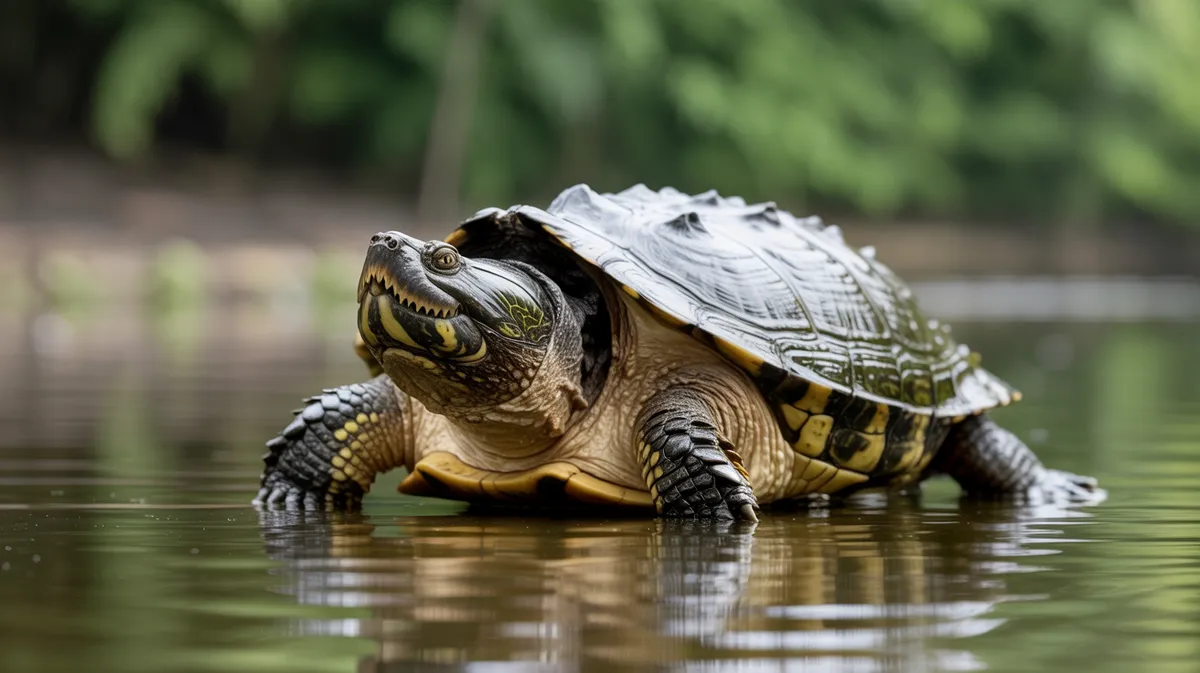
The alligator snapping turtle is one of very few vertebrates that fishes with a lure. It lies on the river bottom with its jaws open and wiggles a pink, worm-shaped appendage on the floor of its tongue; a fish that comes to inspect the "worm" is taken by a strike that closes the jaws in a fraction of a second. It is a genuine ambush specialist that may sit motionless for so long that algae grow on its shell, and its three high ridges of keels, hidden eyes set at the sides of the head, and hooked beak separate it clearly from the far more aggressive common snapper. The popular claim that it can bite through a broomstick is not true: measured bite forces are around 150 pounds of force, respectable but comparable to a large dog and well below the crushing power of many turtles that eat shellfish. Males can exceed 100 kg. Populations across the Mississippi basin were gutted in the twentieth century by commercial harvest for turtle soup, and the species is slow-maturing enough that recovery takes decades.
Fascinating facts
Camouflage Expert
The rough, ridged shell and algae that grows on it help the alligator snapping turtle blend perfectly with the muddy river bottom.
Powerful Bite
Its jaw strength is so intense that it can crush through bone and even break wooden broom handles.
Lure Hunter
It uses a pink, worm-like appendage on its tongue to mimic prey and attract fish directly into its mouth.
Detailed description
The alligator snapping turtle (Macrochelys temminckii) is a massive, prehistoric-looking freshwater turtle, often reaching carapace lengths of 35–80 cm (14–32 in) and weights commonly between 35–70 kg (77–154 lbs), with exceptional individuals exceeding 100 kg (220 lbs). Its rugged, dark-brown to black shell is adorned with three prominent dorsal ridges of raised, spiky scutes, providing both camouflage and protection. The head is large and triangular, equipped with a hooked, beak-like jaw capable of exerting tremendous bite force, and the eyes are set laterally for a wide field of vision. The species is renowned for its vermiform (worm-shaped) lingual appendage, a unique adaptation on the tongue used to lure prey. The thick, muscular tail is nearly as long as the shell, and the limbs are robust with large claws for digging and gripping. Alligator snapping turtles are primarily aquatic, spending the vast majority of their lives submerged in deep water, surfacing only briefly to breathe. Their skin is rough and often covered in algae, enhancing their camouflage among submerged logs and debris. Sexual dimorphism is present, with males generally larger and possessing longer tails than females. Lifespans in the wild are estimated at 50–100 years, with some individuals in captivity surpassing a century.
Did you know?
Despite their fearsome appearance and power, alligator snapping turtles are primarily sit-and-wait predators that conserve energy by remaining motionless for hours at a time.
Research & sources
Wikipedia summary
The alligator snapping turtle is a large species of turtle in the family Chelydridae. They are the largest freshwater turtle in North America. The species is endemic to freshwater habitats in the United States. M. temminckii is one of the heaviest living freshwater turtles in the world. It is often associated with, but not closely related to, the common snapping turtle, which is in the genus Chelydra. The specific epithet temminckii is in honor of Dutch zoologist Coenraad Jacob Temminck.
Behaviour & social structure
Alligator snapping turtles are solitary and highly sedentary, typically remaining motionless for hours on river or lake bottoms. They are primarily nocturnal but may also be active during the day in turbid or shaded waters. Their signature hunting strategy is ambush predation: the turtle lies with its mouth open, wriggling its worm-like tongue appendage to attract fish and other prey, then snaps its jaws shut with remarkable speed and force. Diet is opportunistic and carnivorous, including fish, amphibians, aquatic invertebrates, other turtles, snakes, and occasionally small mammals or carrion. Juveniles may consume more invertebrates and plant matter. Social interactions are minimal outside of the breeding season, and individuals are highly territorial, especially mature males. They rarely bask and are seldom seen out of water except during nesting or dispersal events. Daily routines involve long periods of inactivity, punctuated by brief foraging or repositioning.
Reproduction & life cycle
Breeding occurs primarily in spring (April–June), with males seeking out females in deep water. Courtship involves tactile and olfactory cues, and copulation takes place underwater. Females migrate to sandy or soft-soiled banks to nest, often traveling considerable distances overland. Clutch sizes range from 10 to 50 eggs, with larger females producing more eggs. Eggs are spherical to slightly elliptical, measuring about 3.5 cm (1.4 in) in diameter. Incubation lasts 100–140 days, depending on temperature and humidity. Sex determination is temperature-dependent, with warmer nests producing females. There is no parental care after oviposition; hatchlings emerge in late summer or early autumn and instinctively make their way to water. Juvenile mortality is high due to predation by raccoons, birds, and fish.
Adaptations & survival
Macrochelys temminckii exhibits several remarkable adaptations: the lingual lure is a rare example of aggressive mimicry among reptiles, allowing the turtle to attract prey without expending energy. Its cryptic coloration and algae-encrusted shell provide exceptional camouflage. The massive, hooked jaws and powerful neck muscles enable it to capture and subdue large, slippery prey. The turtle's low metabolic rate and ability to absorb oxygen through the cloaca allow extended periods underwater, sometimes exceeding 40–50 minutes without surfacing. The heavily armored shell and spiked scutes deter most predators. Evolutionarily, the species is a relic of ancient chelydrid turtles, with fossil records dating back to the Miocene.
Cultural significance
The alligator snapping turtle has long been a subject of fascination in North American folklore, often depicted as a 'dinosaur' or 'monster' of southern rivers. It features in Native American stories as a symbol of strength and endurance. Historically, the species was harvested for its meat, especially for turtle soup, which contributed to population declines. In modern times, it is a popular subject in wildlife documentaries and environmental education, symbolizing the unique biodiversity of southeastern U.S. waterways. Its formidable appearance and behavior have inspired both respect and myth.
Recent research
Recent genetic studies have clarified the taxonomy of Macrochelys, with evidence suggesting historical population structure and possible cryptic species, though current consensus retains a single species. Ongoing research focuses on movement ecology using radio telemetry, revealing large home ranges and site fidelity. Studies of diet using stable isotopes have shown significant variation based on habitat and age. Conservation genetics is being used to assess genetic diversity and inform reintroduction efforts. There is increasing interest in the effects of environmental contaminants (e.g., heavy metals, pesticides) on health and reproduction. Head-starting and nest protection programs are being evaluated for effectiveness in population recovery.
Videos
Habitat
Slow-moving freshwater rivers, lakes, swamps, and bayous


Conservation
The Alligator Snapping Turtle is currently classified as Vulnerable on the IUCN Red List.
Threats & challenges
Major threats include habitat destruction (especially river channelization, damming, and wetland drainage), water pollution, and overharvesting for the pet trade and human consumption. Illegal poaching remains a significant problem, particularly for large adults. Road mortality during nesting migrations and nest predation by invasive species (e.g., feral hogs) further reduce recruitment. The species is listed as Vulnerable by the IUCN and is included in CITES Appendix II. Population declines have been documented throughout much of its historical range, with some local extirpations. Conservation efforts focus on habitat protection, regulation of harvest, and head-starting programs for juveniles.
Taxonomy
Scientific name
Macrochelys temminckii
- Kingdom
- Animalia
- Phylum
- Chordata
- Class
- Reptilia
- Order
- Testudines
- Family
- Chelydridae
- Genus
- Macrochelys
- Species
- temminckii
Where to see an alligator snapping turtle
12 zoos and aquariums in 3 countries are recorded as keeping this species.
 Downtown Aquarium🇺🇸 Denver, United States
 National Zoological Park🇺🇸 Washington, United States
 North Carolina Zoo🇺🇸 Asheboro, United States
 Paignton Zoo🇬🇧 Paignton, United Kingdom
 Śląski Ogród Zoologiczny🇵🇱 Chorzów, Poland
Community notes
Share your observations about the Alligator Snapping Turtle.
No community notes yet. Be the first!
Discover more wildlife
More fascinating animals from the encyclopedia.