
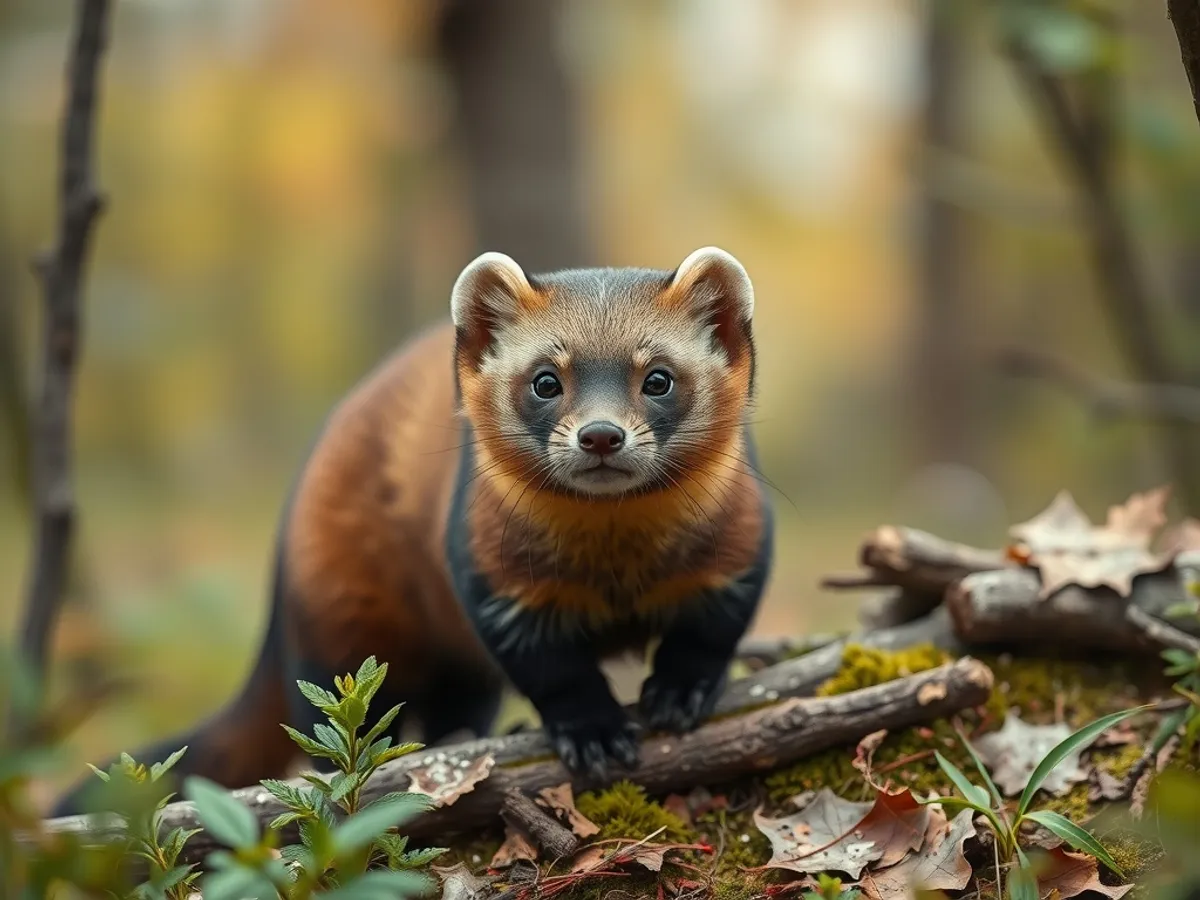
About the American Marten
The American Marten is a small, agile mammal native to the forests of North America. Characterized by its slender body, bushy tail, and silky brown fur, this elusive predator is well adapted for life among thick trees and snowy landscapes. Martens are solitary and primarily nocturnal, skillfully navigating the forest canopy in search of prey. They play an important role in their ecosystem by helping to control rodent populations and dispersing seeds from the fruits they eat.
Fascinating facts
Forest Dweller
The American Marten is most commonly found in mature, dense forests where it uses fallen logs and tree cavities for shelter.
Relatives
Martens belong to the Mustelidae family, making them relatives of weasels, otters, and wolverines.
Winter Adaptations
Their dense, soft fur provides excellent insulation against cold temperatures, allowing them to remain active year-round even in snowy conditions.
Detailed description
The American marten (Martes americana) is a small, slender mustelid measuring 48–68 cm (19–27 in) in total length, with males averaging 600–1,300 g and females 400–900 g, exhibiting pronounced sexual dimorphism. Its body is elongated with short limbs, a pointed muzzle, and large, rounded ears that aid in acute hearing. The fur is dense and silky, varying from pale yellowish-buff to dark brown or nearly black, with a distinctive pale or orange throat patch ('bib'). The bushy tail, comprising about one-third of its length, assists with balance in arboreal habitats. Martens are highly agile climbers, using semi-retractable claws and flexible ankles to navigate trees and snow-laden branches. They are primarily solitary and territorial, marking ranges with scent glands. Activity is mostly crepuscular and nocturnal, but diurnal foraging occurs in winter. The species is omnivorous, with a diet shifting seasonally between small mammals (especially voles and squirrels), birds, insects, fruits, and carrion. Reproduction involves delayed implantation, with breeding in summer but actual gestation beginning months later, resulting in a single annual litter of 1–5 kits born in early spring. Kits are altricial at birth, developing rapidly and weaning by 6–8 weeks. Martens are long-lived for small carnivores, with wild individuals reaching up to 15 years. Their ecological role includes regulating prey populations and dispersing seeds, contributing to forest health.
Did you know?
Despite their small size, American Martens can take down prey larger than themselves, such as snowshoe hares.
Research & sources
Wikipedia summary
The American marten, also known as the American pine marten, is a species of North American mammal, a member of the family Mustelidae. The species is sometimes referred to as simply the pine marten. The name "pine marten" is derived from the common name of the distinct Eurasian species, Martes martes. Martes americana is found throughout Canada, Alaska, and parts of the northern United States. It is a long, slender-bodied weasel, with fur ranging from yellowish to brown to near black. It may be confused with the fisher, but the marten is lighter in color and smaller. Identification of the marten is further eased by a characteristic bib that is a distinctly different color than the body. Sexual dimorphism is pronounced, with males being much larger.
Behaviour & social structure
American martens are solitary and maintain exclusive territories, with home range sizes varying by habitat quality and sex (males: 2–15 km², females: 1–6 km²). They are primarily crepuscular and nocturnal, but may be active during the day, especially in winter when prey is scarce. Martens hunt using a combination of ground and arboreal locomotion, employing stealth and agility to ambush small mammals, particularly voles, mice, and red squirrels. They cache surplus food in tree hollows or under snow. Social interactions are limited outside the breeding season, but individuals communicate via scent marking, vocalizations (chirrups, hisses), and visual cues. Martens use complex three-dimensional movements in the forest canopy and subnivean (under-snow) tunnels to access prey and avoid predators. They rest in dens constructed in hollow logs, tree cavities, or abandoned squirrel nests, often changing resting sites frequently.
Reproduction & life cycle
Breeding occurs from late June to early August. After copulation, the species exhibits delayed implantation: fertilized embryos remain dormant for 7–8 months, with active gestation lasting 27–36 days. Litters of 1–5 (average 2–3) kits are born in March or April in well-concealed dens, typically in hollow trees or stumps. Kits are blind, deaf, and nearly naked at birth, but develop rapidly, opening their eyes at 5–6 weeks and weaning at 6–8 weeks. Females provide all parental care, nursing and grooming the young until they are independent by late summer or early autumn. Sexual maturity is reached at 1–2 years. Reproductive success is closely linked to food availability and habitat quality.
Adaptations & survival
The American marten possesses several adaptations for life in northern forests. Its dense, insulating fur provides protection against cold temperatures, while furred footpads act as snowshoes, enabling efficient movement atop snow. Flexible ankles and semi-retractable claws facilitate climbing and maneuvering through trees. Acute senses of hearing and smell aid in detecting prey beneath snow or leaf litter. The species' omnivorous diet and ability to switch food sources seasonally enhance survival during periods of scarcity. Delayed implantation allows timing of births to coincide with optimal spring conditions, maximizing kit survival. Martens are also adept at using subnivean spaces to hunt and avoid predators.
Cultural significance
Martens have held significance in Indigenous cultures across North America, valued for their luxurious pelts used in clothing and trade. The fur trade of the 18th and 19th centuries contributed to European exploration and settlement of northern forests. In folklore, martens are sometimes depicted as clever, elusive creatures. Their pelts remain prized in the fur industry, though demand has declined. Conservation efforts for martens have also raised public awareness about the importance of old-growth forests and biodiversity.
Recent research
Recent genetic studies have clarified the taxonomy of Martes americana, distinguishing it from closely related Eurasian species and identifying several subspecies, including the endangered Newfoundland marten (M. a. atrata). Ongoing research focuses on the effects of habitat fragmentation, climate change, and interspecific competition on marten populations. Radio-telemetry and camera-trapping have improved understanding of home range, habitat use, and movement ecology. Studies have also examined the species' role in seed dispersal and forest regeneration. Conservation genetics is being used to inform management of isolated and declining populations.
Videos
Habitat
Boreal and northern temperate forests
 Polar and Subpolar Regions
Tundra
Cold, treeless regions with permafrost supporting specialized cold-adapted wildlife.
 Elevated Terrain
Mountain
High-altitude environments with varying climates and specialized wildlife adapted to rugged terrain and thin air.
 Global
Forest
Wooded areas with significant tree cover and diverse plant and animal communities.
Conservation
The American Marten is currently classified as Least Concern on the IUCN Red List.
Threats & challenges
Major threats to American martens include habitat loss and fragmentation due to logging, urbanization, and conversion of mature forests to younger stands. Martens require structurally complex, late-successional forests with abundant coarse woody debris for denning and foraging. Trapping for fur, though regulated, can impact local populations, especially where habitat is degraded. Climate change poses emerging risks by altering snow cover, forest composition, and prey availability. In some regions, competition with fishers (Pekania pennanti) and other carnivores may limit marten distribution. Despite these challenges, the species remains widespread and is classified as Least Concern, though some subspecies (e.g., Newfoundland marten) are threatened.
Taxonomy
Scientific name
Martes americana
- Kingdom
- Animalia
- Phylum
- Chordata
- Class
- Mammalia
- Order
- Carnivora
- Family
- Mustelidae
- Genus
- Martes
- Species
- americana
Community notes
Share your observations about the American Marten.
No community notes yet. Be the first!
Discover more wildlife
More fascinating animals from the encyclopedia.