
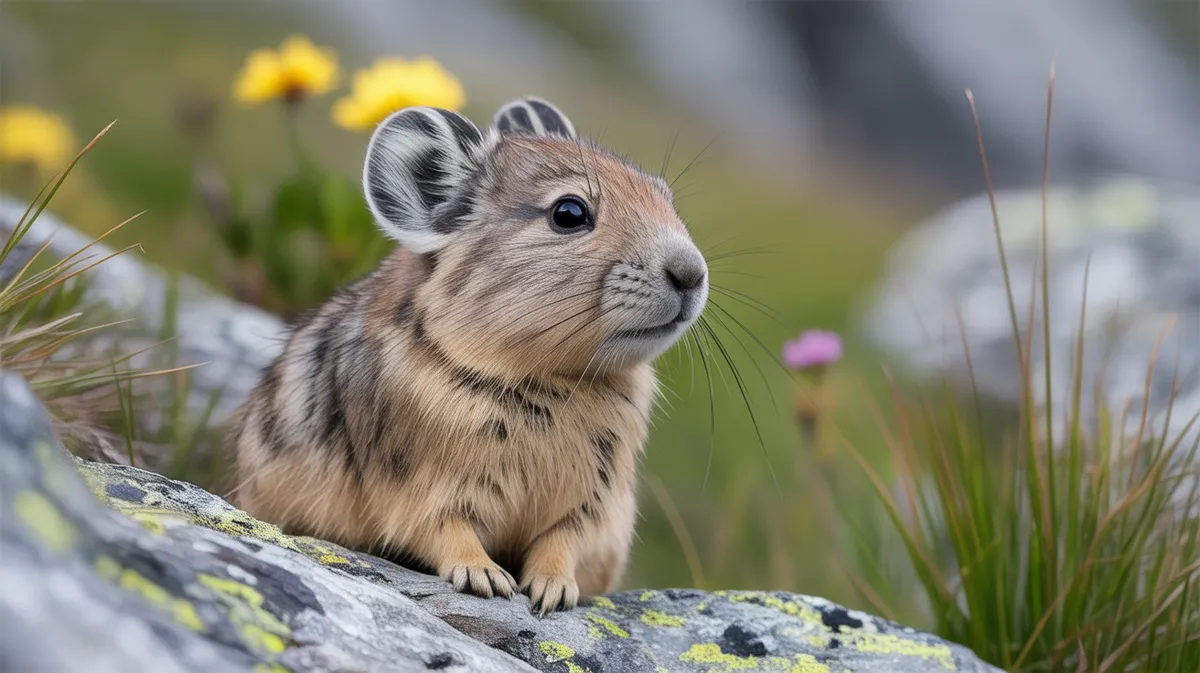
About the American Pika
The pika is not a rodent — it is a lagomorph, a close relative of rabbits and hares, and it is one of the very few mammals that stays awake and active all winter in alpine talus without hibernating. It gets through by farming. Through summer it makes repeated dashes into the meadow, cutting vegetation and stacking it on rocks to cure in the sun, building a haypile that may contain dozens of plant species and can fill a wheelbarrow. The selection is not random: pikas deliberately include plants loaded with toxic phenolics, which act as preservatives and slow decay, and they eat those portions later in the winter once the toxins have degraded. Its constraint is heat, not cold. A pika's dense fur and high metabolism mean it can die after only a few hours' exposure at around 25.5 C, so it retreats into the cool interstices of the rock slope on hot days and cannot cross warm valleys — which is why populations in the Great Basin have been winking out at lower elevations as summers warm.
Fascinating facts
Haypile Hoarders
American Pikas spend the summer collecting and drying plants to build haypiles, which they use as their sole food source during the winter months.
Mountain Dwellers
They are typically found at elevations between 2,400 and 4,000 meters (7,900–13,100 ft), thriving in cool, moist microclimates among rocky slopes.
Vocal Alarms
Pikas use loud, sharp calls to communicate with one another, particularly to alert others of predators or to defend their territory.
Detailed description
The American pika (Ochotona princeps) is a small lagomorph, typically measuring 16–22 cm (6.3–8.7 in) in length and weighing 120–180 g (4.2–6.3 oz). It has a compact, rounded body, short limbs, and no visible tail, with dense, soft fur that varies from grayish-brown to cinnamon depending on the season and subspecies. Its large, rounded ears and prominent whiskers enhance its sensory perception in rocky habitats. Adapted to cold, high-elevation environments, the American pika is primarily found between 2,400 and 4,000 meters (7,900–13,100 ft) in the western mountains of North America. Pikas are diurnal and highly vocal, using sharp, high-pitched calls to communicate territory and warn of predators. They are solitary and territorial outside of the breeding season, with individuals maintaining and defending haypiles and foraging areas. Their diet consists of a wide variety of alpine plants, which they both consume immediately and cache for winter survival. Reproduction occurs in spring and early summer, with females producing up to two litters per year. The American pika is renowned for its behavioral and physiological adaptations to cold, including efficient thermoregulation and a reliance on stored food rather than hibernation. Its sensitivity to temperature makes it a sentinel species for monitoring the impacts of climate change in alpine ecosystems.
Did you know?
Unlike many small mammals in cold habitats, American Pikas are active year-round and do not hibernate, relying entirely on their haypiles for winter survival.
Research & sources
Wikipedia summary
The American pika, a diurnal species of pika, is found in the mountains of western North America, usually in boulder fields at or above the tree line. They are herbivorous, smaller relatives of rabbits and hares. Pikas have two different ways of foraging; they either directly consume food or they cache food in piles for the winter (haying).
Behaviour & social structure
American pikas are primarily active during daylight hours (diurnal), with peak activity in the morning and late afternoon to avoid midday heat. They exhibit two main foraging behaviors: direct consumption of vegetation and the collection of plant material to create haypiles, which are stored in crevices for winter use. Haying is a highly organized activity, with individuals selecting a diverse array of plant species to maximize nutritional value and minimize spoilage. Pikas are territorial, using vocalizations and scent marking to delineate boundaries. Social interactions are generally limited to aggressive encounters over territory, though neighboring individuals may tolerate each other at territory edges. Pikas maintain a complex system of vocal and visual signals, including alarm calls to warn of predators such as weasels, raptors, and foxes. They do not hibernate, remaining active beneath the snow and relying on cached food throughout winter.
Reproduction & life cycle
Breeding typically begins shortly after snowmelt, from late April to early June, depending on elevation and latitude. American pikas are polygynandrous, with both males and females mating with multiple partners. After a gestation period of about 30 days, females give birth to litters of 2–6 altricial young in well-concealed nests within talus crevices. The young are weaned at around 3–4 weeks and reach sexual maturity by the following year. Females may produce a second litter if conditions allow, but high-elevation populations often have only one reproductive event per year due to the short growing season. Parental care is provided exclusively by the female, who nurses and protects the young until they are independent.
Adaptations & survival
The American pika exhibits several key adaptations to its alpine environment. Its dense fur provides insulation against cold temperatures, while its compact body reduces heat loss. Pikas have a high metabolic rate and can maintain activity at temperatures well below freezing. Behavioral adaptations include haying, which allows them to survive winter without hibernating, and the selection of microhabitats within talus fields that offer thermal refuges during temperature extremes. Their acute hearing and vision aid in predator detection, and their vocalizations serve as both alarm signals and territorial markers. Physiologically, pikas have a limited ability to tolerate heat; temperatures above 25.5°C (77.9°F) can be lethal, making them highly sensitive to climate warming.
Cultural significance
The American pika has become a symbol of alpine wilderness and is often featured in conservation campaigns as an indicator species for climate change. While it does not have a prominent role in indigenous mythology or traditional use, its charismatic appearance and vocalizations have made it a favorite among hikers and naturalists. The pika's plight has been highlighted in environmental education and advocacy, underscoring the broader impacts of global warming on mountain ecosystems.
Recent research
Recent research has focused on the American pika's responses to climate change, including studies of microclimate use, genetic diversity, and population connectivity. Notably, pikas have demonstrated some behavioral plasticity, such as utilizing cooler microhabitats within talus and shifting foraging times to avoid heat stress. Ongoing studies are investigating the genetic basis of thermal tolerance and the potential for adaptation to changing environments. Long-term monitoring projects, such as those led by the US National Park Service and academic institutions, are providing valuable data on population trends and habitat use. The American pika continues to serve as a model organism for understanding the ecological impacts of climate change on alpine mammals.
Sources
Videos
Habitat
Mountainous talus slopes and alpine meadows


Conservation
The American Pika is currently classified as Least Concern on the IUCN Red List.
Threats & challenges
The primary threat to American pika populations is climate change, particularly rising temperatures that restrict their suitable habitat to higher elevations. As lower-elevation habitats become too warm, pikas face range contractions and potential local extirpations. Habitat fragmentation, reduced snowpack, and altered plant communities further challenge their survival. While currently listed as Least Concern by the IUCN, some regional populations have experienced declines. Human activities such as mining, recreational development, and livestock grazing can degrade talus habitats. Pikas are also vulnerable to predation, though their cryptic coloration and vigilance provide some protection.
Taxonomy
Scientific name
Ochotona princeps
- Kingdom
- Animalia
- Phylum
- Chordata
- Class
- Mammalia
- Order
- Lagomorpha
- Family
- Ochotonidae
- Genus
- Ochotona
- Species
- princeps
Community notes
Share your observations about the American Pika.
No community notes yet. Be the first!
Discover more wildlife
More fascinating animals from the encyclopedia.