
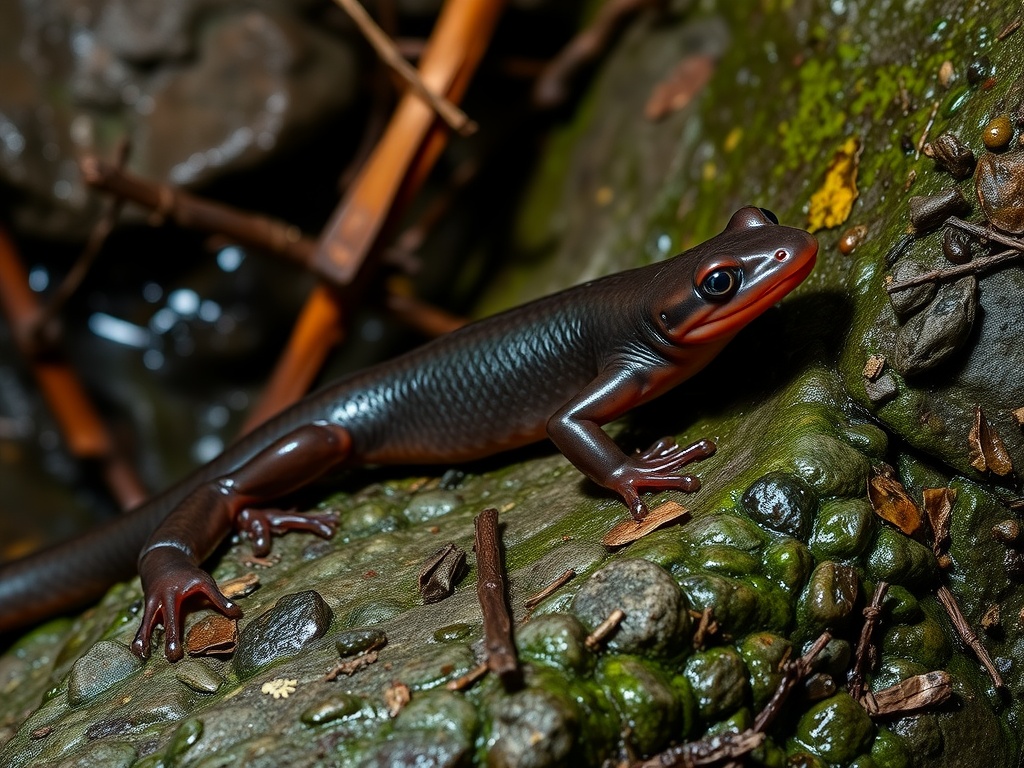
About the Appalachian Seal Salamander
The Appalachian Seal Salamander is a medium-sized, robust amphibian native to the Appalachian Mountains in the eastern United States. Its body is gray to brownish with scattered dark spots and a noticeably lighter belly, often giving it a 'seal-like' appearance. This salamander is primarily nocturnal and prefers the cool, moist environments found near rocky streams and seepages in forests. It is lungless and relies on cutaneous respiration, making it highly sensitive to environmental changes. Despite its secretive nature, it is commonly found within its range and plays an important ecological role in its habitat.
Fascinating facts
Rocky Refuge
Appalachian Seal Salamanders are most often found hiding under rocks and logs near fast-flowing streams in the Appalachian Mountains.
Nocturnal Hunter
These salamanders are primarily active at night, preying on invertebrates such as insects, worms, and small crustaceans.
Lungless Wonder
They belong to the family Plethodontidae, all of which lack lungs and rely on their moist skin for breathing.
Detailed description
The Appalachian Seal Salamander (Desmognathus monticola) is a moderately large member of the family Plethodontidae, typically reaching an adult snout-vent length of 6–12 cm (2.4–4.7 in), with total lengths up to 16 cm (6.3 in). Its robust, muscular body is well-adapted for life among rocks and debris in fast-flowing streams. The dorsal coloration varies from gray to brown or olive, often with irregular dark blotches or spots, while the ventral surface is distinctly lighter, sometimes with a faint marbled pattern. The head is broad with a rounded snout and prominent, lidless eyes adapted for low-light environments. As a lungless salamander, it relies entirely on its moist skin and buccal cavity for respiration, necessitating a habitat with high humidity. The tail is laterally compressed, aiding in swimming and maneuvering among stream substrates. Juveniles often display more contrasting patterns and a lighter tail tip, which may serve as a decoy for predators. The species is primarily nocturnal, emerging at dusk to forage, and is secretive during the day, sheltering under rocks, logs, or leaf litter. Its ecological role as both predator and prey is critical in maintaining the balance of aquatic and riparian invertebrate communities.
Did you know?
Despite being an amphibian, the Appalachian Seal Salamander spends almost its entire life on land, only returning to water to lay eggs.
Research & sources
Behaviour & social structure
Appalachian Seal Salamanders are solitary and territorial, especially during the breeding season. They are most active at night and during periods of high humidity or rainfall. Foraging behavior involves slow, deliberate movements along stream banks and under stones, where they prey on a variety of invertebrates such as insects, earthworms, snails, and small crustaceans. They use chemosensory cues to locate prey and may exhibit sit-and-wait tactics or active searching. When threatened, they exhibit defensive behaviors such as rapid tail undulation, biting, or secreting noxious skin secretions. These salamanders are known to maintain small home ranges and show site fidelity, often returning to the same cover objects. Social interactions are generally limited to breeding encounters and occasional aggressive displays between males.
Reproduction & life cycle
Breeding occurs primarily in late winter to early spring, though timing can vary with elevation and local climate. Courtship involves a complex sequence of tactile and chemical cues, with males engaging in a tail-straddling walk to transfer spermatophores to the female. Females lay clutches of 15–40 eggs in moist, concealed locations such as under rocks or within streamside crevices, often above the waterline to avoid aquatic predators. Incubation lasts 1.5–3 months, depending on temperature and humidity. Females exhibit parental care by guarding the eggs until hatching, which is relatively uncommon among salamanders. Hatchlings emerge as fully aquatic larvae with external gills, remaining in the larval stage for 6–12 months before metamorphosing into terrestrial juveniles.
Adaptations & survival
Desmognathus monticola exhibits several key adaptations for its streamside habitat. Its lungless physiology allows for efficient cutaneous respiration in oxygen-rich, cool environments, but also restricts it to moist microhabitats. The laterally compressed tail and strong limbs facilitate movement in swift currents and among rocky substrates. Cryptic coloration provides camouflage against predators, while the ability to autotomize (shed) the tail offers an escape mechanism. Behavioral adaptations include nocturnality and site fidelity, reducing predation risk and competition. Chemosensory abilities are highly developed, aiding in prey detection and mate location.
Cultural significance
The Appalachian Seal Salamander does not have a prominent role in folklore or traditional culture, but it is valued by naturalists and researchers as an indicator species for stream health and ecosystem integrity. Its presence is often used in environmental assessments, and it contributes to the rich biodiversity of the Appalachian region. In some areas, local educational programs highlight the salamander’s ecological importance and unique adaptations, fostering conservation awareness.
Recent research
Recent research on Desmognathus monticola has focused on its genetic diversity and phylogeography, revealing significant population structure across its range, likely driven by historical riverine barriers and habitat fragmentation. Studies have also examined the effects of environmental contaminants on its development and immune function, underscoring its sensitivity to ecosystem changes. Ongoing monitoring projects are assessing the impacts of climate change on distribution and breeding phenology. Additionally, the species is often included in broader studies of plethodontid salamander community dynamics and interspecific competition.
Sources
Desmognathus monticola (Appalachian Seal Salamander): Taxonomy, Ecology, and Conservation
Petranka, J.W. (1998)
scientificDesmognathus monticola: The IUCN Red List of Threatened Species 2014
IUCN SSC Amphibian Specialist Group
conservationVideos
Habitat
Moist forests near mountain streams and seeps
 Elevated Terrain
Mountain
High-altitude environments with varying climates and specialized wildlife adapted to rugged terrain and thin air.
 Global
Forest
Wooded areas with significant tree cover and diverse plant and animal communities.
 Global
Freshwater
Lakes, rivers, and wetlands with diverse aquatic ecosystems.
Conservation
The Appalachian Seal Salamander is currently classified as Least Concern on the IUCN Red List.
Threats & challenges
Although currently listed as Least Concern, the Appalachian Seal Salamander faces several ongoing threats. Habitat degradation from logging, agriculture, and urbanization leads to siltation and pollution of streams, directly impacting survival and reproduction. Climate change poses additional risks by altering stream flow and temperature regimes, potentially reducing suitable habitat. The species is also sensitive to acidification and chemical contamination due to its permeable skin. While populations remain stable in many areas, localized declines have been observed where habitat quality has deteriorated. Disease, such as chytridiomycosis, is a potential emerging threat, though not yet documented as a major issue for this species.
Taxonomy
Scientific name
Desmognathus monticola
- Kingdom
- Animalia
- Phylum
- Chordata
- Class
- Amphibia
- Order
- Caudata
- Family
- Plethodontidae
- Genus
- Desmognathus
- Species
- monticola
Community notes
Share your observations about the Appalachian Seal Salamander.
No community notes yet. Be the first!
Discover more wildlife
More fascinating animals from the encyclopedia.