
About the Arroyo Toad
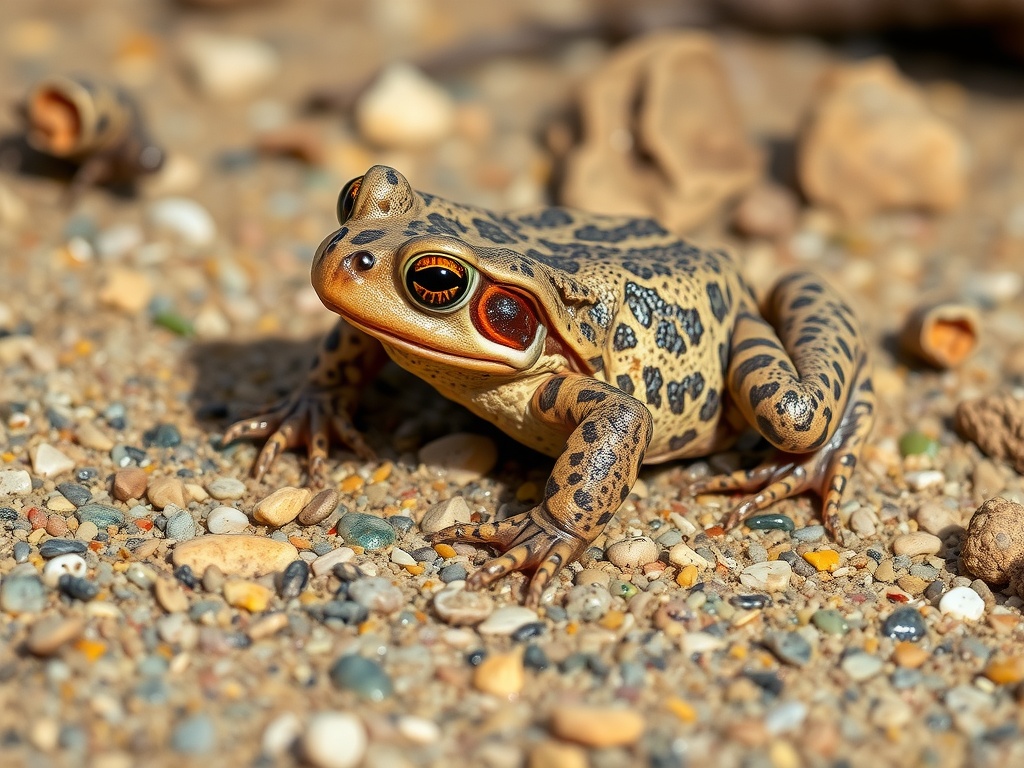
The Arroyo Toad is a small, stocky amphibian native to southwestern California and Baja California, Mexico. Characterized by its olive-gray warty skin and pale stripe across its head and back, this toad is specialized for life in sandy streamside habitats. Arroyo Toads are nocturnal and spend much of their life buried underground, emerging mainly during the breeding season after spring rains. Their populations are vulnerable due to habitat destruction, altered water flow, and invasive species.
Fascinating facts
Stream Specialist
Arroyo Toads require shallow, slow-moving streams with sandy or gravelly bottoms for successful breeding, making them highly sensitive to changes in water flow.
Nocturnal Lifestyle
These toads are most active at night, helping them avoid predators and extreme daytime temperatures in their arid habitats.
Defensive Camouflage
Their coloration and behavior allow them to blend into sandy streambeds, making them difficult for predators to spot.
Detailed description
The Arroyo Toad (Anaxyrus californicus) is a small, robust amphibian, typically measuring 5–7.5 cm (2–3 inches) in snout-vent length. Its dorsal coloration ranges from olive-gray to light brown, often matching the sandy substrates of its habitat, with a distinctive pale or whitish stripe running from the head down the middle of the back. The skin is dry and warty, with prominent parotoid glands behind the eyes that secrete toxins as a defense against predators. The ventral surface is pale and unmarked. Arroyo Toads possess short limbs and a blunt snout, adaptations suited for burrowing and a fossorial lifestyle. Their eyes are relatively large, aiding nocturnal activity. During the dry season, individuals remain dormant underground, emerging mainly at night during the spring and early summer breeding season. Their specialized toe structure and muscular limbs allow them to dig into loose sand to avoid desiccation. The species is highly adapted to ephemeral streams and arroyos, relying on shallow, slow-moving water for breeding and sandy banks for foraging and refuge.
Did you know?
The Arroyo Toad was once common throughout much of Southern California, but its range has been reduced by over 75% due to urban development and waterway modifications.
Research & sources
Wikipedia summary
The arroyo toad is a species of true toads in the family Bufonidae, endemic to California, U.S. and Baja California state, Mexico. It is currently classified as an Endangered species on the IUCN Red List of Threatened Species because of habitat destruction. The arroyo toad is at the intersection of ecological significance and conservation concern.
Behaviour & social structure
Arroyo Toads are primarily nocturnal, emerging at dusk to forage for invertebrates such as ants, beetles, spiders, and other small arthropods. They exhibit sit-and-wait predatory behavior, remaining motionless and ambushing prey that passes within reach. Outside of the breeding season, individuals are solitary and spend most of their time buried in sandy soils to conserve moisture and avoid extreme temperatures. During breeding, males establish territories along stream margins and produce a distinctive, high-pitched trill to attract females and deter rival males. Aggressive interactions between males are common, involving physical displays and occasional wrestling. Toads are generally sedentary, with limited home ranges, but may disperse up to several hundred meters between breeding and non-breeding habitats.
Reproduction & life cycle
Breeding occurs from March to July, triggered by seasonal rains that create shallow pools and slow-flowing streams. Males congregate at breeding sites and call to attract females, often forming loose choruses. Amplexus (the mating embrace) is axillary, with males clasping females around the forelimbs. Females lay long strings of eggs, each clutch containing 2,000–10,000 eggs, which are deposited in shallow water with minimal current. Embryonic development is rapid, with hatching occurring within 3–6 days, depending on temperature. Larval development (tadpoles) lasts 6–8 weeks, after which metamorphosis produces small, terrestrial toadlets. There is no parental care post-oviposition; survival depends on suitable hydrological conditions and absence of predators.
Adaptations & survival
The Arroyo Toad exhibits several adaptations to its arid, ephemeral stream habitats. Its cryptic coloration and warty skin provide camouflage against sandy substrates and protection from desiccation. The toad's ability to burrow deeply into loose sand allows it to escape surface heat and conserve water during prolonged dry periods. Its breeding strategy is synchronized with seasonal rainfall, ensuring that eggs and larvae develop in temporary pools before they dry out. The species can tolerate moderate salinity and fluctuating water temperatures, an advantage in unpredictable environments. Toxins secreted from the parotoid glands deter many predators, though some native snakes are resistant.
Cultural significance
The Arroyo Toad has limited direct cultural significance but serves as an indicator species for healthy riparian ecosystems in southern California and Baja California. Its presence is often used to assess the success of habitat restoration projects. The species has become a symbol of conservation efforts in the region, highlighting the need to balance human development with the preservation of native biodiversity. There are no known traditional uses or prominent roles in indigenous mythology.
Recent research
Recent research has focused on the species' habitat requirements, genetic diversity, and responses to hydrological changes. Studies using environmental DNA (eDNA) have improved detection of Arroyo Toads in low-density populations. Ongoing research examines the impacts of climate change on breeding phenology and larval survival. Conservation genetics work has revealed low genetic diversity in isolated populations, underscoring the need for habitat connectivity. Restoration ecology studies are testing methods to recreate suitable breeding pools and manage invasive species. The Arroyo Toad is also the subject of long-term monitoring programs to track population trends and inform adaptive management.
Videos
Habitat
Sandy streamsides and arroyos in semi-arid regions
 Various Continental Regions
Grassland
Open areas dominated by grasses rather than trees, supporting numerous herbivores and their predators.
 Global
Forest
Wooded areas with significant tree cover and diverse plant and animal communities.
 Global
Freshwater
Lakes, rivers, and wetlands with diverse aquatic ecosystems.
Conservation
The Arroyo Toad is currently classified as Endangered on the IUCN Red List.
Threats & challenges
Major threats to the Arroyo Toad include habitat destruction and fragmentation due to urbanization, agriculture, and flood control projects that alter natural stream hydrology. Invasive species such as bullfrogs (Lithobates catesbeianus) and non-native fish prey on eggs and tadpoles, further reducing recruitment. Recreational activities (off-road vehicles, camping) degrade breeding habitats, compact soils, and increase mortality. Prolonged droughts and climate change exacerbate water scarcity, reducing suitable breeding sites. The species has experienced significant population declines, with many historical populations extirpated or severely reduced. Conservation efforts focus on habitat restoration, invasive species control, and protection of remaining breeding sites.
Taxonomy
Scientific name
Anaxyrus californicus
- Kingdom
- Animalia
- Phylum
- Chordata
- Class
- Amphibia
- Order
- Anura
- Family
- Bufonidae
- Genus
- Anaxyrus
- Species
- californicus
Community notes
Share your observations about the Arroyo Toad.
No community notes yet. Be the first!
Discover more wildlife
More fascinating animals from the encyclopedia.