
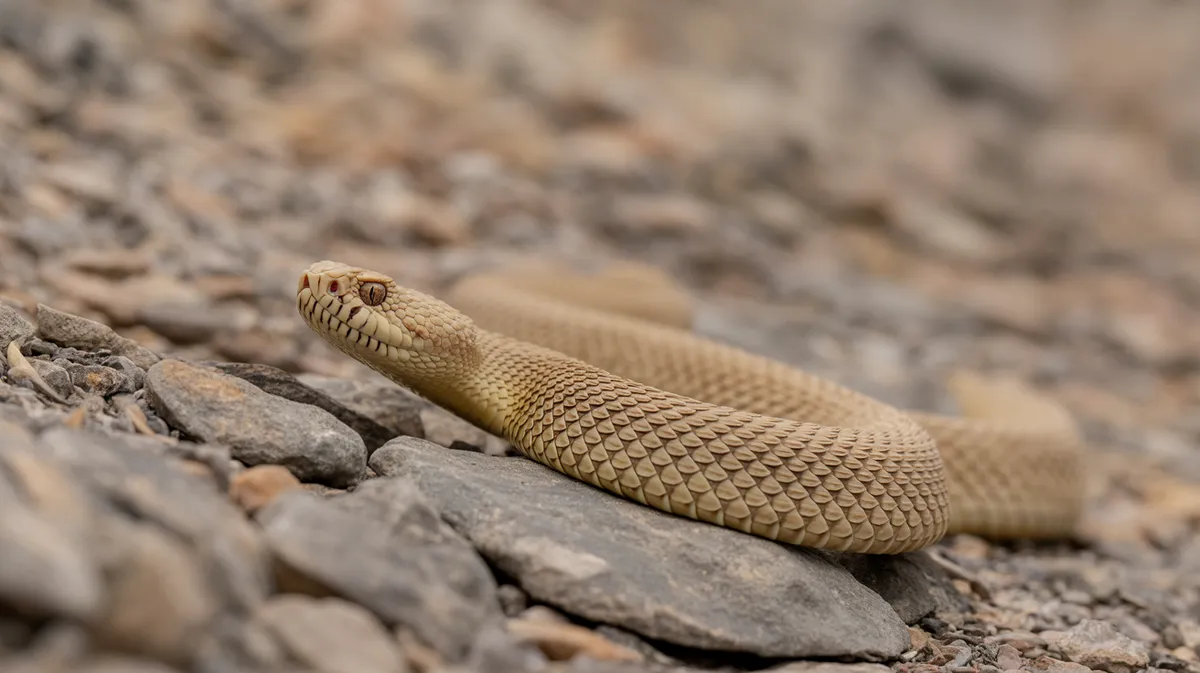
About the Aruba Island Rattlesnake
The Aruba Island Rattlesnake is a highly endangered pit viper species endemic to the island of Aruba in the southern Caribbean. It has a light brown or grayish coloration with faint, diamond-shaped patterns that help it blend into the arid, rocky hillsides where it lives. Adapted to a desert-like environment, this snake is primarily nocturnal, emerging at dusk to hunt small mammals, birds, and lizards. With a calm disposition compared to other rattlesnakes, it is rarely encountered by humans and plays a vital role in its ecosystem as both predator and prey.
Fascinating facts
Endemic Range
The Aruba Island Rattlesnake is found exclusively on the small Caribbean island of Aruba, making its habitat extremely limited.
Mild Temperament
While venomous, this rattlesnake is typically shy and avoids confrontation with humans, relying on camouflage to stay hidden.
Live Birth
Unlike many reptiles, the Aruba Island Rattlesnake gives birth to live young, usually producing 5-10 offspring per litter.
Detailed description
The Aruba Island Rattlesnake (Crotalus unicolor) is a medium-sized pit viper, typically reaching lengths of 70–90 cm (28–35 inches), with some individuals exceeding 100 cm. Its coloration is highly variable, ranging from pale gray to light brown or pinkish hues, often with faint, indistinct diamond or blotched patterns that provide exceptional camouflage against the island’s arid, rocky terrain. The head is broad and triangular, with heat-sensing loreal pits between the eyes and nostrils, enabling precise detection of warm-blooded prey. The eyes have vertical pupils, an adaptation for nocturnal activity. The body is relatively slender for a rattlesnake, and the tail ends in a small rattle, which is less developed than those of mainland relatives. Crotalus unicolor is primarily terrestrial but is capable of limited climbing among rocks and low shrubs. It is a solitary species, except during the breeding season, and spends much of the day sheltering under rocks or in burrows to avoid extreme heat. This rattlesnake is generally docile, rarely striking unless provoked, and relies on its cryptic coloration and stillness to avoid detection by predators and humans. Its venom is primarily hemotoxic, adapted for subduing small mammals, birds, and lizards, and plays a crucial role in both predation and defense.
Did you know?
This species is found only on Aruba and nowhere else in the world.
Research & sources
Wikipedia summary
The Aruba Island rattlesnake, is a venomous pit viper species endemic to the Caribbean island of Aruba, off the coast of Venezuela. It is sometimes still classified as a subspecies of Crotalus durissus.
Behaviour & social structure
Aruba Island Rattlesnakes are crepuscular to nocturnal, emerging at dusk and during the night to hunt, particularly during the cooler months or after rainfall. They are ambush predators, often lying motionless near rodent trails or lizard basking sites, striking rapidly when prey approaches. Their diet consists mainly of endemic rodents (such as the Aruba whiptail lizard, Cnemidophorus arubensis), small birds, and occasionally amphibians or insects. Social interactions are minimal; individuals maintain exclusive home ranges, with occasional overlap during the breeding season. Defensive behaviors include coiling, tail rattling (though the rattle is relatively quiet), and bluff strikes. They exhibit seasonal activity patterns, with reduced movement during the hottest, driest months. Juveniles are more diurnal, likely due to higher predation risk and different thermal requirements.
Reproduction & life cycle
Crotalus unicolor is ovoviviparous, giving birth to live young rather than laying eggs. Mating typically occurs in the early rainy season (September–November), when males actively search for receptive females, sometimes engaging in ritualized combat with rivals. Females undergo a gestation period of approximately 4–5 months, with parturition occurring between February and April. Litters are small, usually comprising 4–8 neonates, each measuring about 20–25 cm at birth. Neonates are born fully venomous and independent, receiving no parental care beyond birth. Sexual maturity is reached at 3–4 years of age. Reproductive output is limited by the harsh environment and the energetic cost of producing large, well-developed young.
Adaptations & survival
The Aruba Island Rattlesnake exhibits several adaptations to its xeric environment: cryptic coloration for camouflage, efficient water conservation mechanisms (such as concentrated urine and reduced evaporative loss), and a low metabolic rate to withstand periods of food scarcity. Its venom is specialized for rapid immobilization of small, agile prey. The heat-sensing pits allow for precise prey detection in low light. Behavioral adaptations include nocturnality and seasonal activity shifts to avoid extreme heat and dehydration. The reduced rattle may be an evolutionary response to the lack of large terrestrial predators on Aruba, minimizing unnecessary energy expenditure.
Cultural significance
Locally known as 'Cascabel' in Papiamento, the Aruba rattlesnake is a symbol of the island’s unique biodiversity and is featured in conservation campaigns and educational programs. While historically feared and sometimes killed due to its venomous nature, recent efforts have promoted coexistence and appreciation for its ecological role. The species has no known use in traditional medicine or folklore but is increasingly recognized as a flagship species for Aruba’s conservation initiatives.
Recent research
Recent research has focused on the population genetics of Crotalus unicolor, revealing low genetic diversity due to its small, isolated population. Studies on its venom composition have identified unique proteins with potential biomedical applications. Ongoing telemetry projects track movement patterns and habitat use, informing habitat restoration and management strategies. Conservation breeding programs, such as those at the Bronx Zoo and other AZA-accredited institutions, have successfully bred the species in captivity, with the goal of potential reintroduction. Ecological studies continue to monitor the impacts of invasive species and climate variability on population viability.
Sources
Snake Species of the World: A Taxonomic and Geographic Reference, vol. 1
McDiarmid RW, Campbell JA, Touré T. (1999)
scientificCrotalus unicolor: The IUCN Red List of Threatened Species 2017
IUCN SSC Viper Specialist Group
conservationPopulation genetics and conservation of the critically endangered Aruba Island rattlesnake (Crotalus unicolor)
Martínez-Gómez, J.E. et al. (2015)
researchVideos
Habitat
Arid, rocky hillsides and dry scrublands


Conservation
The Aruba Island Rattlesnake is currently classified as Critically Endangered on the IUCN Red List.
Threats & challenges
Crotalus unicolor is classified as Critically Endangered by the IUCN, with an estimated wild population of fewer than 250 mature individuals. Major threats include habitat loss and fragmentation due to urban expansion, tourism development, and quarrying. Invasive species such as feral goats and cats disrupt the ecosystem and prey on juveniles. Road mortality, illegal collection for the pet trade, and occasional persecution by locals further exacerbate population decline. Climate change poses additional risks by altering rainfall patterns and increasing drought frequency. Conservation challenges include the snake’s limited range (less than 25 km²), low reproductive rate, and genetic bottlenecks.
Taxonomy
Scientific name
Crotalus unicolor
- Kingdom
- Animalia
- Phylum
- Chordata
- Class
- Reptilia
- Order
- Squamata
- Family
- Viperidae
- Genus
- Crotalus
- Species
- unicolor
Community notes
Share your observations about the Aruba Island Rattlesnake.
No community notes yet. Be the first!
Discover more wildlife
More fascinating animals from the encyclopedia.