
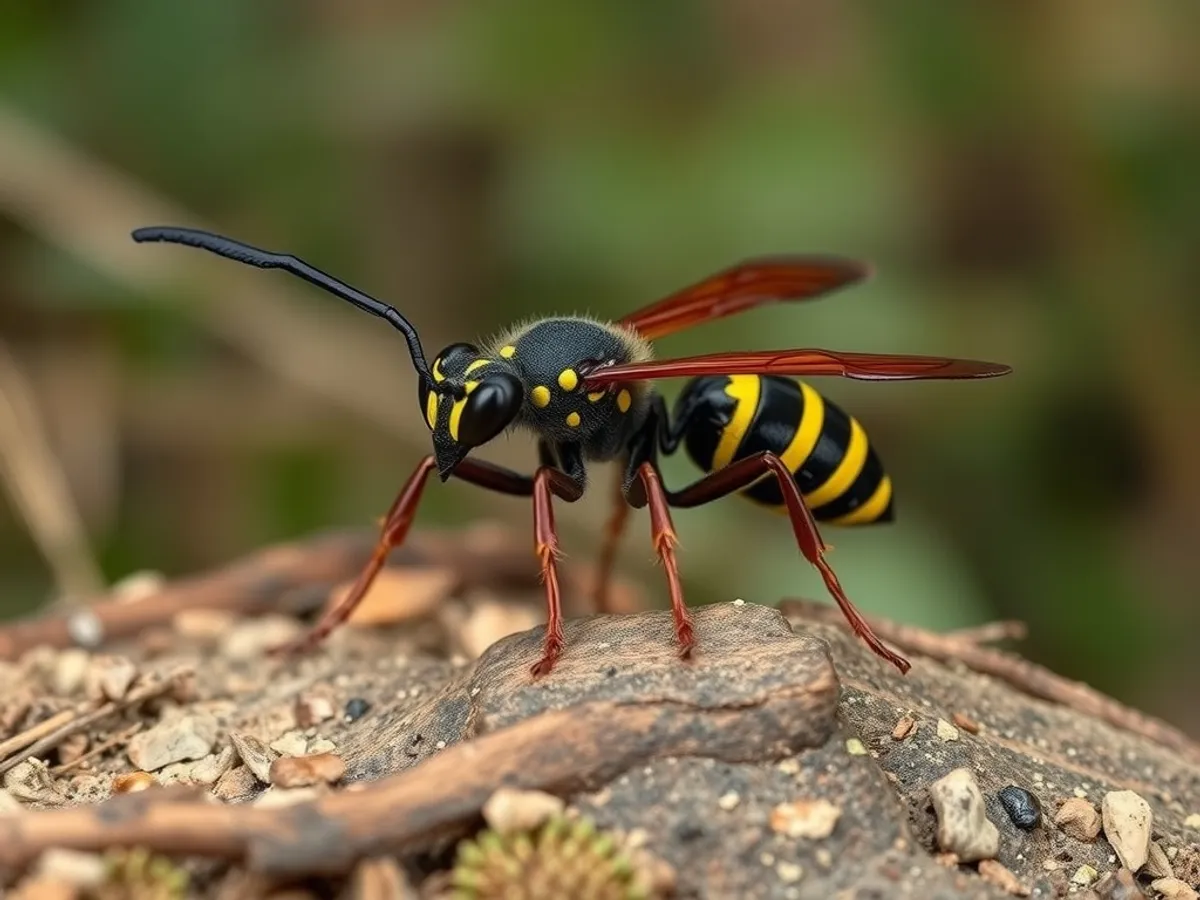
About the Asian Giant Hornet
The Asian giant hornet is the largest hornet on Earth, and its reputation rests on what a few dozen of them can do to a beehive. A scout marks a colony with a pheromone, and the raiding party that follows does not sting the bees — it decapitates them, working through a hive of tens of thousands in a matter of hours, then carries the brood home to feed its own young. European honeybees, which never evolved alongside it, have no answer at all. Japanese honeybees do. When a scout is detected, hundreds of bees engulf it in a ball and vibrate their flight muscles, driving the temperature inside the ball above the hornet's tolerance while their own runs just below it, and raising the carbon dioxide at the same time — the combination kills the hornet without a single sting being used. Its own sting is long enough to penetrate beekeeping suits and the venom is potent, though the danger to people has been widely exaggerated.
Fascinating facts
Bee Predators
Asian Giant Hornets are notorious for attacking honeybee colonies, using coordinated group raids to wipe out hives and feed on larvae.
Potent Sting
Their sting is extremely painful and contains a potent neurotoxin, which can cause severe reactions in humans and is even capable of being fatal in rare cases.
Underground Nests
Unlike many other hornet species, Asian Giant Hornets often build their nests underground or in decaying tree roots rather than in aerial locations.
Detailed description
The Asian giant hornet (Vespa mandarinia) is the largest hornet species in the world, with queens reaching up to 5 cm (2.0 in) in length and a wingspan of about 7.5 cm (3.0 in). Workers are slightly smaller, typically 3.5–4.0 cm (1.4–1.6 in) long. The species is distinguished by its robust, orange-yellow head, large compound eyes, and powerful, dark mandibles adapted for chewing through tough insect exoskeletons and plant fibers. The thorax is dark brown to black, while the abdomen features alternating bands of black and yellow-orange. Their stinger, which can be up to 6 mm (0.24 in) long, delivers a potent venom capable of causing severe pain and, in rare cases, life-threatening reactions in humans. Nests are constructed from chewed plant material, forming a papery structure typically located underground, in abandoned rodent burrows, or occasionally in hollow tree trunks. Colonies are highly organized, with a single reproductive queen and hundreds to thousands of sterile female workers. The species exhibits complex social behaviors, including coordinated attacks on prey and sophisticated chemical communication. Asian giant hornets are apex insect predators, preying primarily on other insects, especially honeybees, but also mantises, beetles, and even other wasps. Their annual colony cycle includes founding, growth, reproductive, and decline phases, tightly linked to seasonal changes.
Did you know?
A small group of Asian Giant Hornets can destroy an entire honeybee colony within a few hours by entering a 'slaughter phase,' where they rapidly kill adult bees to harvest larvae and pupae.
Research & sources
Wikipedia summary
The Asian giant hornet, also known as the northern giant hornet, and the Japanese giant hornet, is the world's largest hornet. It is native to temperate and tropical East Asia, South Asia, mainland Southeast Asia, and parts of the Russian Far East. It was also found in the Pacific Northwest of North America in late 2019, with a few more additional sightings in 2020, and nests found in 2021, prompting concern that it could become an invasive species, but in December 2024, the hornets were announced to have been eradicated from the region, as well as from the rest of the United States.
Behaviour & social structure
Asian giant hornets are eusocial, living in colonies with a strict caste system consisting of a queen, workers, and males (drones). Workers exhibit aggressive territorial defense and are highly coordinated during predatory raids, particularly on honeybee hives. They employ a 'slaughter phase' attack, in which a small group of hornets can decimate an entire bee colony within hours by decapitating adult bees and carrying away the brood as food for their larvae. Foraging is primarily diurnal, with peak activity in the morning and late afternoon. Workers communicate using pheromones to mark prey or coordinate attacks. Within the nest, tasks are divided by age and caste, with younger workers tending to brood and older ones foraging or defending the colony. Hornets exhibit strong homing abilities and can navigate complex environments to return to their nests.
Reproduction & life cycle
Reproduction in Vespa mandarinia follows a typical annual cycle. In late summer to early autumn, the queen produces reproductive individuals: new queens (gynes) and males. After mating, males die, and fertilized queens leave the nest to overwinter in sheltered locations, such as under bark or in soil. The original colony, including the old queen and workers, dies off with the onset of winter. In spring, overwintered queens emerge to establish new nests, initially working alone to rear the first brood of workers. The developmental period from egg to adult is approximately 40–50 days, depending on temperature. Parental care is provided by workers, who feed larvae a protein-rich diet of masticated prey.
Adaptations & survival
Asian giant hornets possess several adaptations for predation and survival. Their large mandibles are specialized for cutting and carrying prey, while their potent venom contains cytolytic peptides (such as mastoparan) that cause tissue damage and can deter vertebrate predators. Their exoskeleton is robust, providing protection during aggressive encounters. The species exhibits advanced chemical communication, using pheromones to coordinate attacks and mark targets. Thermoregulation is achieved through wing fanning and behavioral adjustments, allowing them to remain active in a range of temperatures. Their vision is acute, with compound eyes adapted for detecting movement and polarized light, aiding navigation.
Cultural significance
In several East Asian cultures, the Asian giant hornet is both feared and respected. In Japan, it is known as 'ōsuzumebachi' and features in folklore as a symbol of danger and strength. The larvae and pupae are considered a delicacy in some regions, consumed fried or as part of traditional dishes. The hornet’s venom has been studied for potential medicinal properties, including antimicrobial and anti-inflammatory effects. Their predation on honeybees has made them notorious among beekeepers, influencing local apicultural practices and inspiring defensive adaptations in native bee species, such as the 'bee ball' defense of Japanese honeybees.
Recent research
Recent research has focused on the hornet’s venom composition, revealing unique peptides with potential biomedical applications. Studies on their invasive potential in North America have highlighted the risk to native pollinators and the importance of early detection and eradication. Behavioral studies have documented the sophisticated communication and coordination during group predation events. Genetic analyses have clarified the relationships between Vespa species and traced the origins of invasive populations. Ongoing research is investigating the ecological impacts of hornet predation on pollinator communities and the effectiveness of various control measures.
Videos
Habitat
Forests and low mountain woodlands


Conservation
The Asian Giant Hornet is currently classified as Least Concern on the IUCN Red List.
Threats & challenges
Currently, Vespa mandarinia is listed as Least Concern by the IUCN, with stable populations across its native range. However, habitat loss due to deforestation and urbanization poses localized threats. Invasive populations, such as those briefly established in North America, raise concerns about ecological disruption, particularly to native pollinators and apiculture. Human persecution occurs due to their painful sting and threat to beekeeping. Climate change may alter their distribution, potentially expanding their range northward. Despite these challenges, the species remains resilient due to its adaptability and generalist predatory habits.
Taxonomy
Scientific name
Vespa mandarinia
- Kingdom
- Animalia
- Phylum
- Arthropoda
- Class
- Insecta
- Order
- Hymenoptera
- Family
- Vespidae
- Genus
- Vespa
- Species
- mandarinia
Community notes
Share your observations about the Asian Giant Hornet.
No community notes yet. Be the first!
Discover more wildlife
More fascinating animals from the encyclopedia.