
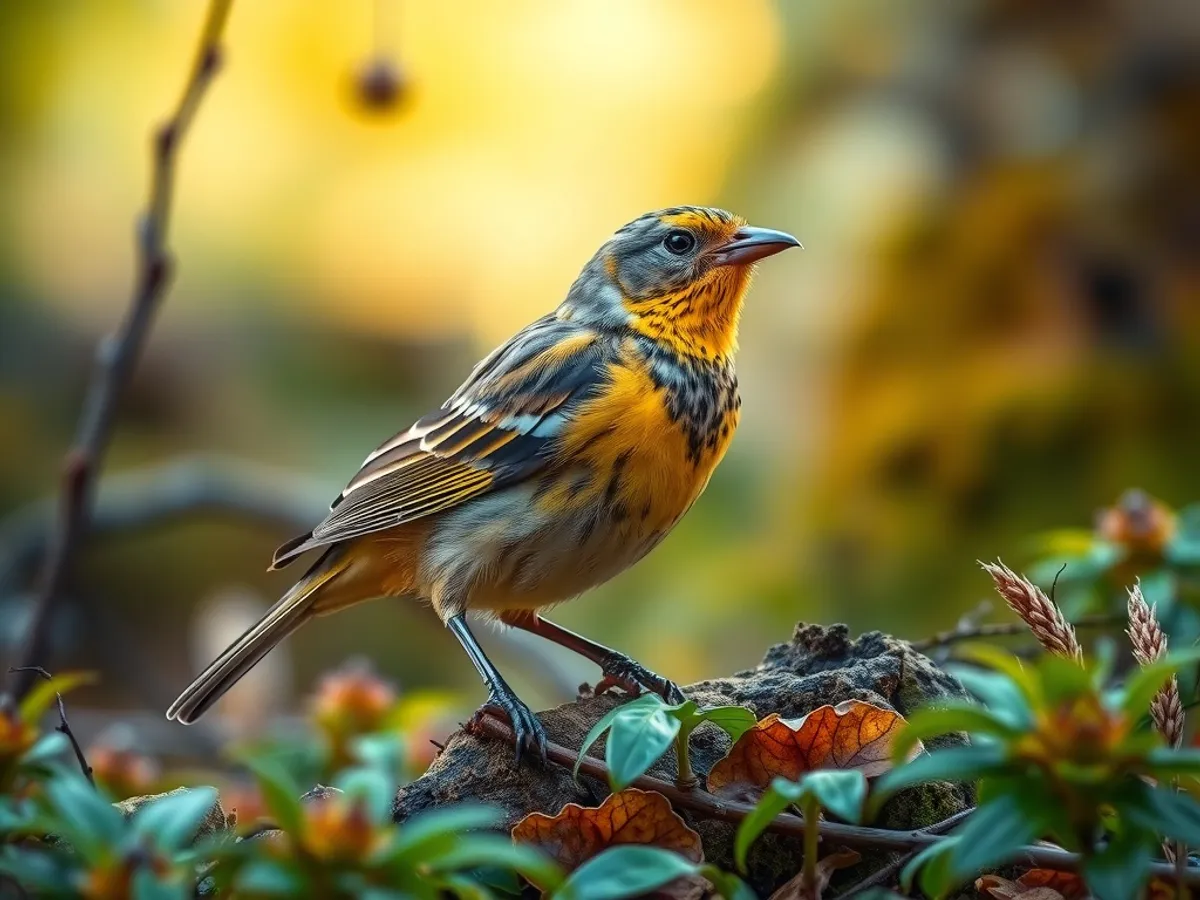
About the Atlantic Canary
The Atlantic Canary is a small, vibrant songbird native to the Macaronesian Islands, particularly the Canary Islands, Azores, and Madeira. Recognized for its bright yellow-green plumage and melodic singing, it has been widely bred in captivity, giving rise to the popular domestic canary. Wild Atlantic Canaries inhabit forests, shrublands, and gardens, where they feed mainly on seeds and small insects. Their pleasant song and adaptability make them a favorite among bird enthusiasts worldwide.
Fascinating facts
Famous Songster
The Atlantic Canary is renowned for its melodious and varied song, which has made it a popular pet bird for centuries.
Wild Ancestor
This species is the wild ancestor of all domestic canaries, which have been selectively bred for color and song.
Diverse Habitats
Atlantic Canaries thrive in a variety of habitats, from laurel forests to gardens and agricultural areas in their native islands.
Detailed description
The Atlantic Canary (Serinus canaria) is a small passerine bird, typically measuring 12.5–13.5 cm in length and weighing between 15–20 grams. Wild individuals display a predominantly yellow-green plumage, with males often brighter and more vividly colored than females, especially on the head and underparts. The back and wings are streaked with brown, providing camouflage among foliage. The bill is short, conical, and robust, adapted for cracking seeds. Eyes are dark and alert, and the tail is relatively short and notched. Atlantic Canaries are renowned for their melodious and complex song, which plays a key role in territory establishment and mate attraction. They are highly social, forming loose flocks outside the breeding season and exhibiting coordinated flight patterns. Their diet consists mainly of a wide variety of seeds, but they also consume small invertebrates, especially during the breeding season to provide protein for growing chicks. The species is well-adapted to diverse habitats, ranging from laurel forests and pine woodlands to cultivated gardens and shrublands across the Macaronesian islands. Notably, the Atlantic Canary is the wild ancestor of the domestic canary, which has been selectively bred for centuries for color and song.
Did you know?
Although known for their singing, only male Atlantic Canaries sing elaborate songs, especially during the breeding season.
Research & sources
Wikipedia summary
The Atlantic canary, known worldwide simply as the wild canary and also called the island canary, common canary, or canary, is a small passerine bird belonging to the genus Serinus in the true finch family, Fringillidae. It is native to the Canary Islands, the Azores, and Madeira. Wild birds are mostly yellow-green, with brownish streaking on the back. The species is common in captivity and a number of colour varieties have been bred.
Behaviour & social structure
Atlantic Canaries are diurnal and spend much of the day foraging on the ground or in low vegetation, often in small groups. Their feeding behavior involves agile hopping and pecking, with a preference for grass and weed seeds, supplemented by buds, fruits, and occasional insects. Social interactions are frequent, with individuals engaging in mutual preening and vocal communication through a repertoire of trills, whistles, and chirps. During the breeding season, males become territorial and sing persistently to attract females and deter rivals. Outside of breeding, they are gregarious and may form mixed-species flocks with other finches. Roosting occurs communally in dense foliage, providing protection from predators. Daily routines include periods of intensive foraging in the early morning and late afternoon, interspersed with rest and social activity.
Reproduction & life cycle
The breeding season for the Atlantic Canary typically extends from February to July, with some variation depending on local climate conditions. Males perform elaborate song displays and aerial chases to court females. Once paired, the female constructs a cup-shaped nest from grasses, moss, and feathers, usually positioned in shrubs or small trees. Clutch size ranges from 3 to 5 pale blue or greenish eggs, which are incubated solely by the female for about 13–14 days. Both parents participate in feeding the altricial chicks, which fledge after 14–21 days. Multiple broods (up to three) may be raised in a single season if conditions are favorable. Parental care continues post-fledging, with juveniles remaining near the nest and learning foraging skills from adults.
Adaptations & survival
The Atlantic Canary exhibits several adaptations for island life and seed-based diets. Its strong, conical bill is specialized for husking a variety of hard seeds. Plumage coloration provides camouflage among foliage, while brighter male coloration may be a result of sexual selection. Their vocal abilities are highly developed, with complex song learning and mimicry, which are important for mate selection and territory defense. Physiologically, they are capable of exploiting a range of habitats, from humid laurel forests to arid shrublands, and can tolerate moderate human disturbance. Behavioral flexibility, such as flocking and opportunistic feeding, enhances survival in variable environments.
Cultural significance
The Atlantic Canary holds significant cultural and historical importance, particularly as the wild progenitor of the domestic canary, which has been bred since the 17th century for its song and plumage. Domestic canaries became popular pets and status symbols in Europe, and their use as early warning systems in coal mines (to detect toxic gases) is well documented. The bird is emblematic of the Canary Islands, featuring in local folklore, art, and as a regional symbol. Its melodious song has inspired music and poetry, and the canary remains a favorite among aviculturists worldwide.
Recent research
Recent genetic studies have clarified the evolutionary relationships within the genus Serinus and confirmed the Atlantic Canary's role as the ancestor of all domestic canaries. Research on song learning has provided insights into neurobiology and the mechanisms of vocal communication in birds. Ecological studies have examined the species' adaptability to urban environments and the effects of habitat fragmentation. Ongoing monitoring of wild populations contributes to understanding the impacts of climate change and invasive species on island avifauna. The Atlantic Canary also serves as a model organism in studies of sexual selection and domestication.
Videos
Habitat
Woodlands, shrublands, gardens
 Various Continental Regions
Grassland
Open areas dominated by grasses rather than trees, supporting numerous herbivores and their predators.
 Elevated Terrain
Mountain
High-altitude environments with varying climates and specialized wildlife adapted to rugged terrain and thin air.
 Global
Forest
Wooded areas with significant tree cover and diverse plant and animal communities.
Conservation
The Atlantic Canary is currently classified as Least Concern on the IUCN Red List.
Threats & challenges
Currently classified as Least Concern by the IUCN, the Atlantic Canary maintains stable populations across its native range. However, localized threats include habitat degradation due to urbanization, agriculture, and invasive plant species that alter native vegetation. Predation by introduced mammals (rats, cats) and competition with other granivorous birds can impact nest success. Climate change poses a potential long-term threat by altering habitat suitability and food availability. Despite these pressures, the species' adaptability and widespread distribution have so far mitigated major population declines.
Taxonomy
Scientific name
Serinus canaria
- Kingdom
- Animalia
- Phylum
- Chordata
- Class
- Aves
- Order
- Passeriformes
- Family
- Fringillidae
- Genus
- Serinus
- Species
- canaria
Community notes
Share your observations about the Atlantic Canary.
No community notes yet. Be the first!
Discover more wildlife
More fascinating animals from the encyclopedia.