
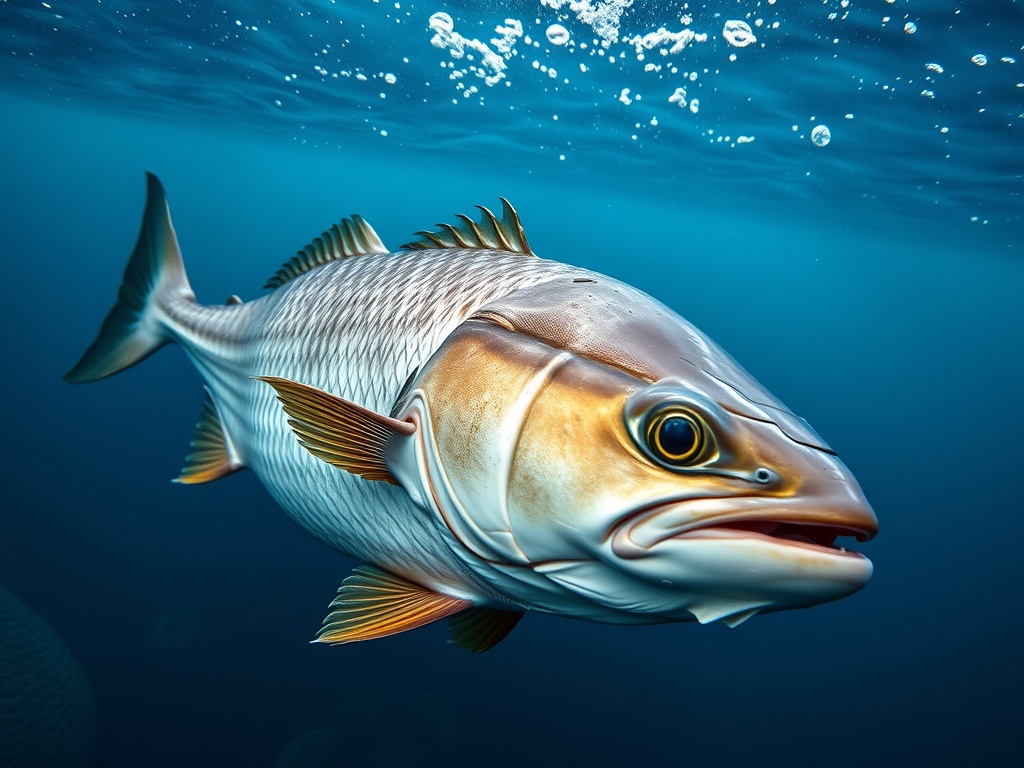
About the Atlantic cod
Atlantic cod is the fish that built empires and then supplied the twentieth century's most notorious fisheries collapse. Basque and Portuguese boats were working the Newfoundland banks before Cabot formally "discovered" them, and salt cod fed European navies, plantations and armies for four centuries. Then, in July 1992, Canada closed the northern cod fishery outright, throwing roughly 30,000 people out of work in a single announcement; the stock, which had already fallen by more than 95 percent, has still not properly recovered more than three decades later. Cod are astonishingly fecund — a large female can release several million eggs in a season — which is exactly why nobody believed they could be fished out. Fishing also changed the fish itself: by removing the biggest, oldest, latest-maturing individuals for decades, it selected for cod that mature younger and smaller, an evolutionary shift that makes recovery harder. Northern cod carry antifreeze glycoproteins in the blood, letting them work water below the normal freezing point of their body fluids.
Fascinating facts
Three Dorsal Fins
Atlantic cod are easily identified by their three distinct dorsal fins and two anal fins, which set them apart from many other fish species.
Prolific Spawners
A large female Atlantic cod can lay up to 5 million eggs during a single spawning season, increasing the chances of offspring survival.
Historic Importance
For centuries, Atlantic cod supported major fishing industries in Europe and North America, profoundly shaping the culture and economy of coastal communities.
Detailed description
The Atlantic cod (Gadus morhua) is a robust, streamlined fish that can reach lengths of up to 2 meters, though individuals more commonly measure between 60 and 100 centimeters. Adults typically weigh 5–12 kg, but exceptional specimens may exceed 40 kg. The species is characterized by a prominent chin barbel, three distinct dorsal fins, and two anal fins, which aid in stability and maneuverability. Its coloration varies from greenish to brownish with lighter sides and a pale belly, often mottled with spots that provide camouflage against the seafloor. Cod possess a lateral line running the length of their body, which is highly sensitive to vibrations and assists in detecting prey and navigating their environment. They are demersal, inhabiting both coastal and deep offshore waters, often at depths ranging from 20 to 200 meters, but have been recorded as deep as 600 meters. Atlantic cod are known for their migratory behavior, moving between feeding and spawning grounds seasonally. They exhibit complex social structures, forming large, loosely organized schools, particularly during migration and spawning. The species is long-lived, with some individuals reaching ages of 20 years or more, although most harvested fish are much younger due to fishing pressures.
Did you know?
A single female Atlantic cod can produce several million eggs in a single spawning season.
Research & sources
Wikipedia summary
The Atlantic cod is a fish of the family Gadidae, widely consumed by humans. It is also commercially known as cod or codling.
Behaviour & social structure
Atlantic cod are generally considered social fish, often forming large aggregations or schools, especially during the spawning season. They are primarily crepuscular feeders, with peak activity at dawn and dusk, although feeding can occur throughout the day depending on prey availability. Cod are opportunistic carnivores, preying on a wide variety of organisms including small fish (such as herring, capelin, and sand eels), crustaceans, mollusks, and polychaete worms. They use their sensitive lateral line and acute sense of smell to locate prey, often rooting along the seabed with their chin barbel. Cod display site fidelity to certain feeding and spawning grounds, returning to the same locations annually. Juveniles tend to be more solitary and inhabit shallower, inshore waters, gradually moving to deeper habitats as they mature. Cod are known to exhibit hierarchical social interactions, with larger individuals often dominating access to preferred feeding and spawning sites.
Reproduction & life cycle
Atlantic cod are iteroparous broadcast spawners, with spawning typically occurring from late winter to early spring, though timing varies by region. Spawning takes place in large aggregations in specific, often traditional, offshore locations. Females are highly fecund, producing between 2 and 11 million eggs per season, depending on size and age. Fertilization is external, with males releasing sperm into the water column as females release eggs. The eggs are pelagic, floating freely in the water column, and hatch after 8–23 days, depending on temperature. Larvae are planktonic and undergo several developmental stages before settling to the benthic environment as juveniles. There is no parental care post-spawning; survival rates of eggs and larvae are low, with high mortality due to predation and environmental factors. Sexual maturity is typically reached at 2–4 years of age, though this can be delayed in heavily fished populations.
Adaptations & survival
Atlantic cod possess several adaptations for survival in cold, variable marine environments. Their streamlined body and multiple fins provide efficient swimming and maneuverability, essential for both predation and avoiding predators. The chin barbel is a specialized sensory organ, rich in taste buds, used to detect prey hidden in sediment. Cod have a large, well-developed swim bladder, allowing precise buoyancy control for movement through different water layers. Their coloration and mottled pattern offer effective camouflage against the seafloor. Physiologically, cod are adapted to cold waters, with antifreeze proteins in their blood that prevent ice crystal formation at low temperatures. Behaviorally, their migratory patterns enable them to exploit seasonally abundant food resources and optimal spawning conditions.
Cultural significance
Atlantic cod has played a pivotal role in the history, economy, and culture of North Atlantic societies for centuries. It was a staple food for coastal communities and a major commodity in international trade, particularly between Europe and North America from the 16th century onward. Cod fisheries shaped settlement patterns, economic development, and even international conflicts, such as the 'Cod Wars' between the UK and Iceland. The fish is featured in folklore, art, and cuisine, with dishes like bacalhau (Portugal), klippfisk (Norway), and fish and chips (UK) relying heavily on cod. Its decline has had profound social and economic impacts, prompting shifts in fishing practices and cultural identity in affected regions.
Recent research
Recent research on Atlantic cod includes genomic studies revealing population structure and local adaptations, aiding in the identification of distinct management units. Studies on cod's response to warming ocean temperatures suggest shifts in distribution toward higher latitudes and deeper waters. Advances in telemetry and acoustic tagging have improved understanding of cod migration, habitat use, and spawning behavior. There is ongoing investigation into the effects of fishing-induced evolution, with evidence that intense harvesting has led to earlier maturation and smaller adult size in some stocks. Restoration ecology is a growing field, with research into habitat enhancement and the role of marine protected areas in cod recovery. Additionally, paleontological studies have traced the species' evolutionary history back to the Pliocene, providing insights into its resilience and adaptability.
Videos
Habitat
Cold temperate coastal and offshore waters of the North Atlantic Ocean

Conservation
The Atlantic cod is currently classified as Vulnerable on the IUCN Red List.
Threats & challenges
The primary threat to Atlantic cod is overfishing, which has led to dramatic population declines and the collapse of several major stocks, particularly in the Northwest Atlantic. Bycatch, habitat degradation (such as trawling impacts on benthic habitats), and climate change—affecting ocean temperatures and prey availability—pose additional challenges. Cod are also vulnerable to predation by seals and larger fish, especially during early life stages. Despite management measures, many populations remain below historical levels, and recovery has been slow or absent in some regions. Shifts in ecosystem structure due to reduced cod abundance have led to trophic cascades, altering the balance of marine communities. Conservation efforts focus on catch limits, closed areas, and improved monitoring, but illegal, unreported, and unregulated (IUU) fishing remains a concern.
Taxonomy
Scientific name
Gadus morhua
- Kingdom
- Animalia
- Phylum
- Chordata
- Class
- Actinopterygii
- Order
- Gadiformes
- Family
- Gadidae
- Genus
- Gadus
- Species
- morhua
Community notes
Share your observations about the Atlantic cod.
No community notes yet. Be the first!
Discover more wildlife
More fascinating animals from the encyclopedia.