
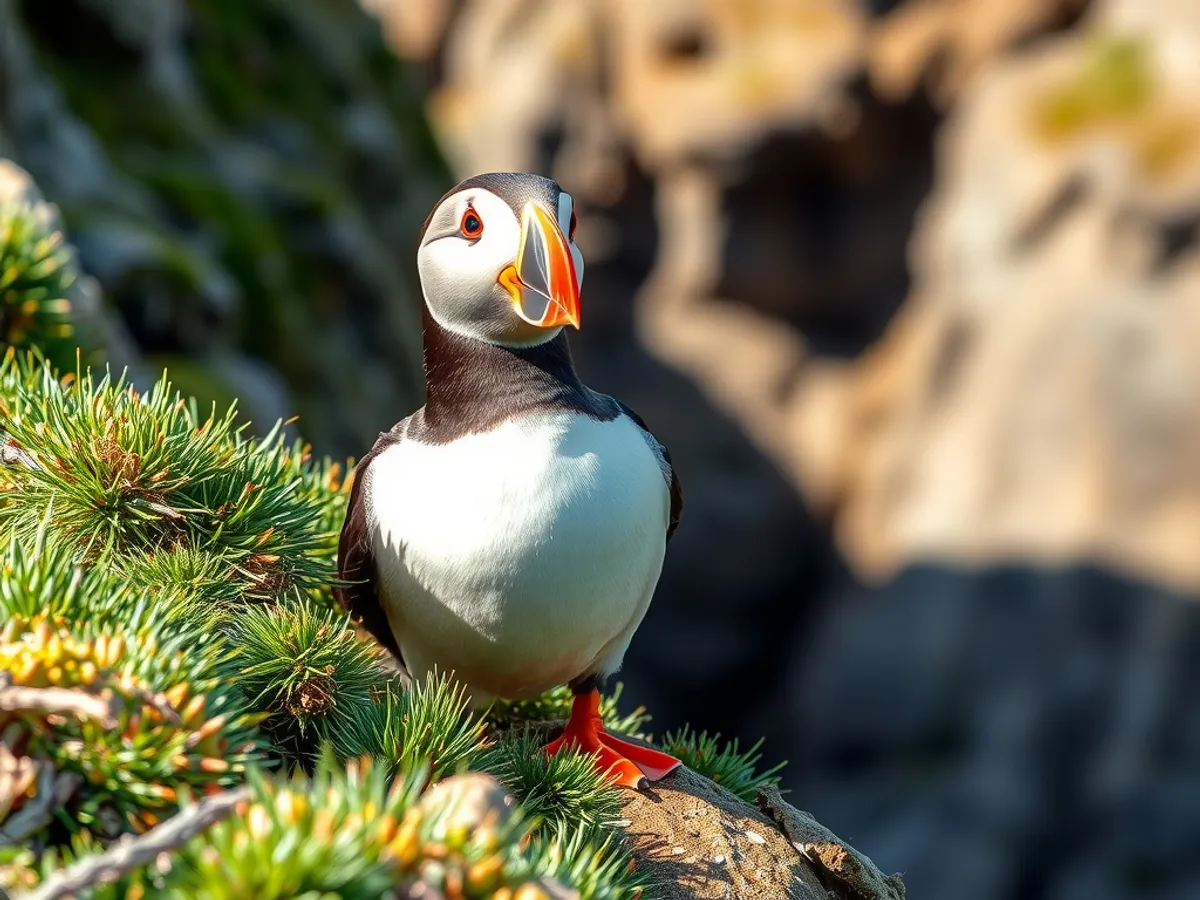
About the Atlantic Puffin
The Atlantic puffin's parrot-bright bill is a seasonal ornament: the orange, blue and yellow plates are grown for the breeding season and shed afterwards, leaving a smaller, duller bill for the winter at sea. That bill performs a trick few birds manage — a puffin can carry a dozen or more small fish crosswise at once, pinning the catch against backward-pointing spines on its tongue and palate while still opening its beak for the next one. In the air it is frankly inelegant, beating stubby wings around four hundred times a minute just to stay up; underwater those same wings become superb, and the bird effectively flies beneath the surface in pursuit of sandeels and herring. Puffins spend most of the year far out on the open ocean, touching land only to breed, when they nest in burrows dug into clifftop turf or take over abandoned rabbit holes. They are long-lived and faithful to both mate and burrow, returning to the same patch of cliff year after year. Their decline is mostly a food-web problem: warming seas have pushed the small fish they depend on beyond reach of the colonies.
Fascinating facts
Fish Carrier
Puffins have a specialized tongue and spines in their beak that allow them to hold several fish crosswise while catching more.
Burrow Nesters
They dig burrows or use natural crevices on steep cliffs to lay a single egg and raise their chick, called a 'puffling.'
Fast Flyers
Despite their short wings, Atlantic Puffins can flap up to 400 times per minute and reach speeds up to 55 mph (88 km/h).
Detailed description
The Atlantic Puffin (Fratercula arctica) is a medium-sized seabird, measuring 26–29 cm (10–11.5 in) in length with a wingspan of 47–63 cm (18.5–25 in) and weighing approximately 320–500 grams (11–18 oz). Its most distinctive feature is its large, laterally compressed bill, which becomes brightly colored in hues of orange, yellow, and blue during the breeding season, contrasting with its black back and white underparts. The bird's face turns pale grey in summer, with a striking triangular patch and orange legs and feet. Outside of the breeding season, the bill and face become duller. Puffins possess short wings adapted for both flying and swimming; they beat their wings rapidly (up to 400 times per minute) to stay airborne and use them to 'fly' underwater while pursuing prey. Their eyes are set forward, providing binocular vision for precise hunting. On land, puffins display an upright posture and walk with a waddling gait. Socially, they are colonial nesters, forming dense breeding colonies on grassy or rocky islands. They are generally silent at sea but produce deep growls and grunts in their burrows. Puffins are monogamous, often returning to the same mate and nest site each year. They dig burrows up to 1 meter deep or use natural crevices for nesting. Chicks, known as 'pufflings,' are reared with remarkable parental cooperation, and fledglings depart for the open ocean at night to avoid predators. The species is highly pelagic outside the breeding season, spending most of its life far from land in the North Atlantic.
Did you know?
Atlantic Puffins are sometimes called 'sea parrots' due to their colorful beaks and expressive faces.
Research & sources
Wikipedia summary
The Atlantic puffin, also known as the common puffin, is a species of seabird in the auk family. It is the only puffin native to the Atlantic Ocean; two related species, the tufted puffin and the horned puffin being found in the northeastern Pacific. The Atlantic puffin breeds in Russia, Iceland, Ireland, Britain, Norway, Greenland, Newfoundland and Labrador, Nova Scotia, and the Faroe Islands, and as far south as Maine in the west and France in the east. It is most commonly found in the Westman Islands, Iceland. Although it has a large population and a wide range, the species has declined rapidly, at least in parts of its range, resulting in it being rated as vulnerable by the IUCN. On land, it has the typical upright stance of an auk. At sea, it swims on the surface and feeds on zooplankton, small fish, and crabs, which it catches by diving underwater, using its wings for propulsion.
Behaviour & social structure
Atlantic Puffins are diurnal, spending daylight hours foraging at sea and returning to colonies to feed chicks during breeding. They are exceptional divers, using their wings for propulsion and feet for steering, reaching depths of up to 60 meters (197 ft) and remaining submerged for 20–30 seconds per dive. Their diet consists mainly of small fish such as sand eels, herring, and capelin, but they also consume zooplankton and small crustaceans. Puffins can carry multiple fish crosswise in their bills at once—up to 10–20 in a single trip—thanks to a unique hinge in the upper mandible and backward-pointing spines on the tongue and palate. Socially, puffins engage in mutual preening (allopreening), bill-knocking displays ('billing'), and vocalizations to reinforce pair bonds and territory. They are territorial within their burrow area but tolerant of neighbors in dense colonies. Outside the breeding season, they are solitary and spend months at sea, rarely coming to land.
Reproduction & life cycle
Breeding occurs from late April to early August, with timing varying by latitude. Puffins are monogamous, often forming long-term pair bonds. Courtship involves billing displays and mutual preening. Both sexes excavate or maintain a burrow, which may be reused for many years. A single egg is laid per season, typically in May or June. Incubation lasts 36–45 days and is shared equally by both parents. After hatching, both parents feed the chick (puffling) multiple times a day, with feeding rates and prey size varying by local conditions. The chick fledges at 34–60 days old, leaving the burrow at night and heading directly to sea. There is no post-fledging parental care; fledglings are entirely independent upon departure.
Adaptations & survival
The Atlantic Puffin exhibits several adaptations for its marine lifestyle. Its compact, waterproof plumage provides insulation in cold northern waters. The bird's specialized bill allows it to carry multiple fish without dropping them, a key adaptation for efficient chick provisioning. Its wings are short and strong, optimized for both rapid flight (reaching up to 88 km/h or 55 mph) and underwater pursuit of prey. The legs are set far back on the body, aiding in swimming but resulting in a waddling gait on land. Puffins undergo a complete molt after breeding, losing all flight feathers and becoming temporarily flightless—a rare trait among birds. Their cryptic coloration (black above, white below) provides camouflage from both aerial and aquatic predators.
Cultural significance
The Atlantic Puffin is an iconic species in northern maritime cultures, especially in Iceland, where it is known as 'lundi' and features prominently in folklore, art, and tourism. Puffins have been harvested traditionally for meat, eggs, and feathers in some regions, though this is now limited or regulated. The bird's colorful appearance and charismatic behavior have made it a symbol of wildlife conservation and ecotourism, particularly in places like the Faroe Islands, Scotland, and Newfoundland. Puffins are often featured in stamps, coins, and children's literature, and are sometimes called 'sea parrots' or 'clowns of the sea' due to their vivid bills and expressive faces.
Recent research
Recent research has focused on the effects of climate change and ocean warming on puffin breeding success and chick diet composition. Studies using GPS and geolocator tags have revealed extensive winter migrations, with some individuals traveling over 2,000 km from breeding sites to overwintering grounds in the mid-Atlantic. Isotope analysis of feathers has provided insights into shifts in diet and foraging areas over time. Conservation projects are experimenting with artificial burrows and social attraction techniques to restore colonies. Genetic studies have clarified subspecies distinctions and population structure, indicating limited gene flow between some colonies. Ongoing monitoring programs in the UK, Iceland, and Norway track population trends and inform management strategies.
Videos
Habitat
Coastal cliffs and offshore islands in the North Atlantic

Conservation
The Atlantic Puffin is currently classified as Vulnerable on the IUCN Red List.
Threats & challenges
Major threats to Atlantic Puffins include climate change (affecting prey availability and breeding success), overfishing (reducing key forage fish populations), pollution (oil spills, plastic ingestion), and introduced predators (rats, cats, mink) on breeding islands. Extreme weather events and shifting ocean currents have led to breeding failures in some regions. Bycatch in fishing gear and disturbance from tourism also pose risks. The global population is estimated at 12–14 million individuals, but significant declines have been documented in parts of Iceland, Norway, and the UK. The IUCN currently lists the species as Vulnerable, reflecting rapid declines in several core breeding areas.
Taxonomy
Scientific name
Fratercula arctica
- Kingdom
- Animalia
- Phylum
- Chordata
- Class
- Aves
- Order
- Charadriiformes
- Family
- Alcidae
- Genus
- Fratercula
- Species
- arctica
Community notes
Share your observations about the Atlantic Puffin.
No community notes yet. Be the first!
Discover more wildlife
More fascinating animals from the encyclopedia.