
About the Atlas Moth
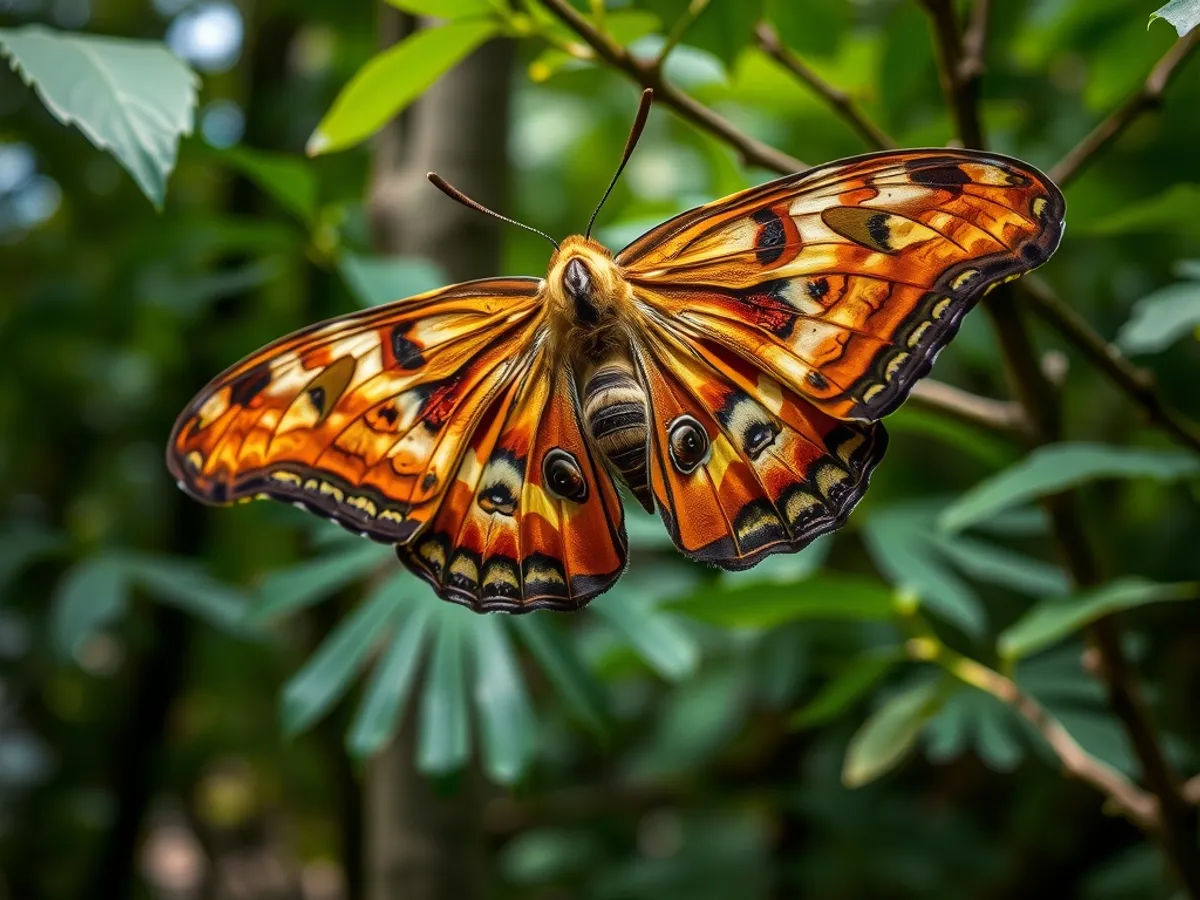
The atlas moth is among the largest insects in the world by wing area — and the adult has no functional mouth. It cannot eat. It emerges from the cocoon carrying every calorie it will ever have, banked as fat during its caterpillar stage, and it spends the week or two it has left doing one thing: finding a mate. The division of labour is total. The female barely moves, releasing pheromones and waiting; the male flies, sometimes for kilometres, guided by vast feathered antennae sensitive enough to detect a few molecules of her scent on the night air. The wingtips are the moth's other famous feature: each is patterned to resemble the head of a snake, complete with a suggestion of an eye and scales, and a disturbed moth will drop to the ground and slowly writhe its wings to sell the illusion. Its cocoon produces a coarse, durable silk called fagara, which is harvested commercially.
Fascinating facts
Huge Wingspan
The Atlas Moth can have a wingspan reaching up to 24-30 centimeters (9.4-11.8 inches), making it one of the largest moths in the world.
Snake-Headed Wings
The tips of the Atlas Moth's wings resemble snake heads, which helps them avoid predation by scaring off birds and small mammals.
Leaf-Eating Larvae
Atlas Moth caterpillars are herbivores that feed on the leaves of citrus, guava, cinnamon, and other trees, growing rapidly before pupating.
Detailed description
The Atlas Moth (Attacus atlas) is among the largest moths in the world, with females typically boasting a wingspan of 25–30 cm (9.8–11.8 in) and a wing surface area that can exceed 400 cm². Its forewings are broad and triangular, adorned with reddish-brown, orange, and black patterns, and feature distinctive transparent 'windows' that may serve as camouflage or predator deterrents. The tips of the forewings are uniquely curved and marked, resembling snake heads—a likely anti-predator adaptation. The body is robust, covered in dense, rust-colored scales, and the antennae are feathery in males (for detecting female pheromones) but thinner in females. Atlas Moth larvae are large, pale green caterpillars with waxy, white tubercles, capable of reaching 11.5 cm (4.5 in) in length. Adults are nocturnal and exhibit minimal activity during the day, relying on cryptic coloration for concealment. Lacking functional mouthparts, adults do not feed and survive solely on fat reserves accumulated during the larval stage, resulting in a short adult lifespan of 5–14 days. The species is solitary, with interactions mainly limited to mating. Atlas Moths undergo complete metamorphosis, with the pupal stage occurring inside a silken cocoon attached to foliage. Their ecological role includes regulating host plant populations and serving as prey for birds, reptiles, and small mammals.
Did you know?
The silk produced by Atlas Moth caterpillars is used in some parts of India to make a durable, natural fabric called 'fagara silk.'
Research & sources
Wikipedia summary
Attacus atlas, the Atlas moth, is a large saturniid moth endemic to the forests of Asia. The species was described by Carl Linnaeus in his 1758 10th edition of Systema Naturae.
Behaviour & social structure
Atlas Moths are primarily nocturnal, emerging at dusk to engage in reproductive behaviors. Adults are strongly attracted to light sources, a phenomenon known as positive phototaxis. Males actively seek out females by detecting pheromones released by the latter, often traveling considerable distances using their highly sensitive, bipectinate antennae. Once mated, females remain relatively sedentary, focusing on oviposition. Larvae are voracious feeders, consuming the leaves of a wide variety of host plants, including citrus, guava, cinnamon, and evergreen trees. Caterpillars feed mostly at night to avoid diurnal predators and rest in clusters during the day. There is no evidence of social structure or cooperative behavior; individuals are solitary throughout all life stages. Defensive behaviors include dropping from host plants when disturbed and, in adults, displaying the wing tips to mimic snake heads as a deterrent.
Reproduction & life cycle
Reproduction in Atlas Moths is characterized by a brief but intense adult phase. Females emit strong pheromones to attract males, which can detect these chemical cues from several kilometers away. Courtship is minimal, and copulation may last several hours. Females lay between 150 and 300 eggs on the undersides of suitable host plant leaves. The eggs hatch after approximately 10–14 days, depending on temperature and humidity. Larvae undergo five to six instars over a period of 4–6 weeks before spinning a papery, silken cocoon for pupation. The pupal stage lasts 3–4 weeks, after which the adult emerges. There is no parental care; all life stages are independent after oviposition. In tropical climates, breeding can occur year-round, but in subtropical regions, there may be seasonal peaks linked to rainfall and host plant availability.
Adaptations & survival
The Atlas Moth exhibits several notable adaptations. The snake-head mimicry at the forewing tips is a classic example of Batesian mimicry, deterring predators such as birds and lizards. The large, cryptically colored wings provide camouflage against tree bark and dead leaves. Larvae possess waxy tubercles that may deter parasitoids and predators. The adult's lack of mouthparts is an adaptation for maximizing reproductive output in a short lifespan, as energy is allocated entirely to mating and egg-laying. The silken cocoon spun by the pupa is tough and camouflaged, providing protection during metamorphosis. The highly sensitive, feathery antennae of males are specialized for detecting female pheromones over long distances, enhancing reproductive success.
Cultural significance
The Atlas Moth holds significant cultural value in several Asian societies. Its impressive size and striking appearance have made it a symbol of transformation and beauty in local folklore. In India, the silk produced by its cocoons, known as 'fagara' or 'eri' silk, is used in traditional textiles. The moth is often featured in educational exhibits and butterfly gardens, serving as an ambassador for insect diversity. In some cultures, the Atlas Moth is associated with omens or spiritual messages, and its image appears in art and jewelry. Its resemblance to a snake is sometimes referenced in myths and stories as a protective or magical trait.
Recent research
Recent research has focused on the molecular genetics of wing pattern formation, revealing genes responsible for the moth's unique coloration and mimicry. Studies on pheromone chemistry have identified specific compounds used in mate attraction, with implications for pest management and conservation. The Atlas Moth's silk has been analyzed for its strength and potential biomedical applications, such as in wound dressings and biodegradable materials. Ongoing ecological studies are examining the impact of habitat fragmentation on population genetics and dispersal. Citizen science initiatives and butterfly house breeding programs contribute valuable data on life history and behavior.
Videos
Habitat
Tropical and subtropical forests


Conservation
The Atlas Moth is currently classified as Least Concern on the IUCN Red List.
Threats & challenges
While the Atlas Moth is currently listed as Least Concern, it faces localized threats from habitat destruction, deforestation, and pesticide use, particularly in rapidly developing regions of Southeast Asia. Overharvesting of cocoons for the silk industry, especially in India where the species is used for 'fagara' silk, can impact local populations. Light pollution may disrupt nocturnal behaviors and mating success. Climate change poses a potential threat by altering the distribution of host plants and suitable habitats. Despite these challenges, the species remains widespread and adaptable, with stable populations in many areas. Conservation efforts focus on habitat preservation and sustainable harvesting practices.
Taxonomy
Scientific name
Attacus atlas
- Kingdom
- Animalia
- Phylum
- Arthropoda
- Class
- Insecta
- Order
- Lepidoptera
- Family
- Saturniidae
- Genus
- Attacus
- Species
- atlas
Where to see an atlas moth
1 zoo and aquarium in 1 country are recorded as keeping this species.

Community notes
Share your observations about the Atlas Moth.
No community notes yet. Be the first!
Discover more wildlife
More fascinating animals from the encyclopedia.