
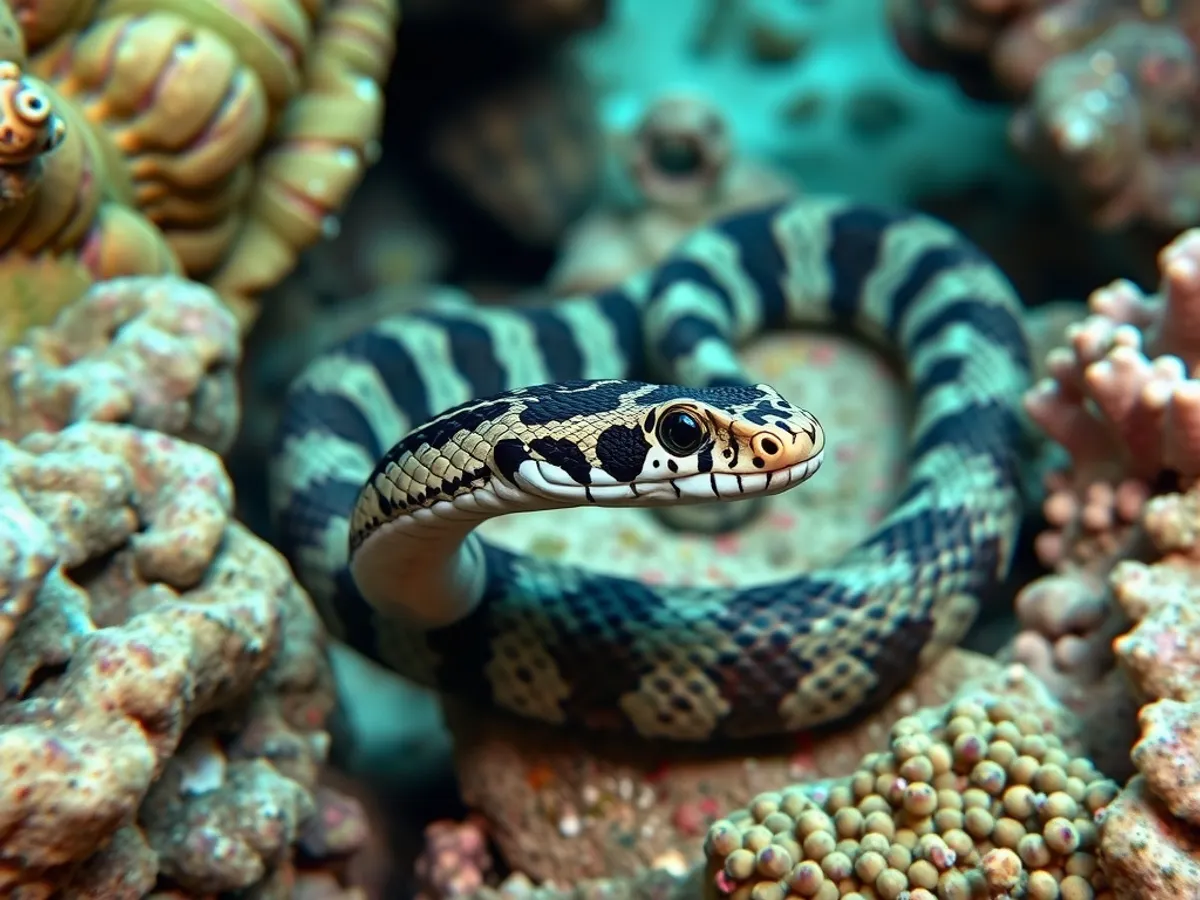
About the Banded sea krait
The banded sea krait is amphibious in a way true sea snakes are not. It retains broad belly scales, so it can crawl properly on land, and it hauls out constantly — to digest, to shed its skin, to mate and, crucially, to lay eggs, which it does in crevices and caves above the tide line. True sea snakes give birth at sea and would be effectively stranded on a beach. Its hunting is specialised and strikingly divided by sex: larger females work deeper water and take conger eels, while the smaller, slimmer males hunt moray eels in shallow reef crevices, so the sexes are not competing for the same prey. It carries extremely potent neurotoxic venom, but it is famously placid and bites people almost never, so fishermen in the Pacific handle them casually. It also cannot drink seawater: it needs fresh or brackish water and depends on rain, drinking from the freshwater lens that floats briefly on the sea surface after a downpour.
Fascinating facts
Amphibious Lifestyle
Banded sea kraits are one of the few sea snakes that regularly leave the water, coming ashore to rest, digest, and lay eggs.
Coral Reef Hunters
Their diet consists mostly of eels and small fish, which they hunt among coral reefs using their potent neurotoxic venom.
Warning Colors
The snake’s bold black and white banding is an example of aposematic coloration, signaling its dangerous venom to potential predators.
Detailed description
The banded sea krait (Laticauda colubrina) is a medium to large-sized marine snake, typically reaching lengths of 1 to 1.5 meters, with some females exceeding 1.6 meters. Its body is cylindrical and robust, encircled by 20–65 distinct black bands on a bluish-silver or white background, which serve as aposematic (warning) coloration. The head is black with a characteristic yellow upper lip and snout, and the eyes are relatively large, adapted for underwater vision. The tail is laterally flattened into a paddle shape, enhancing swimming efficiency. Unlike fully aquatic sea snakes, the banded sea krait retains enlarged ventral scales, allowing for effective terrestrial locomotion. This species is amphibious, spending significant time both in water and on land; it forages in coral reefs but returns to land, often on rocky islets or coastal forests, to rest, digest prey, shed skin, and lay eggs. Banded sea kraits possess highly potent neurotoxic venom, delivered through fixed front fangs, but are generally docile and rarely bite humans unless provoked. Sexual dimorphism is present, with females being larger and more robust than males. The species exhibits remarkable navigational abilities, often returning to the same terrestrial sites after extended foraging trips at sea.
Did you know?
Despite possessing highly toxic venom, the banded sea krait is very docile and bites humans only in extreme self-defense.
Research & sources
Wikipedia summary
The yellow-lipped sea krait, also known as the banded sea krait or colubrine sea krait, is a species of highly venomous snake found in tropical Indo-Pacific oceanic waters. The snake has distinctive black stripes and a yellow snout, with a paddle-like tail for use in swimming.
Behaviour & social structure
Banded sea kraits are primarily nocturnal hunters, although some diurnal activity is observed. They are solitary foragers, preying mainly on eels (family Muraenidae) and occasionally small fish, using chemosensory cues to locate prey hidden within reef crevices. The snake immobilizes prey with a rapid venomous bite and swallows it whole. After feeding, individuals often return to land to digest their meal, as digestion is more efficient at higher terrestrial temperatures. Social interactions are limited, but temporary aggregations may occur during the breeding season or at favored terrestrial resting sites. The species exhibits strong site fidelity, with individuals returning to the same terrestrial refugia and nesting areas. Banded sea kraits are known to perform periodic terrestrial excursions for skin shedding and egg laying, sometimes traveling several hundred meters inland.
Reproduction & life cycle
Laticauda colubrina is oviparous, unlike most fully aquatic sea snakes, and requires land for reproduction. Breeding typically occurs during the warmer months (late spring to early autumn), with males often congregating around receptive females in shallow coastal waters. Courtship involves multiple males competing for a single female, engaging in tactile stimulation and body alignment. Females lay clutches of 3 to 10 leathery eggs in moist, sheltered terrestrial sites above the high tide line, such as crevices, burrows, or under debris. Incubation lasts approximately 4 to 6 months, depending on ambient temperature. There is no parental care after egg deposition; hatchlings are fully independent and immediately make their way to the sea. Sexual maturity is reached at 2–3 years for males and 3–4 years for females.
Adaptations & survival
The banded sea krait exhibits a suite of adaptations for its amphibious lifestyle. Its laterally compressed, paddle-shaped tail provides powerful propulsion in water, while enlarged ventral scales enable effective movement on land. Nostrils are dorsally positioned and equipped with valvular flaps to prevent water entry during diving. The lungs are elongated, extending nearly the full length of the body, allowing for extended dives of up to 2 hours. Salt glands located under the tongue excrete excess salt ingested during marine foraging. The species has highly developed chemoreception, using its forked tongue to detect prey and navigate both aquatic and terrestrial environments. Its potent venom is specialized for rapid immobilization of slippery, agile prey such as eels.
Cultural significance
In many Indo-Pacific cultures, the banded sea krait is recognized for its striking appearance and potent venom. It features in local folklore as both a symbol of danger and protection, sometimes believed to ward off evil spirits. In some Pacific island communities, the presence of sea kraits is considered an indicator of healthy reefs. The species has been used in traditional medicine and, less commonly, for its skin. Its docile nature and unique amphibious habits have made it a subject of fascination for naturalists and divers.
Recent research
Recent research has focused on the navigation and homing abilities of Laticauda colubrina, revealing that individuals use a combination of magnetic, olfactory, and visual cues to return to specific terrestrial sites. Genetic studies indicate significant population structure across its range, with limited gene flow between island populations, highlighting the importance of local conservation. Investigations into venom composition have identified unique neurotoxins with potential biomedical applications. Ongoing studies are examining the impacts of climate change on reproductive success and habitat use, particularly as rising sea levels threaten nesting sites.
Videos
Habitat
Tropical coral reefs and coastal shorelines


Conservation
The Banded sea krait is currently classified as Least Concern on the IUCN Red List.
Threats & challenges
Currently assessed as Least Concern by the IUCN, the banded sea krait faces localized threats from habitat degradation, especially the destruction of coastal forests and nesting sites due to development and tourism. Coral reef degradation from climate change, pollution, and destructive fishing practices reduces foraging habitat and prey availability. Bycatch in fisheries and targeted collection for the pet trade or traditional medicine pose additional risks in some regions. Despite these challenges, the species remains widespread and locally abundant, but continued monitoring is recommended due to its reliance on both healthy reefs and undisturbed terrestrial habitats.
Taxonomy
Scientific name
Laticauda colubrina
- Kingdom
- Animalia
- Phylum
- Chordata
- Class
- Reptilia
- Order
- Squamata
- Family
- Elapidae
- Genus
- Laticauda
- Species
- colubrina
Community notes
Share your observations about the Banded sea krait.
No community notes yet. Be the first!
Discover more wildlife
More fascinating animals from the encyclopedia.