
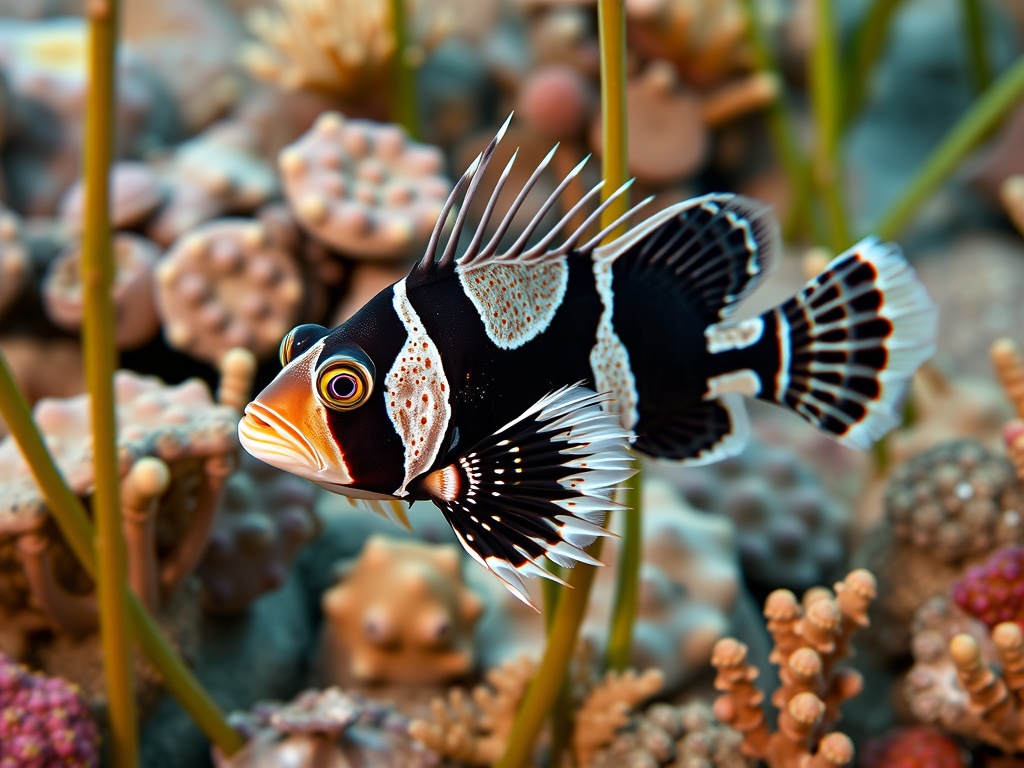
About the Banggai cardinalfish
The Banggai cardinalfish is a small, striking marine fish known for its bold black vertical stripes, silver body, and elongated fins. Endemic to the Banggai Archipelago in Indonesia, this species inhabits shallow coastal waters, often among seagrass beds and coral reefs. It is popular in the aquarium trade due to its attractive appearance and peaceful nature. The Banggai cardinalfish forms small social groups and displays unique parental care, with males mouthbrooding the eggs until they hatch. Due to overcollection and habitat loss, the species is considered endangered in the wild.
Fascinating facts
Male Parental Care
Male Banggai cardinalfish incubate fertilized eggs in their mouths for up to 20 days, protecting them until they hatch.
Limited Range
This species is native only to the Banggai Archipelago in Indonesia, making its global distribution extremely limited.
Sea Urchin Allies
Banggai cardinalfish often shelter among the spines of long-spined sea urchins, which offer them protection from predators.
Detailed description
The Banggai cardinalfish (Pterapogon kauderni) is a small, laterally compressed marine fish, typically reaching a maximum standard length of about 8 cm. Its striking appearance is characterized by a silver body adorned with three prominent black vertical bars and numerous small white spots on the fins and body, which serve as camouflage among sea urchin spines and coral branches. The species possesses two distinct dorsal fins, with the anterior dorsal fin featuring elongated rays that contribute to its ornate look. The mouth is terminal and slightly oblique, adapted for capturing small prey. Banggai cardinalfish are diurnal and tend to form stable social groups, often consisting of 2–25 individuals, which display a well-defined social hierarchy. They are site-attached, exhibiting strong site fidelity and rarely venturing far from their home range. The species is renowned for its unique reproductive strategy: paternal mouthbrooding, in which males incubate fertilized eggs in their buccal cavity until the fry are fully developed. This adaptation increases offspring survival in the wild. Banggai cardinalfish are endemic to the Banggai Archipelago in Indonesia, where they inhabit shallow coastal habitats, especially seagrass beds, coral reefs, and areas with abundant sea urchins (Diadema setosum), which provide shelter from predators. Their limited natural range and specialized habitat requirements make them particularly vulnerable to environmental disturbances.
Did you know?
Unlike many reef fish, Banggai cardinalfish lack a larval dispersal stage, making their populations highly localized and vulnerable to habitat changes.
Research & sources
Wikipedia summary
The Banggai cardinalfish is a small tropical cardinalfish in the family Apogonidae. It is the only member of its genus. This attractive fish is popular in the aquarium trade. It is among the relatively few marine fish to have been bred regularly in captivity, but significant numbers are still captured in the wild and it is now an endangered species. The detrimental impact of humans on its environment and certain fatal diseases threaten this species' numbers significantly. Iridovirus diseases are known to be significant reason for fish mortality.
Behaviour & social structure
Banggai cardinalfish exhibit strong site fidelity, maintaining small, stable territories within seagrass beds, coral branches, or around sea urchins. They are primarily crepuscular feeders, foraging at dawn and dusk for small crustaceans, copepods, planktonic invertebrates, and occasionally fish larvae. Socially, they form cohesive groups with a clear dominance hierarchy, often centered around a breeding pair. Aggressive interactions are rare but may occur during competition for mates or shelter. The fish rely heavily on visual cues for communication, using body postures and fin displays to signal submission or dominance. During the day, individuals remain close to shelter, emerging to feed during low-light periods. Juveniles frequently associate with the spines of sea urchins, gaining protection from predators.
Reproduction & life cycle
Reproduction in Pterapogon kauderni is characterized by monogamous pair bonds and paternal mouthbrooding. Spawning can occur year-round in the wild, with peaks during the rainy season (December to March). Courtship involves elaborate displays, including synchronized swimming and fin spreading. After spawning, the female deposits a clutch of 30–90 large eggs (2.5–3 mm in diameter), which the male collects and incubates in his mouth for 20–30 days. During this period, the male abstains from feeding to avoid swallowing the eggs. Upon hatching, the male releases fully developed, miniature versions of the adults, which immediately seek shelter. Parental care is exclusively provided by the male, and there is no further care after release. The species' low fecundity and extended brooding period limit population growth.
Adaptations & survival
The Banggai cardinalfish has evolved several adaptations for survival in its restricted habitat. Its bold coloration and patterning provide effective camouflage among the spines of sea urchins and coral branches, reducing predation risk. The species' mouthbrooding behavior is a specialized reproductive adaptation that enhances offspring survival by protecting eggs and larvae from environmental hazards and predators. Their laterally compressed bodies and large pectoral fins allow for precise maneuvering in complex habitats. Additionally, their site fidelity and social grouping behaviors help reduce predation and increase reproductive success.
Cultural significance
While the Banggai cardinalfish does not have a prominent role in traditional local culture, it has become an icon in the marine aquarium trade due to its beauty and peaceful temperament. Its plight has raised awareness about the impacts of the aquarium industry on wild populations and has spurred international conservation efforts. The species is sometimes featured in educational programs and conservation campaigns as a flagship species for sustainable marine resource management.
Recent research
Recent research has focused on the genetic diversity and population structure of Pterapogon kauderni, revealing significant genetic differentiation among island populations, which has implications for conservation management. Studies have also examined the effects of captive breeding on genetic health and disease susceptibility, with findings suggesting that captive-bred individuals may have reduced fitness if not managed carefully. Ongoing research is investigating the impacts of iridovirus outbreaks and the effectiveness of marine protected areas in safeguarding remaining wild populations. The species has also been used as a model for studying paternal care and social behavior in marine fishes.
Videos
Habitat
Shallow coral reefs and seagrass beds

Conservation
The Banggai cardinalfish is currently classified as Endangered on the IUCN Red List.
Threats & challenges
The primary threats to Banggai cardinalfish include overexploitation for the aquarium trade, habitat degradation, and disease. Unsustainable collection practices have led to significant population declines, with some local populations extirpated. Habitat loss due to coastal development, destructive fishing methods, and climate change-induced coral bleaching further threaten their survival. The species is also susceptible to iridovirus infections, which can cause mass mortality events. The IUCN estimates a population decline of over 90% in some areas since the 1990s. Conservation challenges include enforcing sustainable harvest quotas, protecting critical habitats, and promoting captive breeding to reduce wild collection.
Taxonomy
Scientific name
Pterapogon kauderni
- Kingdom
- Animalia
- Phylum
- Chordata
- Class
- Actinopterygii
- Order
- Perciformes
- Family
- Apogonidae
- Genus
- Pterapogon
- Species
- kauderni
Where to see a banggai cardinalfish
1 zoo and aquarium in 1 country are recorded as keeping this species.

Community notes
Share your observations about the Banggai cardinalfish.
No community notes yet. Be the first!
Discover more wildlife
More fascinating animals from the encyclopedia.